I. The Last Train
The 21:47 to Darnwick was never on time.
It wheezed into the provincial station twenty-three minutes late that October Saturday, coughing sparks onto wet rails while the guard’s whistle echoed like a distant scream.
I was the only passenger to alight. My city lungs inhaled air so cold it tasted of pennies and peat. Fog, thick as wet wool, pressed against the platform lamps and turned their glow into bruised moons.
I had come for solitude, notebook and camera in my backpack, renting an old lineworker’s cottage for the weekend. The letting agency’s e-mail ended with an odd post-script:
“Stay on the paths after dusk. The Hollow does not like visitors.”
I laughed—marketing gimmick, I thought—and followed the exit sign toward the lane.
II. The Footpath
A single page of A4 had been taped to the wicket gate:
“WARNING
The scarecrows are not symbolic.
Do not enter the Hollow after sunset.
If you hear your name, do not answer.”
It was signed, in spidery ink, “Mrs. B. Darnwick, Stationmistress (Ret.)”.
The path narrowed between hawthorn hedges twisted into living walls by centuries of wind. My phone’s GPS stuttered, arrow spinning like a drunk compass. I switched it off and used the moon instead—an anemic silver disc caught in skeins of cloud.
Every hundred yards a scarecrow stood.
Not the cheerful, straw-stuffed dummies of harvest festivals: these were man-sized figures sewn from potato sacks, painted with tar for faces. Button eyes—mother-of-pearl, some cracked—caught the moonlight like wet shells. Their mouths were stitched with red twine, smiles too wide, stretching as the sacking weathered. Each wore a different relic: a child’s cardigan, a wedding waistcoat, a railway porter’s cap. Their arms, cruciform, were lashed to hawthorn stakes thicker than my thigh.
I told myself it was folk art, a village competition perhaps, and walked faster.
III. The Clearing
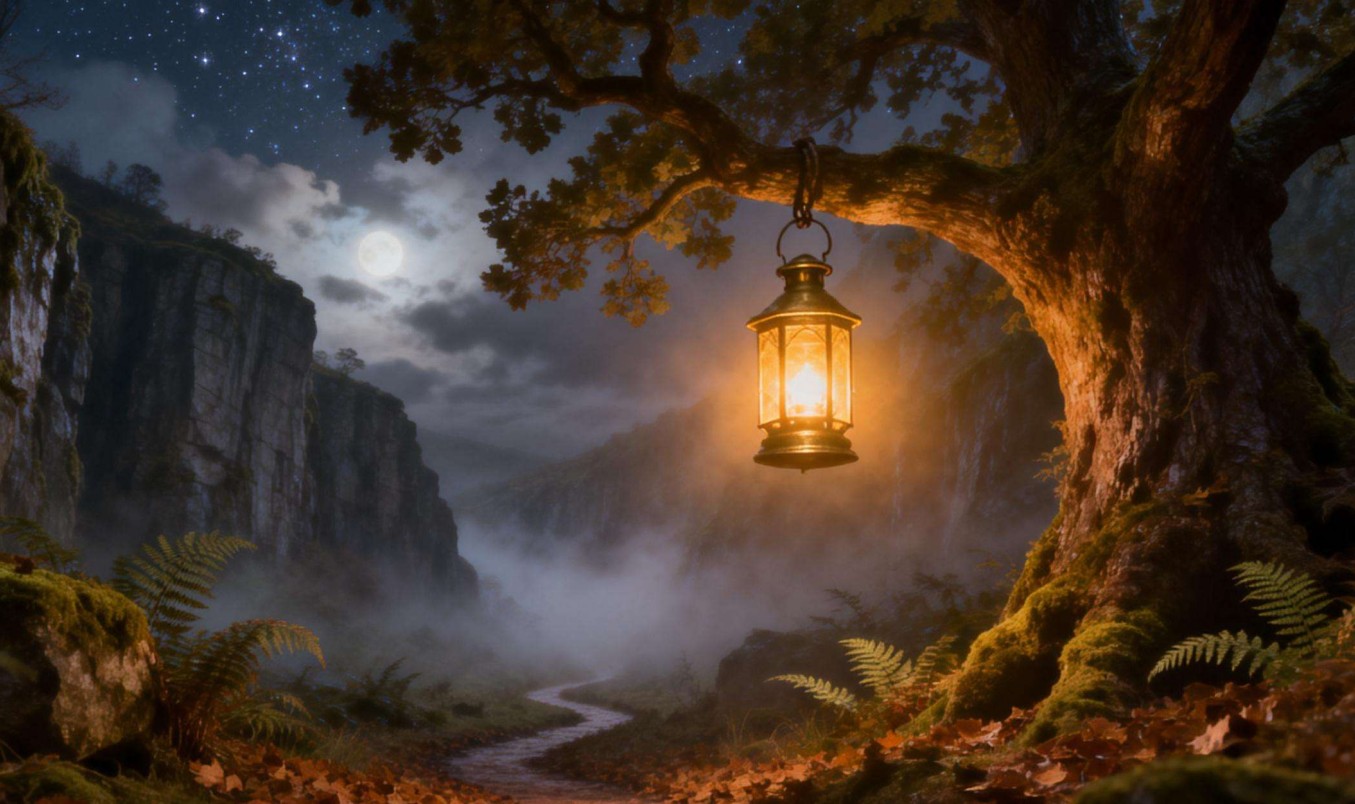
The hedges ended at a pasture drowned in mist. In its center stood an oak so old its trunk had split into a cathedral arch. From that hollow a faint greenish glow pulsed—phosphorescence, I guessed, fox-fire from rotting wood.
Then the wind shifted.
The glow wasn’t fungal; it was lantern-light. A lantern suspended in the black maw of the tree, swaying though the air was still.
And the whisper began—soft, sibilant, genderless:
“Elias…”
My name. Spoken perfectly, though no living soul here knew it. I had introduced myself to no one, signed the cottage ledger only as “E. M.”
“Elias… come closer. We remember you.”
I backed away. The scarecrows had moved.
They now formed a semicircle at the pasture’s edge, arms lowered, heads cocked as if listening to the same voice. Their pearl eyes reflected the lantern, hundreds of pin-prick moons.
My retreat was blocked by hawthorn that had not been there moments earlier. Thorns hooked my coat, drew blood from my knuckles. The only open path led toward the oak.
IV. The Roots
A root broke the turf and wrapped around my ankle—not snakelike, but with the slow insistence of botanical time. I tore free, sprinted toward the footpath I prayed still existed. Behind me the whisper grew plural, a choir rustling through leaves:
“Feed the roots, feed the roots.”
I ran until lungs burned hotter than the thorn-scratches on my face. The fog thickened, carrying the smell of iron and damp sacking. When I dared look back the lantern was closer, floating now, no tree behind it, only darkness wearing a green corona.
Something crunched underfoot. My phone’s screen, shattered, though I had not dropped it. Beside it lay a driver’s license—my own face staring up, but the laminate bubbled as if steeped in peat water for decades. The issue date read 1987, seven years before I was born.
V. The Cottage
At last the lineworker’s cottage appeared, windows glowing amber. I staggered inside, slammed the door, drew every bolt. The sitting-room fire was already lit, kettle humming. A note on the mantel, in the same spidery hand:
“Welcome home, Elias.
The Hollow keeps what it reaps.
Do not look outside after midnight.
—Mrs. D.”
I searched the cottage for signs of recent habitation. Cupboards held tins of tongue and powdered eggs stamped with expiry dates from 1973. In the bedroom wardrobe hung railway uniforms, name tapes stitched:
“E. MERROW.”
My surname. My initials.
The wardrobe’s mirror reflected not me but a man in porter’s attire—my face, but gaunt, eyes rimmed with coal-dust, mouth sewn with red twine. I spun around; the room was empty. When I looked again the mirror showed only my own ashen reflection.
VI. The Scrapbook
On the bedside table lay a photograph album. Inside: yellowed images of scarecrows being erected in 1940s drizzle; villagers with eyes scratched out; a boy who grew into the man in the mirror—each page dated in my handwriting, though I had never seen the book before. The last photograph was empty, save for a silhouette shaped like me, arms outstretched, waiting for straw.
Midnight struck from the station far away—thirteen chimes. The fire died though coals still glowed. Outside, the lantern pressed against the windowpane, green light leaking through cracks in the curtains. The whisper came again, right against the glass:
“The photograph is taken. Come outside and be developed.”
I did not move. The door-handle turned slowly, slowly, until the latch snapped. Frost poured in, carrying the smell of wet sacking. The scarecrows filled the garden, heads swaying like poppies. Between them stood Mrs. Darnwick—tiny, veiled in black, eyes like torn buttons. She raised a railway lamp and the beam was the green glow I had followed all night.
“You signed the ledger,” she said. “You took the photograph. The Hollow reaps what is named.”
I fled upstairs, barricaded the bedroom door with the wardrobe. Through the keyhole I watched straw fingers worm beneath, plucking at the carpet threads, weaving it into sacking.
VII. The Escape
Dawn seemed impossible, but eventually grey seeped under the curtains. The whisper withdrew like tide. When I opened the door the cottage was pristine—no straw, no frost, fire freshly laid, kettle cold. My backpack stood by the exit, zipper open, notebook filled with pages in my handwriting recounting nights I never lived: scarecrows, lanterns, a woman in black. The final entry, dated tomorrow, ended:
“I will run for the 06:02. The Hollow will let me board, but it keeps the reflection.”
I caught the 06:02—empty carriages smelling of wet wool and iron. As the train pulled away I saw them on the platform: scarecrows in a row, Mrs. Darnwick at their center, holding a square of light—my photograph, newly developed. She raised it in farewell.
In the window opposite me, the glass reflected not my face but the scarecrow with my features, button eyes wet with morning dew. It lifted a hand and waved. I waved back, unable to stop. The reflection smiled, mouth unstitching to reveal thorns.
The guard’s voice crackled: “Next stop—no stop. End of the line.”
We plunged into fog that never ends.
VIII. Epilogue
Police found the empty train idling on a disused siding three weeks later. My backpack contained a notebook blank except for one sentence, repeated to the final page:
“The Hollow keeps what it reaps, and it always learns your name.”
They searched the cottage. In the wardrobe mirror they saw a porter in 1940s uniform, mouth sewn shut, eyes like cracked pearl. When they looked closer the glass was only glass, reflecting their own puzzled faces—yet each officer, days later, found straw in his pockets and forgot the sound of his own name at crucial moments.
The station clock still strikes thirteen at midnight. If you wait on the platform you may see a lantern drifting along the tracks, green and patient, searching for the next Elias.
Do not answer.
Do not follow.
The Hollow is always hiring, and it pays in reflections.