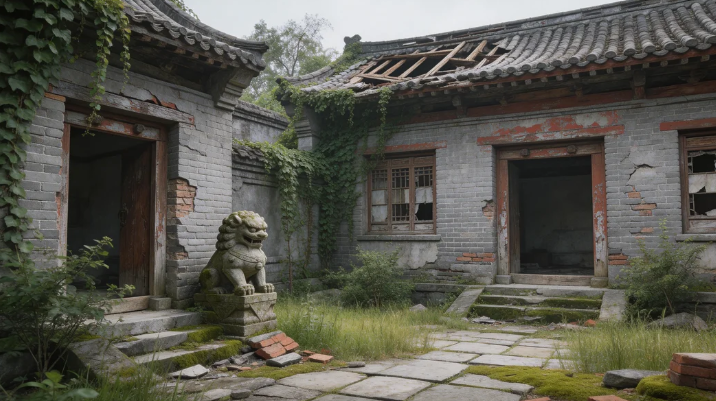
Rural-Shandong, 1998.
Archivist Lila came to map disappearing village wells for UNESCO. Locals pointed her to a Ming-dynasty courtyard abandoned since the 1938 invasion. In its center lay a four-eyed well: two stone rings carved with 水 (water) and two with 鬼 (ghost), alternating like a checkerboard. A hemp rope, frayed to three strands, dangled into darkness. The village head warned: “Draw water after dusk, draw something else instead.”
Lila scoffed, set up her tripod at 7 p.m., and lowered a LED lantern. Thirty metres down, water glimmered—then blinked. She realised it wasn’t reflection; four submerged faces stared back, each occupying a quadrant, mouths open like inverted funnels. When she raised the lantern, the rope stiffened, threading itself through her belt loop, and yanked. Her camera toppled, capturing one frame: the well-mouth now showed four eyes of liquid stone crying upward.
Remembering folk logic—“ghosts count in fours, break the square”—she grabbed her square clipboard, snapped it across her knee, and tossed the triangular half down the shaft. The rope slackened; she rolled away, clutching the remaining triangle like a broken compass. Behind her, the courtyard imploded into dust, leaving only a sealed concrete slab printed with the warning: 四眼勿近 (Four eyes, keep away).
She fled to Jinan, developed the film: the single exposed slide showed her own face four times, wedged between the stone characters, eyes replaced by dripping 水. Every subsequent photo she takes—of rivers, storms, even puddles—develops with the same quartet of faces staring out, as if the well water now travels through every lens she raises. And on nights when the moon is ringed by four faint halos, she hears hemp fibres creak, reminding her that triangles only delay squares, never defeat them.