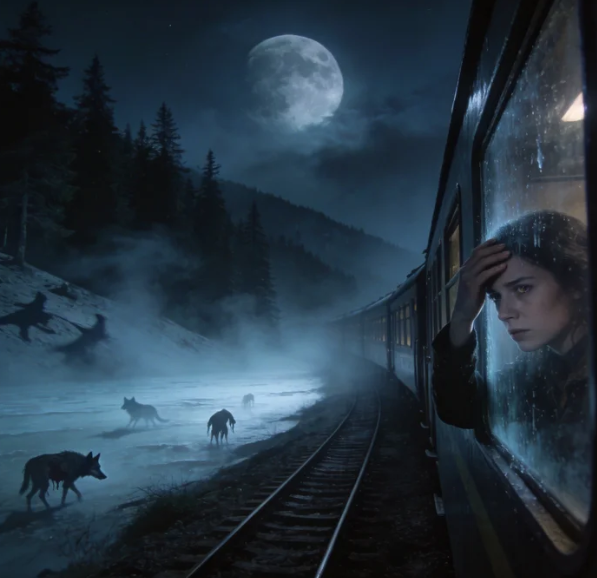
The first whispers reached Lucinda Graves on the night train from Bucharest—whispers of a wolf that walked like a man, of shepherds found flayed beneath a bloated moon. As the railway sliced through the Carpathian evergreens, she pressed her forehead to the cold glass and watched the fog roll over the slopes like some pale, living tide. Lucinda was a doctoral fellow of ethno-zygology, a fancy term her supervisor had coined for the study of cursed bloodlines. She had come to Transylvania to chase a legend older than the diesel engine that now rattled her bones.
The village of Vârcolac clung to the mountainside like a barnacle. Stone houses with split-shingle roofs leaned together for warmth, their chimneys coughing pine-smoke into a sky already bruised by dusk. A single electric bulb flickered above the tavern door, casting long shadows that seemed to crawl uphill toward the ruined abbey whose broken steeple pierced the moon.
Inside the tavern, the air was thick with plum brandy and fear. An old fiddler sawed out a mournful tune while men spoke in low Romanian about the recent killings: fifteen sheep in one night, throats opened with surgical precision, not a drop of blood left in the snow. "Lupul de Argint," they muttered—the Silver Wolf. Lucinda caught the phrase and repeated it aloud. Conversation died. Even the fiddler's bow paused mid-stroke. The landlord, a slab-shouldered man named Ion, whispered that the beast had once been human, a boy born during an eclipse whose mother screamed until her vocal cords tore. On his seventeenth birthday the boy had vanished into the forest; three nights later the first mutilated shepherd was discovered. That had been ninety years ago. The attacks never stopped for more than a decade.
Lucinda's academic instincts flared. Ninety years implied heredity, not infection. She asked to see the victim from two nights prior. Ion led her through a back corridor smelling of mildew and rendered fat, into a room where a body lay beneath a waxed canvas sheet. When he peeled it back, Lucinda tasted iron at the back of her throat. The corpse was a young woman named Anya, face frozen in a rictus of horror. Her abdomen had been opened from sternum to pelvis, ribs bent outward like petals of a ghastly flower. Yet there were no bite marks, only clean incisions. Lucinda noted the absence of blood pooling; the heart had stopped before the cutting began. This was not predation—it was ritual.
She spent the next days collecting saliva from the snow, photographing tracks that shifted between canine and human, and interviewing elders who spoke of a "covenant" struck in 1924 between the villagers and something in the woods. Every generation offered one child as "warden," a living lock on a door that must never open. If the warden fled or died, the covenant shattered and the Silver Wolf would descend. Anya had been the last warden's great-granddaughter. Her death meant the lock had failed.
On the seventh night, the moon rose full and copper-red, a hunter's moon that seemed to pulse. Lucinda climbed the switchback trail to the abbey ruins, carrying a field kit of syringes, silver nitrate, and a tranquilizer rifle loaded with dextro-tetrazepam—enough to drop a Kodiak. Snow whispered beneath her boots. Frost feathered her breath. She felt rather than heard the silence: even the owls had stopped their nightly litigation.
The nave of the abbey lay open to the sky. Ivy strangled columns whose saints had been beheaded during the Great War. Lucinda set up a motion camera and smeared Anya's dried blood on a fragment of altar stone, hoping scent would lure the killer. Hours passed. Moonlight painted the rubble monochrome. Then came the scrape of claw on marble.
It stepped from darkness like something carved out of night itself: seven feet tall, shoulders hunched, fur the color of burnished pewter. The head was lupine but the eyes—those eyes were human, glacier-blue, irises rimmed with scarlet. Instead of attacking, it watched her, nostrils flaring. Lucinda felt her pulse in her gums. She raised the rifle. The creature lifted a clawed hand, palm outward, a gesture almost pleading. She hesitated. In that span it moved faster than thought, striking the rifle aside. Steel clanged against stone. She was on her back, snow cold against her neck, the beast straddling her. Hot drool spattered her cheek, yet the claws did not close. She stared up into twin galaxies of sorrow.
A voice emerged, half-growl, half-lament: "You should not have come, scholar. The chain is broken. I am what they made me—guardian and prisoner both." The syllables were distorted by a muzzle not meant for speech. Lucinda, trembling, asked who "they" were. The wolf's ears flattened. "The ones who worship hunger. My blood is the lock. My blood is the key. They will come for you now."
From the forest below rose an answering chorus—dozens of howls, not wolf, not human, but something between. Torches flickered up the trail. The villagers had come, not to rescue her, but to finish what Anya's death had started. Lucinda realized the truth: the Silver Wolf was not the monster; he was the final bulwark against monsters far older. The villagers had bred him through centuries of selective inbreeding, crucifying their own children beneath eclipses, forging a sentinel strong enough to hold back what lay beneath the mountain—a primordial cannibal god whose name predated Latin.
The wolf flung her over his shoulder and vaulted through a collapsed rose window. They descended the sheer cliff, claws finding purchase in mortar cracks. Wind howled in her ears. At the base he set her down and pressed something into her palm: a silver fang knocked from his own jaw. "Run. Tell the world the covenant is shattered. If I fall, the hunger rises." Then he turned back up the slope, a silhouette against the moon, to face the mob that had once been his kin.
Lucinda ran until the forest thinned and the Orient Express thundered past on its return to Bucharest. She leapt aboard the last freight car, lungs burning. As the train curved along the mountain, she saw firelight atop the abbey—an inferno where wolf and villagers merged in a final, terrible dance. The howls carried for miles.
She later published her findings in the Journal of Transylvanian Anthropology under the title "Silverfang: Hereditary Guardian or Curse Vector?" Academic circles dismissed it as hoax. Yet every winter she receives a single silver bullet in the mail, postmarked from no known village, and on the night of the hunter's moon she hears a lone howl echoing across the Thames. She never sleeps those nights. She keeps the fang beneath her pillow, and when the moon turns copper-red she knows the hunger is still rising, and somewhere in the Carpathians a new warden is being born.