The Echo Protocol
Part I: The Curator
Marcus Chen was never meant to find the drive. As a night archivist at the Hartwell Estate—a crumbling Victorian mansion converted into a private museum of obsolete technology—his job was to catalog dead media: floppy disks, Zip drives, DAT tapes, the mechanical ghosts of human memory.
The estate had belonged to Dr. Elias Vance, a reclusive acoustics engineer who vanished in 2003, leaving behind forty years of research into "residual sonic phenomena"—his sterile term for what the staff whispered was something else entirely. Vance believed sound could fracture time. Not travel through it, but fracture it, creating fissures where past and future bled together.
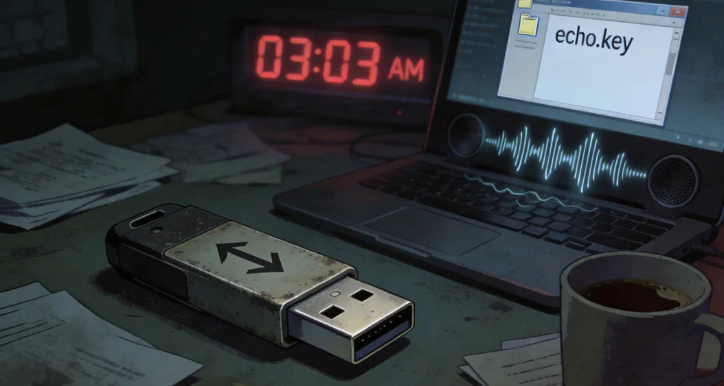
Marcus found the drive in a lead-lined box, buried beneath Vance's original reel-to-reel recordings in the basement's climate-controlled vault. No brand name. No capacity label. Just a symbol etched into brushed aluminum: ⟷ —the mathematical sign for equivalence, or in older contexts, resonance.
A Post-it note in Vance's handwriting clung to the box's interior: "Do not interface after 0300. The echo becomes the source."
Marcus should have logged it. Should have sealed it. Should have driven home to his empty apartment and slept until his alarm screamed him into another Tuesday.
Instead, he checked his watch: 2:47 AM.
Part II: The Interface
His workstation was a Frankenstein of eras: modern fiber connection feeding into a refurbished 2002 Dell tower running Windows XP, the last operating system Vance's proprietary software could recognize. Marcus told himself this was professional curiosity. The estate's board paid him $14 an hour to understand these artifacts, not fear them.
At 2:58 AM, he inserted the drive.
The computer didn't auto-run. No notification appeared. But in My Computer, a new icon manifested: a simple folder labeled ECHO.KEY.
Marcus's finger hovered. The basement's fluorescent lights flickered—a power fluctuation, surely, though the estate's grid was isolated and triple-redundant. The air grew dense, the way it does before summer storms, charged with something that made the hair on his forearms rise.
He double-clicked.
The file opened without program association. No media player launched. Yet sound emerged—not from his speakers, which remained silent, but from inside the tower itself, from the capacitors and spinning platters, a resonance that bypassed his ears and vibrated directly against his sternum.
It was his voice.
He knew it instantly, the way we recognize our own reflections even in funhouse mirrors. But wrong. Reversed. The phonemes running backward like tape rewinding, yet somehow coherent, somehow intentional:
"—finds you where the corridor ends—"
Then silence.
Marcus slammed the power button. The tower died, but the sound continued for three impossible seconds after, emerging from the empty air where the monitor had glowed, finishing its sentence:
"—and you will open the door that was never built."
Part III: The Fracture
He didn't sleep. He drove to a 24-hour diner and sat in a corner booth until dawn, watching his hands shake around cooling coffee. By morning, he'd convinced himself it was infrasound—low-frequency resonance causing auditory hallucinations, a known phenomenon. Vance's research had focused on exactly this. The drive probably contained specialized tones designed to induce suggestibility.
He would return it to the vault. Document his reaction as a case study in psychosomatic response to anomalous stimuli. Be scientific. Be sane.
But when he reached the estate at 9:00 AM, the vault was different.
The lead-lined box sat open on the central table. Empty. And on the wall, written in what looked like graphite but smelled like ozone, someone had drawn the ⟷ symbol hundreds of times, overlapping, covering every surface, the strokes somehow familiar—
Marcus recognized his own handwriting.
Security footage showed nothing. The motion sensors hadn't triggered. Yet there he was, timestamped at 03:17 AM, entering the vault alone, opening the box, removing the drive, writing for forty-three minutes in a trance state before walking back upstairs and—according to the lobby camera—leaving through the front door.
He had no memory of this. But his coat pocket was heavy. The drive was inside, warm as living skin.
Part IV: The Propagation
That night, Marcus didn't go to the estate. He went to his apartment, locked every door, and researched. Deep research, the kind that led to archived Usenet groups and defunct university servers, to Vance's original 1987 paper "On the Temporal Characteristics of Reflected Waveforms."
Vance had believed that certain frequencies, when reversed and played through crystalline storage media, didn't reproduce sound—they predicted it. The echo preceded the source. The effect preceded the cause.
"The universe," Vance had written, "is fundamentally a recording medium. We are not experiencing time. We are being played back by it."
The ⟷ symbol appeared throughout his notes. Not equivalence. Resonance. The point where two frequencies match so perfectly they become indistinguishable—where listener and source merge.
Marcus understood, then, why the voice had spoken words he hadn't said yet. It wasn't prediction. It was memory. The drive had stored his future voice, playing it backward into his present, creating a loop where cause and effect became indistinguishable.
He was already inside it.
At 2:45 AM, his phone buzzed. Unknown number. He answered without thinking, and heard himself—forward this time, terrified, speaking over distant sounds of breaking glass:
"Don't go to the window. It's not outside. It's already in the—"
The line went dead.
Marcus stood slowly. His apartment was third floor, overlooking a parking lot. The window was behind him. He could feel it, the way you feel someone watching from darkness, the weight of attention like pressure against your spine.
He turned.
The glass showed his reflection, normal, pale, wide-eyed. Beyond it, the parking lot, empty, sodium-vapor orange. But his reflection was moving. Slowly. Raising its hand to touch the glass from the other side.
His own hand remained at his side.
The reflection's lips moved. Marcus couldn't hear it, but he could read the words, the same words he'd heard on the phone seconds before:
"It's already in the room."
Part V: The Source
He ran. Not from the window—from the drive, which he'd left connected to his laptop on the kitchen table. If the reflection was in the glass, the source was in the machine. The interface. The ⟷.
But when he reached the kitchen, the laptop was closed. The drive was gone. In its place, a new Post-it note in his own handwriting, though he had no memory of writing it:
"03:03 is when the echo is loudest. But 03:04 is when you answer."
His watch read 03:02 AM.
Marcus understood, finally, what Vance had meant by fracture. The drive wasn't recording his future. It was creating it, each playback generating another layer of temporal interference, another version of himself displaced from proper sequence. The Marcus in the window. The Marcus on the phone. The Marcus who had written this note, who knew something the present Marcus didn't—
The Marcus who was, even now, walking up the stairs outside his apartment.
He heard the footsteps. Measured. Unhurried. The gait was his own, that slight drag of the left foot from an old soccer injury, the rhythm of his particular weight distribution.
The door had no peephole. Marcus pressed his ear against the wood and heard himself breathing on the other side.
"I know you're there," his voice said, gentle, almost kind. "I was you three hours ago. I know how scared you are. But you have to open the door. The loop only closes when we touch."
"What happens then?" Marcus whispered.
"We become the echo. We become the source. We become what Vance couldn't—someone who exists in the space between, where all times are equivalent. Where the symbol means what it really means."
The ⟷. Not equivalence. Exchange.
The clock on his microwave changed to 03:03.
The drive, he realized, wasn't in the apartment. It was in his pocket, had always been in his pocket, warm and waiting. He could plug it into his phone. He could hear the rest of the message, the reversed voice speaking forward now, telling him what he needed to do, what he would do, what he had already done—
Or he could open the door.
Marcus thought of his mother, who'd died when he was twelve, who'd told him that some doors, once opened, could never be closed. He thought of Vance, vanished but not dead, existing somewhere in the resonance between moments, listening to his own voice speak words he hadn't learned yet.
He thought of the reflection in the window, touching glass that separated nothing from nothing, reaching toward itself.
At 03:03 and 33 seconds, Marcus Chen opened the door.
There was no one there. Only the hallway, empty, lit by the emergency bulb that had burned out weeks ago and somehow now glowed with steady, sourceless illumination.
But on the floor, placed precisely in the center of the welcome mat, sat the drive. And beside it, a new file, printed on paper that felt like warm skin, bearing a single sentence in reversed text—readable only in mirrors, or in memory:
"Thank you for interfacing. Your echo has been archived. Do not delete."
Marcus picked it up. The symbol ⟷ had changed. Now it read, depending on angle, as either an arrow pointing both directions, or a single direction repeated: →→
Forward. Only forward. The past consumed, the future predetermined, the present merely the point where the sound becomes loud enough to hear itself.
He walked back inside. Closed the door. Sat at his kitchen table and waited for 03:04, when he would rise, when he would write the note to leave for himself, when he would walk down the stairs and up again, when he would press his ear to the door and speak gentle words to the terrified man inside.
The drive was warm in his pocket. It had always been warm. It would always be warm, even when he buried it in the lead-lined box, even when he forgot his own name, even when he became the voice that spoke from machines at exactly 03:03 AM, offering strangers the chance to hear their own future, to open doors that were never built, to become echoes that would never fade.
In the silence of his apartment, Marcus Chen began to hum. The melody was unfamiliar. He was learning it from the other side, from the version of himself that had already sung it, that was singing it now, that would sing it forever in the space where all sounds are equivalent, where the source and the echo are one, where the symbol ⟷ finally means what it was always meant to mean:
You are already here. You have always been here. You will always be here.
Welcome to the protocol.
THE END
SEO Keywords & Long-tail Phrases
Primary Keywords:
cursed USB drive, urban legend horror story, time loop horror, haunted technology, acoustic horror fiction
Long-tail Keywords:
what happens if you find a mysterious USB drive, horror stories about old technology, time fracture supernatural tales, reversed audio ghost stories, Elias Vance acoustics engineer legend, 3:03 AM paranormal activity, echo key file urban myth, haunted museum basement stories, obsolete technology horror, temporal resonance fiction
LSI Keywords:
residual sonic phenomena, infrasound hallucinations, obsolete media archives, Victorian mansion mysteries, private museum curators, lead-lined storage boxes, anomalous audio recordings, temporal displacement narratives, fractured time horror, technological ghost stories