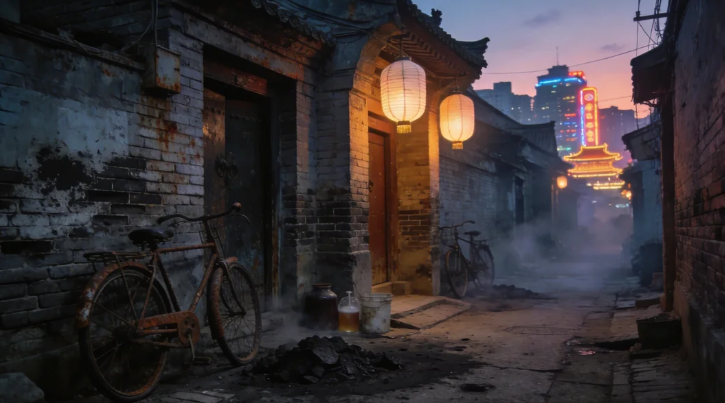
In the old quarter of Chang’an, now swallowed by the neon sprawl of Xi’an, there is a lane locals call Ghost Street. At dawn it looks like any other hutong: soot-stained bricks, bicycles rusting in doorways, the smell of coal and vinegar. But when the paper lanterns click on at twilight, the air thickens with the scent of wet ink, and the past begins to leak through the cracks of the present.
In 1924 a young craftsman named Liang Shou set up shop here, fashioning ink-sticks from pine soot, camphor and musk. His ink dried to a velvet black that seemed to drink light rather than reflect it. Poets swore their verses floated above the page; calligraphers claimed their wolves-in-snow characters howled at night. Liang’s secret was a single drop added at the final grind: a measure of midnight water drawn from the well that once served the imperial scribes. The well had been sealed after a plague of suicides, but Liang pried open its flagstones under a new-moon hush. He took only one gourd of water each month, muttering apologies to whatever listened below.
Business flourished. Yet every Spring Festival, Liang found a fresh red seal stamped on his workshop door: 阴 (shadow). The character was still wet, as though a dripping hand had pressed it moments before. He scrubbed it away, but the stain bled through the wood like a bruise.
One winter night, while the city cracked under a blizzard of lantern ash, Liang stayed late to finish an order of one hundred ink-sticks for the governor’s wedding. The grinding wheel spun, the pine soot rose in black clouds, and he heard the well-lid creak behind him. A woman climbed out, hair streaming water, eyes the colour of smudged calligraphy. She wore a scholar’s robe from the Tang dynasty, hem heavy with well-water that puddled across the floor. In her arms she cradled a cracked ink-stone.
“You steal my ink,” she whispered, voice like wet paper tearing. “Give it back.”
Liang’s knees betrayed him. The woman tipped the ink-stone; a single drop of water—darker than any pigment he had ever brewed—fell into his mixing tray. The soot erupted into a cloud of black moths that beat against the walls, leaving trails of looping characters: 还 (return), 债 (debt), 影 (shadow). When the moths settled, they had formed a perfect seal of the character 阴 across Liang’s own chest, still wet and warm.
The next morning neighbours found the workshop door open, the grinding wheel silent. Every ink-stick had turned the colour of coagulated blood. Liang was gone; only a fresh stick of ink remained on the table, its surface bearing a single fingerprint-shaped depression. When the governor’s scribe tried to use it, the ink would not stick to paper—instead, the words slid off the page, pooled on the floor, and crawled toward the well like black tadpoles.
Ghost Street was abandoned soon after. Today, if you walk the lane at 3 a.m. and press your ear to the sealed well-lid, you can still hear the faint grind of stone on stone—and the soft drip of ink that refuses to dry.