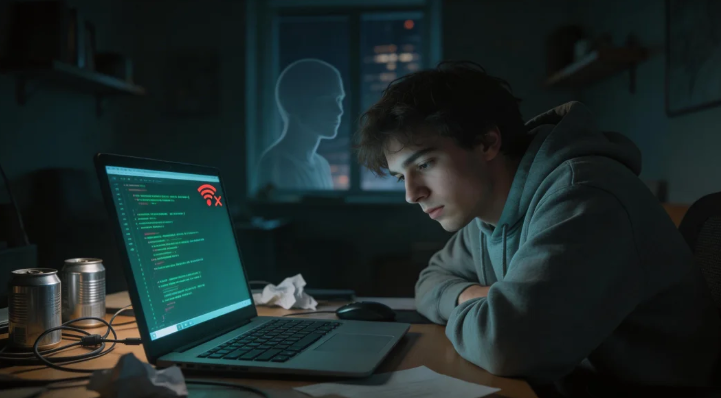
Rowan Hale’s apartment sat above a closed print shop on the edge of Bristol’s old quarter, a place where broadband cables snaked like black vines through crumbling brick. He worked nights debugging cloud security for banks, so he rarely saw daylight and knew every creak of the floorboards at 03:00. The only voice he heard after midnight was the chime of the router rebooting—until the night the signal dropped and a new user appeared in the shared-folder list: “Guest_0.”
Rowan refreshed the network pane; Guest_0 remained, no MAC address, no IP, just a blank avatar. He ran a diagnostic: 0 % packet loss, yet every site timed out. The moment he unplugged the router, Guest_0 vanished. When the modem blinked back to life, the name was gone. He shrugged, blamed firmware, and went to bed.
The next evening the same silence swallowed the web at 02:17. Guest_0 returned, now listed as “Owner” instead of “Guest.” Rowan opened the event viewer; the log showed a single line written in the outage window: “Rowan, don’t look away.” He screenshot it, sent it to his company’s security channel, and received only laughing emojis. While they joked, the router lights died again. In the black reflection of his monitor he saw the outline of someone standing behind his chair—no face, only a smooth oval where features should be. Power returned; the reflection was empty.
He ran every antivirus, flashed the router firmware, even replaced the Ethernet cable with a new one still coiled in plastic. At 03:33 the following night the outage lasted eight minutes. Guest_0 sent a file named “offline_shadow.jpg.” It was a photograph of Rowan’s own bedroom window taken from the inside, timestamped two minutes into the future. He yanked the curtains: glass, rain, empty street. Behind him the computer speaker popped, not with static but with a whisper he felt rather than heard: “Closer now.”
Rowan decided to stay elsewhere. He booked a hostel across town, pocketed his phone, and walked out leaving the router unplugged. The hostel Wi-Fi asked for an email; the captive portal flickered and auto-filled the username field: Guest_0. He dropped the phone like it burned him. Around the common room, travelers scrolled peacefully, unaware. Rowan took the stairs two at a time, checked out within ten minutes, and ran through drizzle to the only place still open: the 24-hour library.
Inside, fluorescent lights hummed over rows of sleeping laptops. He chose a carrel far from windows, logged in with a guest pass, and opened a blank document to type everything he remembered. The cursor pulsed. Without prompting, letters appeared: “You brought me here.” Rowan slammed the laptop shut; the screen cracked along the bezel, leaking liquid crystals like black tears. A librarian hurried over, scolding him for damage. Rowan offered to pay, but when the librarian booted the machine the device looked pristine—no crack, no document, only the library homepage. Rowan’s palms, however, were stained with fine grey dust as if he’d handled ashes.
He left the library at dawn, bought a pay-as-you-go SIM, and phoned his only local friend, Mara, who dealt in vintage radios and believed every wire held a ghost. She invited him to her workshop, a basement full of valves and solder smoke. Rowan arrived shaking. Mara listened, then placed an old cathode-ray oscilloscope between them. “Ghosts need a carrier,” she said, “and Wi-Fi is just invisible ink.” She tuned the scope until the green wave fluttered. Every time Rowan exhaled, the wave dipped, forming deliberate pulses: Morse. Mara translated aloud: “Signal… must… end… with… source.” She looked up. “It wants you to switch yourself off.”
Rowan laughed, a brittle sound. Mara poured coffee laced with something sweet and insisted he nap on the velvet sofa while she researched. He drifted until the workshop’s smart speaker crackled. A calm genderless voice recited his full name, birth date, and the exact second his heart would stop: 04:04 that afternoon. Rowan jolted awake; Mara stood beside the speaker holding a sheared Ethernet lead like a dead snake. “It followed the speaker cable,” she whispered. “We go dark now.” She killed the mains, lit paraffin lamps, and handed Rowan a hand-crank radio. “If it needs signal, we stay analog.”
Hours passed without digits. They played cards, talked of childhood birthdays, and kept the radio low. At 03:55 the radio dial drifted by itself, landing between stations. A carrier wave hummed, and through the static came a sequence of thuds matching Rowan’s pulse. Mara grabbed a screwdriver and pried the radio open. Inside, where capacitors should sit, lay a tiny router board blinking blue. She smashed it with the heel of her boot; the thuds stopped. Simultaneously, upstairs glass shattered. They climbed the stairs and found the streetlamp outside dark, cables swaying though no wind blew. On the pavement lay Rowan’s cracked laptop, the one he’d left at home.
Mara turned to him. “It’s collapsing distance. You have to choose silence.” She offered a pocket notebook and a fountain pen. “Write your name, then never share it online again. Starve the echo.” Rowan wrote “Rowan Hale” in wet ink, tore the page out, and stuffed it into an old tobacco tin Mara buried under a pile of circuit boards. The workshop lights flickered once, then steadied. Outside, the streetlamp reignited; cables hung still.
Rowan left Bristol at sunrise, took a train west until phone bars emptied, and settled in a seaside town where broadband arrived only on Tuesdays by van. He works now in a small museum cataloging ship logs with pencil and card drawers. Sometimes tourists ask why he never joins the free Wi-Fi. He smiles, says signals give him headaches, and walks outside where gulls cry louder than any modem. At night he listens to waves, not whispers, and though storms still knock out power, when the lights return there is no reflection behind him—only his own face, finally unshared.