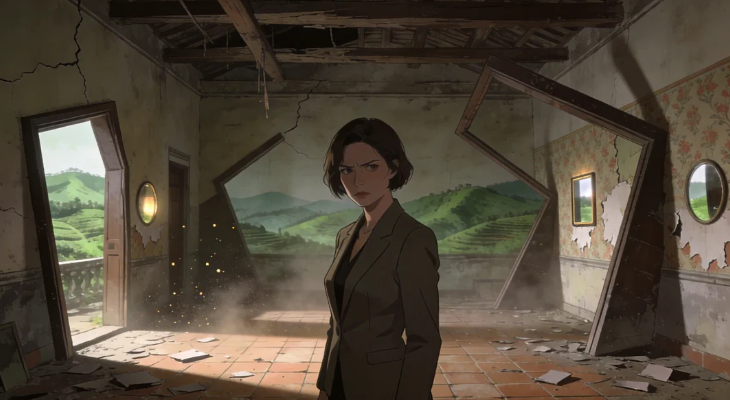
Elara V. Whitlock first saw the house through the drizzle of a March morning, its tiled roof sagging like the spine of a sleeping dragon. The solicitor’s letter had reached her tiny Bloomsbury flat with impossible timing: her mother, who had fled China in 1967 with nothing but a jade hairpin and a sealed envelope, had died two weeks earlier. The envelope contained a single iron key and coordinates that led Elara to this forgotten valley where bamboo grew through abandoned rice terraces.
Local villagers refused to approach the gate. “Yin house,” they muttered, drawing the character for death in the air. Yet Elara, whose career rested on Euclidean certainties, stepped across the threshold armed with a laser measure and a dismissive smile. The foyer was a perfect octagon; each wall held a tarnished mirror whose silver backing had been scraped away in deliberate patterns. When she tilted her head, the mirrors showed not her reflection but corridors that did not exist, lit by a greenish dusk.
On the second night, the compass on her phone spun like a roulette wheel. She woke at 3:07 a.m. to the sound of someone pacing the roof, footsteps tracing the exact curve of the Bagua. Rainwater had pooled in the central courtyard, forming a perfect yin-yang without a single leaf disturbing its border. Elara dipped her finger and tasted iron. She remembered her mother’s bedtime stories: feng-shui as warfare, needles of magnetic force pinning malevolent spirits to the earth’s veins.
The next afternoon, a woman appeared at the gate carrying a lacquer box. She introduced herself only as Mrs. Lim, the last keeper of the array. “Your grandfather was the Luoshan master,” she said, opening the box to reveal a brass luopan whose needle was carved from human bone. “He broke the ring to save the village from a famine, but he tied the debt to his bloodline. The mirrors drink moonlight; the house drinks memory. If the compass stops, the debtor awakens.”
Elara’s rational mind catalogued delusions, yet the luopan trembled like a trapped bird when she touched it. That night she followed its tug through secret panels into a root-cellar where the air tasted of centuries. Eight stone pillars formed a Bagua around a ninth that had been shattered; black water seeped from the fracture. On the fallen shard she found her mother’s name, carved in blood that had never dried.
Mrs. Lim returned at dawn, face the color of wet ash. “The debt is almost paid,” she whispered. “One pillar remains unbroken. If you realign the array, you seal yourself inside. If you flee, the valley rots.” She placed a small hourglass beside the luopan; sand fell upward, each grain a year of her mother’s exile.
Elara spent the day walking the house with the compass, watching how its needle jerked toward every mirror. She realized the building itself was a needle, its octagonal core skewering the intersection of two dragon veins. The mirrors were not reflections but vents, allowing compressed qi to escape slowly enough to keep the prisoner drowsy. Her grandfather had sacrificed symmetry for mercy, giving the spirit a sliver of sky in exchange for crops that grew three harvests a year—until the Cultural Revolution shattered the final pillar in the name of progress.
As dusk bled into the valley, Elara climbed the roof with the luopan in her hand. The moon rose crimson, casting eight shadows that knelt like penitents. She poured the upward-flowing sand across the ridgepole, forming the character for “return.” The mirrors flared, showing her every life the house had devoured: railway workers, war refugees, her own mother boarding a rusty steamer with tears that tasted of iron. In each face she saw the same recognition—geometry can be kindness when the alternative is devouring.
Elara pressed the luopan to her chest. Instead of realigning the array, she turned the bone needle until it pointed at her own heart. The house shuddered; tiles cascaded like black snow. One by one the mirrors cracked, releasing threads of greenish light that braided themselves into the shape of a child-sized figure made of dust and drought. It regarded her with eyes like dried wells, then stepped into the fracture of the ninth pillar. The stone healed with a sigh, sealing both keeper and prisoner in a single act of inheritance.
When the sun rose, the manor was gone. In its place stood a circle of cedar saplings arranged in the Bagua, their trunks bent slightly inward as if listening. Mrs. Lim found Elara’s notebook on the gatepost, its final page inscribed with a new compass bearing: “Compassion is the only true north.” The valley’s rice terraces filled overnight with water so clear that villagers saw their reflections twice—once right-side up, once upside-down, forever balanced.
Some nights, travelers report a woman’s voice teaching geometry to the wind, outlining angles that taste of forgiveness. If you hike the ridge at 3:07 a.m. and hold a compass steady, the needle trembles, then steers you gently home, as though the dragon beneath the earth has learned to dream in curves rather than fangs.