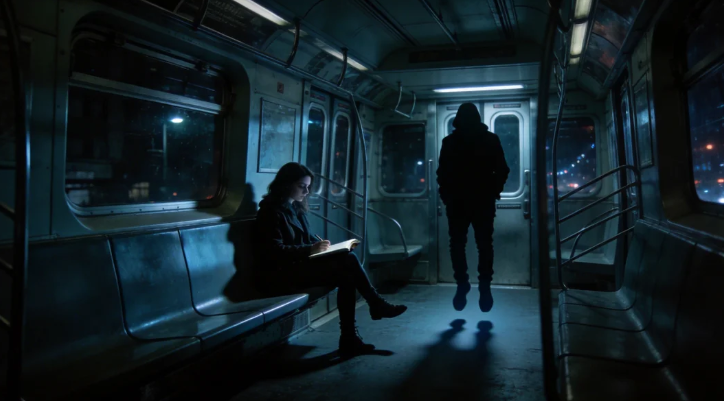
Mara Voss had spent three years chasing urban myths beneath the glass towers of New Avalon, but nothing prepared her for the whispers about the 12:07 to Ravenshollow. According to online forums, the train appeared only when the city’s fog rolled in thick enough to muffle sirens. It stopped at an unmarked platform between 57th and 58th streets, picked up one soul, and vanished until the next fog. No timetable listed it, no camera recorded it, yet the thread stretched back to 1912, each post signed with the same tagline: “Bring no coins; the conductor collects differently.”
On the fourth Friday of October, fog pressed against the windows of Mara’s fifteenth-floor studio like wet tissue. She closed her laptop, pocketed her voice recorder, and rode the escalator down to the deserted station. At 12:05, the tiles began to sweat. Fluorescent lights flickered in a slow arrhythmic heartbeat. She felt, rather than heard, the approach of steel wheels: a vibration climbing the bones of the city. Then the train slid into view—olive-green paint blistered with rust, windows clouded by age. The roll-sign read RAVENSHOLLOW in typeface discontinued before her grandmother was born.
The doors sighed open. Inside, brass handrails gleamed under a single functioning bulb. A conductor in a charcoal uniform stood at the far end, cap lowered, brass ticket punch dangling like a pendulum. Mara stepped aboard; the floor felt warmer than the platform, as if the train had absorbed every passenger’s body heat since its first run. The doors sealed without a sound, and the car lurched forward into a tunnel darker than any she had known.
She tried to record, but her screen displayed only static snow. The conductor beckoned. “No fare,” he rasped, voice echoing inside her skull. “Only memories.” He reached toward her forehead with two fingers that smelled of wet iron. Instinct screamed, yet her legs refused retreat. When his fingertips brushed her skin, the lights died.
Darkness dissolved into a childhood scene: Mara at seven, pedaling a red bicycle along the river where her father once promised to teach her to skim stones. He had died the following winter, and the river had frozen before she mastered the throw. Now, in the spectral replay, her father stood on the bank, sleeves rolled, palm extended. She felt the sting of tears she had forgotten how to release. The conductor’s voice floated nearby: “A memory for passage. One must pay.”
Mara understood the legend’s warning too late. Each rider surrendered their most precious recollection, riding forever in a loop of loss. She watched her father’s smile erode like riverbank mud, dissolving into gray mist. Panic flared; she clawed for the emergency brake, but the handle melted into smoke. The train accelerated, tunnel walls replaced by starless sky.
Then came the second memory: her first night in New Avalon, the skyline glittering with possibility. That moment of arrival—hope raw and electric—began to peel away. She felt ambition leach from her veins, replaced by hollow wind. Desperate, she recalled her mother’s lullaby, the smell of cinnamon on rainy mornings, the laughter of friends who drifted apart—each recollection ripped out like threads from a tapestry, leaving frayed edges of identity.
As the conductor reached for her final memory—the face of the woman she loved—Mara lunged, not away but through him. Cold pierced her chest, yet she passed, stumbling into the adjoining car. Here, passengers sat in orderly rows, eyes vacant, lips moving in silent repetition of their own stolen stories. An elderly man clutched a wedding ring that slipped again and again through fingers like water. A teenager reached for a dog that existed only in the echo of wagging tail. Their endless forgetting hummed like broken neon.
Mara realized the train fed on more than memories; it devoured the future those memories would have shaped. She refused to become another hollow seat. Searching the floor, she found a rusted nail—real, solid, out of place. Gripping it, she scratched a single word into the window: REMEMBER. Glass protested, but the nail bit deep. Light bled through the gouged letters, faint yet growing.
The conductor turned, shrieking a sound of steel twisting underwater. The car convulsed. Passengers stirred, eyes flickering toward the glowing word. One by one, they whispered their own stolen fragments—names of childhood pets, recipes sung by grandmothers, the scent of first snow. Each utterance weakened the train’s hold, seams of rust glowing red. Mara pressed her palm against the window; the word brightened, spreading like sunrise across every compartment.
With a crack, the train split at the couplers. The front section raced into darkness, carrying the conductor and his centuries of plunder. The rear cars slowed, drifting toward a station that materialized like a photograph developing in reverse. Emergency lights flickered alive. Doors slid open onto the 57th Street platform, now washed in dawn’s pale blue. Mara stepped onto concrete that felt fragile yet real.
Behind her, the passengers emerged, eyes no longer vacant but blazing with reclaimed stories. They dispersed into the waking city, each carrying a scar shaped like a rusted nail. No headlines reported the missing train; the fog lifted, schedules resumed. Yet on quiet nights, subway riders sometimes glimpse a word scratched into tunnel walls: REMEMBER. They dismiss it as graffiti, but Mara knows better. Legends never die; they only wait for the next fog to offer passage.
She keeps the rusted nail on her keychain, a talisman against forgetting. And whenever the river freezes, she walks to its edge, skims a stone across the ice, and hears her father’s laughter carried back on the wind—proof that some fares, once refused, can never be collected again.