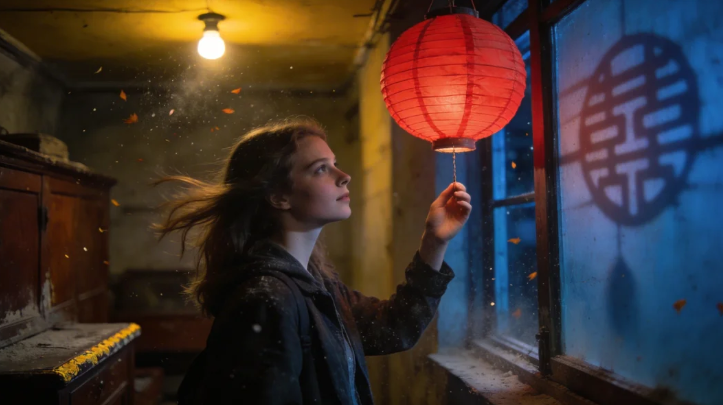
Mara first saw the lantern on the rain-slick evening she arrived at 47 Willow Lane. It hung from the second-floor eave like a single drop of frozen blood, its paper skin so thin that the bulb inside seemed to pulse with a heart of its own. “Leave it,” Mr. Chen had said, pressing the key into her palm as though it burned. “It keeps the house in balance.”
Balance was exactly what Mara needed. Her architecture thesis on Lingnan siheyuan had collapsed with her relationship back in London, and this cramped Cantonese townhouse was her cheapest route to salvage. She told herself the lantern was superstition, yet every night its glow slid across her desk like a fingertip tracing unfinished lines.
On the seventh night, a typhoon watch sent the city into shuttered silence. Power flickered, then died. Mara groped for candles and, without thinking, lifted the lantern to light her way. The moment her fingers brushed the paper, the wind died. The bulb inside flared cold white, illuminating characters she had never noticed: 回頭是岸—turn back and reach the shore.
Footsteps answered from the stairwell—soft, wet, barefoot. A girl’s voice hummed the opening line of Mo Li Hua, the jasmine flower song, each note slightly off, as though learned from memory underwater. Mara’s throat sealed. She set the lantern down exactly where it had hung, but the song simply descended, closer, until breath fogged the banister.
Common sense screamed to flee, yet scholarly instinct pinned her feet. She activated her phone’s recorder and whispered, “Cantonese ghost, 1930s?” The humming stopped. A giggle bubbled up, ending in a hiccup that tasted of river silt. Then nothing—until the recorder crackled later with a different voice, older, male, speaking Toisanese: “The lantern is the door; the door is the debt.”
Library archives the next morning revealed that 47 Willow Lane had once been the city’s largest bridal agency. In 1932, a promised bride named Lin Yue eloped with a sailor. Her jilted groom, heart shattered, hanged himself from that very eave, using the red lantern cord so “her name would burn forever.” Since then, every tenant who moved the lantern met misfortune: a broken spine, vanished child, madness.
Mara’s skin prickled with the thrill of discovery—and terror. She drafted an email to her advisor: “Possible architectural haunting tied to object placement.” Before she could press send, the library lights blinked. Every computer except hers went dark. On her screen, a new PDF opened itself: a scanned marriage contract dated 1932, the groom’s signature wet and red. Her own name appeared beneath it, typed in official font.
That night she returned with incense, chalk, and a measuring tape. If feng shui held the house together, she would redraw its skeleton. She burned incense beneath the lantern, apologizing in broken Cantonese, then chalked the Ba-Gua around its base, aligning north with the cracked roof tile. The lantern swung once, twice, then stilled. Satisfied, she went to bed.
At 3:07 a.m. she woke facing the ceiling mirror—an antique she had covered with a scarf. The fabric now lay folded on her chest. In the reflection, the lantern’s light was inside her room, though she had left it outside. Beneath it stood Lin Yue in sailor’s stripes, face bloated with river water, hair dripping on the floorboards. She extended a lotus foot, stepping into the chalk circle. Each footprint erased a line, snapping the Ba-Gua like thread.
Mara’s breath crystallized. She remembered the recorder’s phrase: “The lantern is the door.” Doors, in architecture, need frames. She grabbed her drafting knife, sliced her palm, and smeared blood on the lintel, sketching a new frame in iron-rich red. “Use mine,” she said. “Let the debt close.”
Lin Yue paused, eyes reflecting centuries of midnight. Slowly she nodded, walked into the blood-drawn doorway, and dissolved. The lantern’s bulb imploded with a sigh, showering the floor with red petals that smelled of jasmine. When Mara woke at dawn, the lantern was gone, leaving only a faint ring on the eave and her palm healed to a thin white line.
She finished her thesis in a month, titling it “Threshold Objects in Lingnan Dwellings: A Study in Spatial Atonement.” Mr. Chen returned her deposit with trembling hands, whispering that for the first time in ninety years the house felt light. Yet on the day Mara boarded her flight back to London, a street vendor tried to sell her a tiny souvenir lantern—red paper, same calligraphy. She almost bought it, then left it swinging on the stall, a door she chose not to open twice.