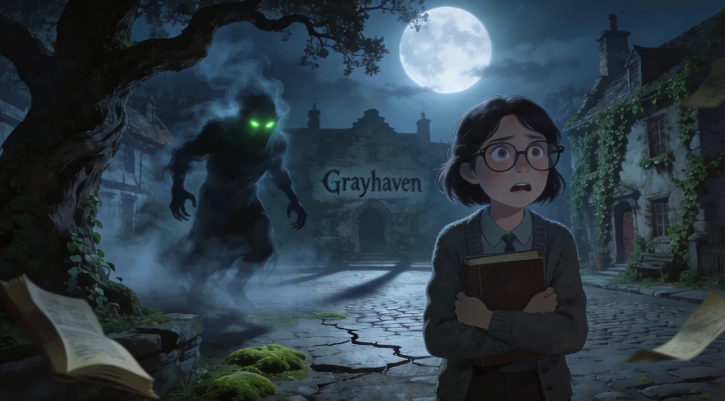
Elena Whitlock had never believed the stories her grandmother whispered by the fire: tales of ancestors who vanished into the Blackthorn Forest whenever the moon grew round, returning at dawn with dirt beneath their nails and blood on their cuffs. She preferred the quiet order of Grayhaven’s dusty library, where the loudest sound was the turning of a page. Yet on the eve of her thirtieth birthday, an envelope slipped between the shelves changed everything. The paper was yellowed, the ink brown like dried rust: “The moon remembers what the blood forgets. Come to the well before the clock strikes twelve.” It was signed with the initials E. W.—her own.
That night, wind rattled the stained-glass windows as Elena climbed the hill to the abandoned well. Fog curled around her ankles like living smoke. She told herself it was a prank, until she heard the breathing—low, rhythmic, almost human. A shape stepped from the mist: a wolf the size of a stallion, eyes reflecting silver fire. Instead of attacking, it bowed its great head and nudged toward her a tarnished locket she recognized from the family album. Inside was a photograph of her grandmother, ageless, standing beside the same creature. The wolf’s gaze held sorrow older than the village itself. Elena’s knees buckled; the earth seemed to pulse beneath her, matching the frantic drum of her heart.
Days blurred into sleepless research. Parish records revealed that every Whitlock heir had disappeared on their thirtieth birthday for two centuries, only to reappear weeks later with no memory. The townsfolk spoke of livestock found torn apart, of moonlit howls that froze blood. Elena traced the pattern: each disappearance coincided with the rare lunar eclipse known as the Crimson Moon. According to a crumbling diary, the curse began when her ancestor, Elias Whitlock, hunted the last spirit-wolf to steal its immortality. The creature cursed the bloodline to become what they destroyed—guardians of the forest, slaves to the moon’s hunger.
As the next eclipse approached, Elena felt her skin prickle at dusk, her reflection in the window flickering between woman and wolf. She tried to flee the valley, but every road curved back to Grayhaven. In desperation she sought Marcus, the reclusive blacksmith whose family had served as keepers of the old ways. Marcus revealed an iron dagger etched with runes that could sever the curse—if used by the cursed upon themselves under the eclipse. Yet the price was steep: the wolf spirit would devour her human soul, leaving only the beast. Elena realized the choice was never to break the curse, but to master it.
On the night of the Crimson Moon, the village square lay empty, doors barred with rowan branches. Elena walked to the forest heart, dagger hidden beneath her coat. The transformation began as a fever, bones stretching like taffy, screams twisting into howls. Through the haze she saw the spirit-wolf waiting, translucent and vast. Instead of plunging the dagger into her own chest, she turned it outward, slicing the air. The blade cut a seam between worlds, releasing a torrent of starlight. The wolf hesitated, confused. Elena spoke with a voice not entirely hers: “I offer not my death, but my guardianship. Let the forest feed on my vigilance, not on my flesh.” The creature circled her, then dissolved into motes that settled on her skin like frost. The dagger melted, forming a silver cuff around her wrist.
Dawn found Elena at the forest edge, human yet changed. Her senses sang with every rustle of leaf, every heartbeat in the village below. She understood now: the curse was a circle that could be widened into a spiral of choice. She returned the locket to the well, sealing it with a promise. Each full moon she walks the woods, not as prey or predator, but as keeper of balance. Livestock are left untouched, children sleep soundly, and the howl that once terrorized Grayhaven has become a lullaby that keeps darker things at bay. In the library she shelves a new volume titled “Moonlit Howl,” dedicated to the next Whitlock who will listen. On the final page she wrote: “We are not the monsters we fear; we are the stories we choose to become.”