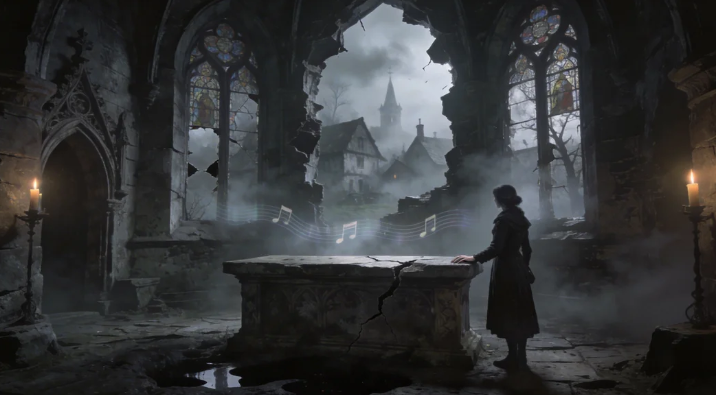
The letter arrived on the eve of All Souls’, inked in sepia and sealed with black wax bearing the crest of a thorn-wrapped cross. Miss Elara Voss, cataloguer of forgotten relics, had never heard of Ravenshollow, yet the script named her sole heir to the Chapel of St. Erasmus, “together with every shadow that clings thereto.”
She traveled by train until the rails ended, then by carriage until the road surrendered to moss. Ravenshollow appeared suddenly: crooked roofs bristling like broken ribs against a bruised sky, and everywhere the smell of wet stone and lilies left too long in coffins. The villagers averted their eyes when she asked about the chapel, crossing themselves with three fingers instead of two.
The building stood on a knoll outside the settlement, its steeple snapped off like a bone. Ivy veined the flying buttresses; gargoyles leaned outward, mouths agape as if still mid-scream. Elara pushed the iron doors and entered a nave chilled by centuries. Shafts of moonlight speared through lancet windows, painting the dust motes silver. At the altar lay a single brass candlestick holding a stump of black wax—unlit, yet warm to the touch.
That night she took quarters in the sacristy, lulled by the hoot of unseen owls. At the stroke of three, the chapel bell tolled once. She woke to find the candle burning with a flame the color of storm clouds. Around it, chalked on the flagstones, was a circle of thorn-runes she had not drawn. From the crypt grate came a breath of air colder than November, carrying the faint scent of myrrh and rust.
Each dusk thereafter the candle re-ignited itself, shortening though no one touched it. Elara’s sketches of the runes revealed they were reversed benedictions—prayers spoken backward to lock something beneath. She read every mildewed ledger in the chapel: baptisms, marriages, and then, in 1789, a final entry—“Interred the Singing, lest it rise with the moon.” The ink trailed into a tear-shaped blot, as though the scribe had wept.
On the seventh night, curiosity overrode dread. Elara descended the spiral stair to the crypt, lantern trembling in her grip. The air thickened, tasting of graves freshly opened. Stone sarcophagi lined the walls, their lids askew. At the chamber’s heart stood an empty bier carved with the same thorn-runes, but here they were gouged, not chalked, and the stone was scorched as if by lightning.
Behind her, the candle upstairs guttered out. Darkness poured downward, carrying a melody—low, sweet, and hungry. It threaded through her ribs, coaxing memories she did not own: a choir of children standing in rain, a priest raising a silver cup that reflected no light, a village choosing the smallest voice to seal the hunger below. Elara understood; the chapel was not built for worship but for containment, and the candle was wick and prisoner both, burning away the years until only inches remained.
She fled up the stairs, but the melody followed, curling like smoke under doors. In the nave, moonlight had turned blood-red through the stained glass. The gargoyles had shifted, heads tilted toward her, throats vibrating with silent song. The candle lay spent, a coil of cooling wax. Yet in its puddle glimmered a single spark.
Elara did what every custodian of dying towns fears: she chose mercy over duty. She pricked her finger, let one drop of blood fall onto the spark. The flame reignited, not gray but gold, and the melody faltered, confused by the taste of willing sacrifice. She sang then—an old lullaby her mother had whispered when nightmares pressed close—simple, human, forward in time. The gargoyles cracked, ivy recoiled, and the crypt below sighed, a centuries-held breath finally released.
When dawn crept over Ravenshollow, villagers found the chapel doors flung wide, sunlight streaming onto a floor washed clean of runes. Elara sat on the threshold, palm wrapped in linen, eyes bright with exhaustion. Inside, a new candle—white, unmarked—stood upright in the old brass holder. It would never burn down, they said, for it fed on no darkness, only the quiet promise of morning.
Some nights, travelers still hear singing on the knoll, but the song no longer claws at the soul; it lingers like the last chord of an organ, gentle, resigned, already fading into echo. Elara stayed, cataloguing not relics but stories, teaching the village children to read the stones. And whenever the wind smells of myrrh, she lights the white candle, reminding the shadows that music can be a lock or a key—depending on who sings last.