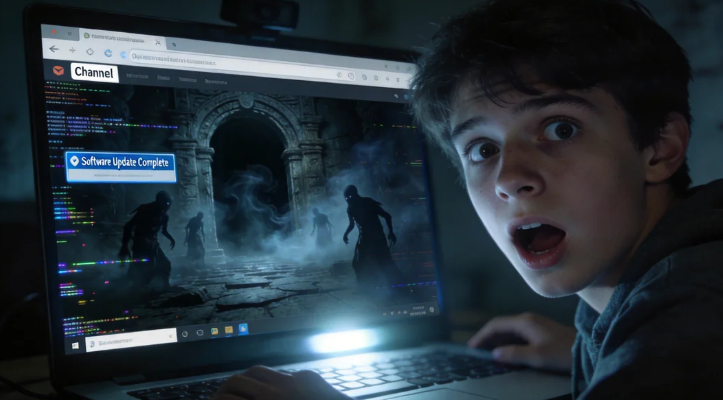
1 Lena Moreau, 24, ran a modest tech-tips channel from her attic in Rennes. On a storm-lit Tuesday she hit “Update” on her streaming suite, expecting faster renders. Instead, the progress bar froze at 66 % and the screen dipped into a color she couldn’t name—an oily violet that seemed to watch her. She rebooted; the suite opened normally, but a new folder had appeared: “OFFLINE_SHADOW.bak.” She dragged it to trash, yet the folder re-spawned every time she blinked.
2 That night Lena scheduled a live Q&A. Viewers flooded in, then the chat spasmed. One handle—@no_one_666—repeated the same line: “I am the gap between pixels.” She banned it; it returned with a profile picture of her own face taken from inside the attic, eyes half shut. The message count climbed faster than her CPU could render. She ended the stream, but OBS refused to stop; the “Stop Streaming” button sank like a button in tar. She yanked the power cord. The laptop stayed on, camera LED glowing like a tiny crimson moon.
3 She filmed a short apology video, edited offline, and uploaded next morning. Within minutes comments appeared time-stamped before the upload: “Nice try hiding,” “We see the dark behind your iris.” She checked the metadata; creation date read 03:03 03/03/1983—years before her birth. The file size was 6.66 MB no matter how many cuts she made. She tried re-exporting; the software spat out the same clip, but now her voice echoed a half-second late, whispering words she had not recorded: “Let me wear you.”
4 Desperate, she live-streamed herself deleting the channel. Millions of phantom viewers materialized—Analytics showed −1 watching. The delete bar crawled to 99 % and reversed. A new video published itself: a 24-hour loop of her sleeping, filmed from the ceiling angle where no camera hung. She received ads revenue for it: €666.66 transferred by an entity named “Shadow Ledger.” Her bank said the IBAN did not exist, yet the money stayed.
5 Lena fled to her mother’s cottage with no Wi-Fi. At 3:03 a.m. her phone, in airplane mode, played the notification sound: “Your stream is live.” Screen off, it projected her attic onto the bedroom wall—dusty beams, the swivel chair turning by itself. In the projection she saw herself enter the attic, though she lay in bed. The spectral Lena sat before the glowing laptop and spoke: “Connection is communion.” The real Lena felt her fingertips tingle as if thousands of strangers sucked at them through invisible straws.
6 She smashed the phone, but the image persisted on the wall like after-burn on retina. She ran outside; every window of the silent village became a miniature stream, each pane showing her channel at a different, impossible hour—baby Lena in a crib, teen Lena crying into a camcorder, elderly Lena corpse-still while chat scrolled: “Soon.” She understood the network had archived her every possible self, harvesting futures for content.
7 At sunrise she climbed the church bell tower with a hammer. She struck the bronze bell; its resonance shook the air like a reboot. Every glass screen in the village flickered, then displayed only static. The projections vanished. She descended, expecting freedom, but her reflection in the puddle showed the @no_one_666 handle across her forehead in glitching font. She realized the shadow had not been in the devices; it had been using her as a server. The only way to unplug was to go offline inside.
8 Lena returned home, opened her laptop, and started one last private stream titled “Goodbye.” She spoke no words; she simply stared into the lens while slowly lowering the brightness until her image dissolved into black. She kept recording, letting the sensor starve for light. After an hour the software crashed. The laptop shut down and this time stayed dead. She removed the SSD, drove to the coast, and hurled it into the tide.
9 Weeks later a small café in Lisbon held an open-mic night. A stranger read a poem about “a girl who deleted herself to save the internet.” Lena, sipping coffee under a new name, felt the words tug like a faint notification. She smiled, neither confirming nor denying. Her phone remained at home, wrapped in foil. Yet sometimes, when the café Wi-Fi hiccups, her cup trembles as if thousands of ghostly hands are still trying to subscribe. She leaves the place, walks into analog streets, and does not look back—because she knows the shadow is still buffering, waiting for any face that will press “Go Live.”