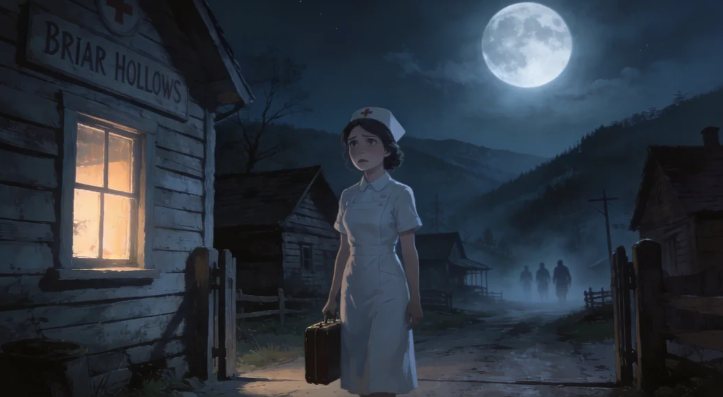
Clara Mercer had seen every kind of emergency during her years in downtown Chicago, but nothing prepared her for the hush of Briar Hollow. The hamlet of four hundred souls had one blinking traffic light, a single grocery that doubled as post office, and a clinic the size of a trailer. On her first evening, while unpacking boxes of antiseptic, old Mrs. Ellery shuffled in unannounced, pressed a sprig of wolfsbane into Clara’s palm, and whispered, “Keep this over the door, dear; the teeth you’ll hear tonight aren’t all in the forest.”
Clara laughed—until she noticed the woman’s eyes: pale, anxious, and shining like wet stones. She pinned the wilting plant above the entrance anyway, more to humor superstition than to honor it.
Autumn fog arrived early that year, sliding between maples and settling in the hollows like thick milk. On the third Friday, a hunter was carried into the clinic at dusk, shirt shredded, ribs clawed in parallel furrows. “Bear,” the men muttered, yet their darting glances betrayed doubt. While Clara stitched the gashes, the hunter gripped her wrist. “Not bear,” he rasped. “Yellow eyes… stood upright… laughed while it bit me.” Then he fainted.
That night, the full moon floated above the ridge, round as a Communion wafer. Wind rattled the clinic’s tin roof. Clara stayed late cataloging vaccines, her only company the rhythmic creak of the building on its cinder-block foundation. At 11:07 p.m., every dog in Briar Hollow began to howl. The chorus rose, cracked, then died abruptly—an orchestra of throats strangled mid-note. Silence pressed heavier than sound.
Clara stepped outside, flashlight trembling in her hand. Across the road, the grocer’s porch light flickered and went out. Something tall padded into the glow of her own doorway: a silhouette elongated by jointed legs, shoulders rolling like a man learning to walk on all fours. Its eyes caught the beam of her torch—two coins of molten gold. The wolfsbane above the door shivered, petals raining down. The creature sniffed once, tilted its muzzle skyward, and unleashed a howl so human it felt like a sentence: I was once like you.
Clara stumbled backward, slammed the door, and threw the bolt. She phoned Sheriff Dalton, but the line hissed with static. Through the window she watched the shape circle the clinic, claws clicking on asphalt. It dragged one paw along the aluminum siding, tracing a line that screeched like brakes. When it reached the back entrance, it stopped, cocked its head, and simply walked away, melting into fog as though reality had swallowed its own thought.
Next morning, the town pretended nothing happened. Clara confronted Dalton at the diner. “We don’t speak of it before sundown,” he said, stirring coffee with a hand that shook just enough to blur the rim of the cup. “Talking gives it shape. Shape gives it power.” The sheriff’s badge was tarnished green, like copper left to bleed in rain.
But Clara was a woman of science; shape already had power—x-rays, blood types, DNA. She drew five vials from the hunter’s arm before he checked himself out against advice. In the lab corner of the clinic she spun the blood, stained slides, and saw what she feared: leukocytes stretched into crescents, nuclei bristling with hair-like projections—cells mid-metamorphosis, neither human nor wolf.
She spent the week reading folklore, medical journals, and lunar tables. The transformation, texts claimed, was triggered not merely by moonlight but by invitation: an act of violence offered, a bite accepted. She replayed the hunter’s words—laughed while it bit me—and understood the infection was voluntary, a covenant sealed in flesh.
Friday came again, cloudless. Clara locked the clinic early, pocketed a syringe of succinylcholine strong enough to paralyze a horse, and climbed the fire tower on Blackthorn Ridge. From that height she watched the village extinguish its lights one by one, houses crouching like guilty things. When the moon cleared the treetops, the change began below: a ripple of sinew under skin, joints popping like wet wood. She counted three figures convulsing behind barns, a fourth writhing beneath the church’s leaning cross. The epidemic was wider than anyone admitted.
Then she heard footsteps on the tower stairs—slow, deliberate, climbing with the patience of someone who owned the night. She steadied the syringe. A man emerged: Sheriff Dalton, shirt unbuttoned, chest hair matted with sap. His pupils were already elongating, irises swirling into amber. “You shouldn’t have looked,” he growled, voice layered with echoes.
Clara backed against the railing. “There’s a cure,” she lied. “The paralytic stops the sequence.”
He smiled, revealing teeth sharpening before her eyes. “Why would I want to stop becoming what this town needs?” He stepped closer; moonlight glazed his fingernails into claws. “Briar Hollow survives because we police ourselves. Outsiders bring questions; questions bring chains. We are the leash.”
Clara realized the wolfsbane wasn’t protection; it was census, marking whose conscience was still human. She had refused to wear its bruise-colored petals, and thus marked herself as witness—someone to be turned or silenced.
Dalton lunged. Clara jammed the needle into his carotid and pushed the plunger. He froze mid-snarl, muscles locking in rigid tableau. The transformation halted, half-man, half-wolf, a living gargoyle. She stepped around him, heart hammering, and descended the tower. Behind her, the paralyzed sheriff teetered against the railing, eyes begging the moon to finish what science had paused.
At dawn she drove to the county highway, flagged the first supply truck, and never looked back. Weeks later, newspapers reported a wildfire on Blackthorn Ridge that burned so hot trees exploded. Among the ashes, they found a single body, teeth fused, claws calcined—identity impossible to determine. Briar Hollow erected no memorial; the town simply erased that Friday from calendars.
Yet on every full moon, drivers passing the hollow hear dogs fall silent, and see a woman in a white coat walking the fog line, sprinkling something that glows pale against the asphalt. Some swear it’s wolfsbane; others claim it’s salt. Clara never speaks of it again, but she keeps a syringe in her purse and a moon-phase app on her phone, because once you learn the shape of a monster, you become the leash the world didn’t know it needed.