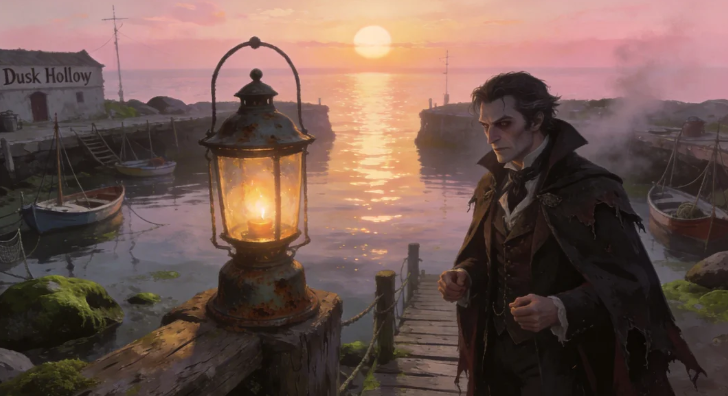
Elias Wren had rowed into Dusk Hollow for the solitude, not the stories. The villagers spoke of a twilight that lingered three hours too long, of gulls that screamed like children, and of a lantern in the window of the abandoned lighthouse that burned without oil. Elias, a doctoral student cataloging coastal folklore, copied the tales into his notebook with the detachment of a man who did not believe in ghosts—until the night the lantern chose him.
On the seventh evening, the sky bruised into an unnatural violet. Elias stood beneath the lighthouse, dictating observations into his recorder, when the lantern flared. A silhouette appeared at the glass: tall, coat snapping in a wind that touched nothing else. The figure raised a hand. The recorder crackled, words reversing, playing forward, then settling on a single sentence in a voice not Elias’s own: “Bring the tide what the tide once took.”
Common sense urged retreat, but scholarship tugged harder. Elias climbed the spiral stairs, each step echoing like a dropped coin. At the summit, the lantern sat on a stone ledge, its brass warm, its glass clouded with centuries of salt. Beside it lay a leather-bound journal sealed by a silver clasp tarnished almost black. When Elias touched the clasp, the lantern dimmed, as though inhaling. He felt a pulse—his own, yet synchronized with something older.
Inside the journal, entries dated back to 1721 were written in the same handwriting that had just spoken through his device. The author signed only with the initial V. The final legible passage read: “I kept the ships safe from rocks, but who keeps the rocks safe from me? If you read this, the tide has returned what it borrowed—my guilt, my hunger, my name. Finish what I could not: extinguish the lantern before the sun stands still.”
That night, Elias dreamed of water filling the lighthouse stairwell, of lungs that did not need air, of tasting every heartbeat in the village below. He woke with canine teeth aching and the lantern glowing on his hostel nightstand though he had left it behind. The villagers avoided his eyes at breakfast; the waitress spilled coffee when his reflection in the window showed only the room behind him. In the mirror of the public bath, Elias saw nothing at all.
Desperate, he returned to the lighthouse at the next violet twilight. The journal’s later pages, previously blank, now bled fresh ink: “Guilt cannot drown; it waits. I waited. You listened. Break the cycle—feed the lantern its last meal: the one who carries me.” Elias understood. The lantern was both keeper and captive of a vampire who had once guided ships, feeding on sailors lured by false beacons. V’s remorse had crystallized into the lantern, transferring the curse to whoever tampered with it. The only liberation was self-sacrifice—yet the vampire’s instinct fought surrender.
Elias felt the thirst scrape his throat like salt on an open wound. Children playing on the pier became metronomes of pulse. He climbed the tower, journal in one hand, a rusted harpoon in the other—iron, for ships and souls. At the summit, the lantern blazed, anticipating. Elias opened the journal to a final blank page and, with the harpoon point, wrote: “Guilt is mine now, but hunger ends here.” He stabbed the harpoon through the lantern’s heart of glass.
Light exploded outward, carrying memories of every sailor devoured, every widow left. Elias saw their faces dissolve into dawn. The sky above Dusk Hollow cracked open to true sunrise; the prolonged twilight finally snapped like a frayed rope. When the light receded, Elias lay intact, human reflection restored in the broken glass. The lantern was cold, its brass cracked, the journal empty except for new words in his own handwriting: “The tide returns what it takes—sometimes, a second chance.”
Weeks later, the lighthouse was renovated into a maritime museum. Tourists admire the quaint lantern, never noticing the faint harpoon scar. Elias lectures at universities, opening every talk with the same recording: “Bring the tide what the tide once took.” He ends by snapping off the recorder, smiling at the sunrise he no longer fears, and walks into daylight—carrying, but no longer controlled by, the lantern of dusk.