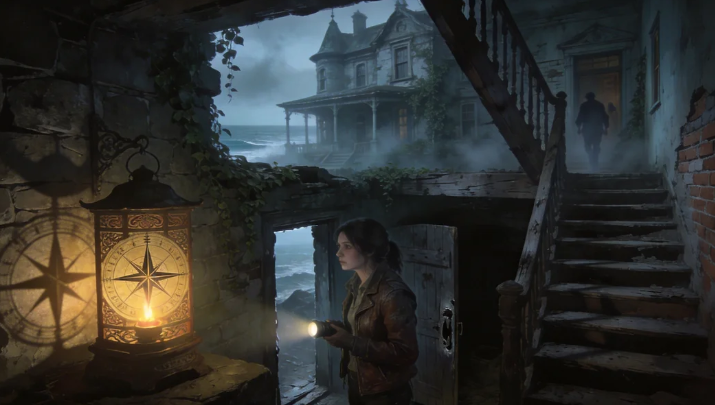
Mara Voss prized straight lines. Her life was a blueprint of measured angles, steel certainties, and deadlines that never slipped. So when the heritage trust asked her to survey Greymarrow House—an 1892 manor teetering on Cornwall’s granite cliffs—she arrived with laser levels and a yawning disdain for folklore. The villagers in Porthluney Cove warned her: “The house follows the wind, not the architect.” She thanked them with the politeness reserved for children who still believe in dragons.
On the first morning she catalogued cracks like battle scars. Salt air had nibbled the stone; ivy strangled the western wall. Yet the east wing remained pristine, its bricks oddly warm. She chalked it up to microclimates and set her coffee on a windowsill. When she turned back, the cup sat on the opposite side. She blamed fatigue, drank the cold dregs, and went on measuring.
That night the wind performed a low, constant chord. Mara worked late, headlamp carving tunnels of light through dust. In the cellar she found a loose plank. Behind it lay a silk-wrapped bundle: a brass lantern no larger than a melon, etched with spirals that seemed to spin when she blinked. A disk inside the base bore Chinese characters—mountain, water, dragon, gate—arranged like a compass rose. She pocketed it as a curiosity and forgot it until the house began to forget itself.
Day three, the main corridor lengthened. She paced it twice: twenty-eight metres, then thirty-two. Her tape measure recoiled in protest. She blamed the uneven floor, but the laser told the same impossible story. Drawings she had pinned in the library migrated to the dining-room wall overnight. Each time she corrected them, the house nudged them back, a silent chess player insisting on its opening.
By the weekend she slept in the caravan she towed behind her truck, yet the house followed. She woke to find lantern-light painted on the ceiling—warm gold, pulsing like a heartbeat. The brass lamp sat on her fold-out table, though she had locked it in the toolbox. That was when she stopped blaming fatigue and started listening to the wind.
Old journals in the parish archive spoke of Elijah Greymarrow, a Victorian shipping magnate who returned from Hong Kong with “a master of the flow of qi.” Together they redesigned the manor to cage a dragon vein running beneath the cliff. The geomancer warned that if the lantern ever left its compass heart, the vein would wander, taking the house with it. The family scoffed—until doors began to open onto brick walls and staircases flipped like hinges. In 1911 they sealed the lantern inside the cellar and fled. The house had been renting itself to strangers ever since, testing whether any heart could read the compass of the land.
Mara, daughter of engineers, felt the story itch like unfinished algebra. She spread survey maps across the caravan floor. Overlaying them, she saw it: the intact east wing pointed to a natural spring uphill; the warped west wing aimed at the cliff’s erosion line. The house was not shifting at random—it was correcting its aim toward water and away from collapse, obeying the same instinct that guides migrating birds. The lantern was not haunted; it was a tuning fork, and the house was trying to retune itself to the earth.
Yet every correction twisted the lives inside. If she allowed the drift, the east wing would eventually swivel until it jutted over the Atlantic, dragging foundations into the sea. If she resisted, the trapped vein might rupture, splitting the cliff and village alike. She needed a third path: to anchor the house without chaining the dragon.
She drove to Falmouth and found Lin Yao, a retired professor of landscape architecture who moonlighted as a feng shui consultant. He smelled of sandalwood and carried a walking stick carved with the same spirals as the lantern. When Mara unwrapped the lamp, his eyes glistened. “Luopan heart,” he whispered. “It remembers the first song.” Together they returned at dusk, the Atlantic gnawing the rocks like a restless choir.
Lin asked for silence. He walked the corridors barefoot, tapping walls until the echoes matched his pulse. At each node he placed a shard of local slate—grey, pink, green—forming a spiral that began at the lantern and ended at the cliff’s edge. “We do not fight the flow,” he said. “We give it a window.” The final shard he set beneath the lantern itself. As it clicked into place, the house exhaled—a long, dusty sigh that rattled every pane. Mara felt the floor settle like a bird folding wings.
That night she slept inside the manor for the first time since arrival. She left the lantern glowing on the new slate heart. In its light she saw the walls straighten—not to rigid squares, but to gentle curves that mirrored the coastline. The corridor measured twenty-eight metres and stayed twenty-eight. Doors opened where they promised. The staircase counted twelve steps, always twelve, and at the top the window framed the moon like a well-earned medal.
Dawn brought a different sound: not wind, but water. A new spring bubbled outside the east wall, clear and cold. Ivy had retreated, revealing a stone tablet carved with the same four characters—mountain, water, dragon, gate—now aligned to true north. Lin pressed the luopan heart into Mara’s hands. “Keep it lit,” he said. “A compass is only brave when someone dares to read it.”
Months later Greymarrow House reopened as a retreat for coastal scientists. Visitors slept deeply, claiming dreams of tides that spoke in measured couplets. Mara stayed on as caretaker, her blueprints rolled beneath the bed. She learned to draw curves, to leave margins for the breath of stone. On still nights she set the lantern on the sill and watched its shadows stretch across the cliff, a golden thread stitching house to horizon, dragon to sea, skeptic to wonder. The wind no longer sounded like a warning; it hummed like a lullaby that knew every name for home.