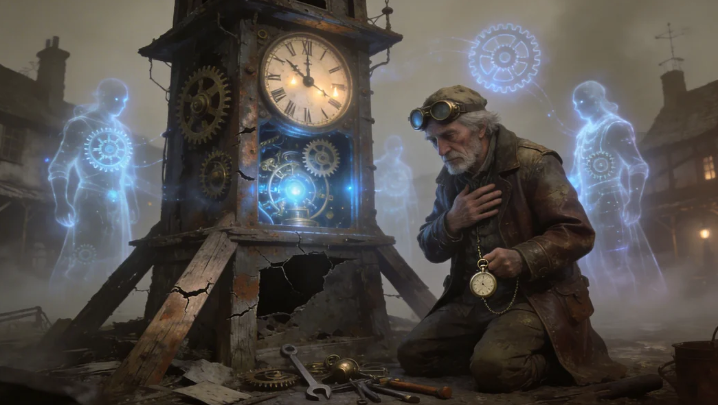
Elias Grueber’s workshop smelled of coal-dust and lavender oil, a combination he claimed kept the phantoms of rust at bay. For forty-seven years he had mended threshing machines, pocket watches, and the occasional automaton built by lovelorn inventors. Yet nothing in his ledger prepared him for the letter that arrived on the last day of October, written in ink the color of dried blood: “The tower tolls thirteen. Come alone, or the town forgets time.”
Windmere’s clock-tower had stood silent since the Great War, its bronze hands fused at eleven past eleven, a monument to the moment the armistice bells froze. Now, at midnight, residents heard an extra stroke—thirteen—shivering windowpanes and stopping hearts for a single beat. Dogs howled; infants laughed in their sleep. Elias, whose own heart ticked to the rhythm of a brass pacemaker he had designed after a childhood fever, felt the extra beat resonate inside his ribs like a second soul knocking.
He climbed the spiral stairs with a lantern and a satchel of tools inherited from his master, old Volkov, who had vanished inside these same walls in 1899. Each step complained in the tongue of rusted iron. Halfway up, Elias’s pacemaker skipped, then quickened to match the phantom thirteenth chime. He pressed a palm to his chest and whispered, “Steady, girl, steady,” as though the device were a nervous horse.
At the summit, the clock-face was shattered outward, gears protruding like broken ribs. In the center hung a pendulum of blackened steel, swaying without wind. Beneath it lay a single white glove, fingers curled in invitation. When Elias lifted it, the glove filled, plumped by invisible flesh, and squeezed his hand with the warmth of a living pulse. A voice—his own, but younger—spoke from the hollow of his ear: “Finish what you started, apprentice.”
Memory flooded back: he was twelve again, holding Volkov’s coat while the master adjusted the escapement. Volkov had spoken of a “time beyond time,” where moments could be stored like coiled springs and released to grant longevity—or stolen to shorten another’s days. The tower, he said, was the vault. Elias had assumed it was fairy-tale nonsense to keep a boy awake on long shifts.
The gloved hand tugged him toward the maintenance panel. Inside, the mechanism had been altered: an extra gear, toothless and mirror-bright, rotated counter to the rest. Etched upon it was the date of Volkov’s disappearance and a name: ELIAS GRUEBER. The gear turned, not by motor, but by the throb of his pacemaker transmitted through the gauntlet. Each beat advanced the wheel one tooth, counting down toward an unseen hour.
He understood the bargain now. Volkov had traded his remaining years to the tower, feeding it his future so the town might never lack time. But the vault demanded balance; when the master ran dry, the debt passed to the apprentice whose heart now kept the ledger. The thirteenth chime was the interest compounding, a beat subtracted from every citizen and stored in Elias’s chest. His pacemaker had not saved his life; it had mortgaged it.
Elias’s fingers moved before his mind consented. He removed the mirrored gear and replaced it with a miniature governor of his own design, one that would allow the extra beat to escape harmlessly into the sky. But the moment the new cog meshed, the tower groaned. The white glove tightened, crushing bones. Mirrors of condensation formed on the inside of the clock-face, reflecting not the town below but a corridor of years: Elias aging backward, Volkov forward, the two meeting in the middle as equals. The ledger, it seemed, preferred symmetry to mercy.
He felt the pacemaker stutter, battery draining into the gears. His vision tunneled until all he saw was the pendulum, now glowing like a moon. A thought, calm as oil, rose: if time must be paid, let it be paid in full, but let the currency be memory, not life. With his free hand he unscrewed the brass back of the pacemaker, exposing the tiny ruby capacitor that stored every recollection of laughter, grief, and love since his boyhood. He plucked it free.
The tower inhaled. Years unraveled from his mind—his first kiss dissolving like frost, the scent of his mother’s bread fading to zero. In their place rushed the borrowed hours of strangers: a soldier’s last sunrise, a schoolgirl’s future wedding, an old woman’s unwritten poem. The mirrored gear cracked, releasing a cascade of silver dust that settled on the gears and restored their teeth. The pendulum slowed, then stilled, perfectly balanced between debt and gift.
When the townspeople found Elias at dawn, he sat cross-legged beneath the silent bell, eyes bright as polished bearings. He could not recall his name, nor the faces of those who carried him down. Yet he smiled at every tick of their watches, as though hearing a favorite song for the first time. The clock-tower never chimed again; instead, at noon each day, its shadow fell across the square in the shape of a heart, reminding Windmere that time is not kept but shared.
Years later, children still leave tiny gears beneath the tower as offerings. They say if you place your ear to the stones at midnight you can hear two heartbeats—one steady, one searching—learning to synchronize across the lattice of seconds. And though Elias Grueber grew old without memories, he died with a peaceful face, clutching a single white glove that pulsed, gently, thirteen times.