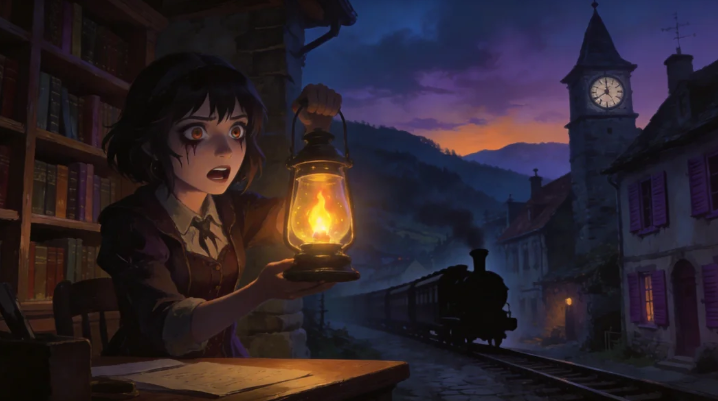
Elsa Brontë had catalogued every book in Dusk Hollow’s one-room library except the slim black volume that arrived without a card. It appeared on the returns desk at 6:13 p.m., the exact minute the autumn sun slipped behind the pines and the streetlamps sputtered like dying stars. The cover was soft as skin and warm to the touch; when she opened it, a single drop of oil fell onto her wrist and vanished, leaving the scent of iron and lilacs.
Inside were no printed pages—only a hollowed cavity containing an old railway lantern. Its glass was smoked the color of dried blood, yet a steady flame danced inside, casting no shadow. Elsa’s reflection in the glass wore a smile she had never given, and the eyes in the reflection were centuries older than her own.
That night the power failed, as it always did during the Week of Darkening. Elsa locked the library and walked the empty high street, lantern in hand. The flame brightened with each step, revealing cobblestones slick like tongues. At the bridge over the frozen stream she met Mr. Vale, the ticket-master who hadn’t sold a ticket since 1987. He doffed his cap, revealing hair as white as moth wings. “You carry Adrien’s lantern,” he whispered. “Return it before he remembers the taste of you.”
Before she could ask who Adrien was, Vale stepped backward into the fog and dissolved, the sound of his boots continuing several seconds after the rest of him had gone. The lantern pulsed, projecting onto the mist a moving image: a young man in a velvet coat standing in this same spot two centuries earlier, clutching the same lantern while a mob advanced with torches. His lips formed the word “Mercy,” but the mob answered with fire. The vision ended when the flames reached the glass, and Elsa felt the lantern grow heavier, as though drinking the scene.
She ran home to her attic flat and wrapped the lantern in blackout curtains, yet the flame seeped through fabric, painting constellations on the slanted ceiling. At dawn—though dawn seemed only a rumor—she uncovered the black book again. Now its pages bore handwritten text that had not been there hours before: I was not born monster; I chose the night to survive the grief of daylight. Each sentence appeared while she read, inked by an unseen quill. The signature at the bottom read Adrien Vallon, 1798.
Elsa’s historian instincts awakened. She microfilmed the local archives and found a warrant for Adrien Vallon’s arrest on charges of “unnatural longevity.” Witnesses claimed he had attended every funeral in the valley for two hundred years unchanged, always carrying a lantern to “guide the newly dead,” though no corpse had ever stayed buried when he passed. The last entry was a note scrawled by a monk: He stores his mortality in the light; break the glass and he becomes what he pretends to be—mortal, vulnerable, mine to forgive.
That evening she returned to the bridge. Frost flowers bloomed on the rails; the air tasted of pennies. She held the lantern at arm’s length and addressed the fog: “Adrien, I offer you what the mob withheld—witness, not judgment.” The flame flattened into a narrow corridor of light, and from it stepped the man she had seen in the vision, no longer youthful but not old—ageless in the way statues are ageless until they crack.
His eyes reflected the lantern, twin flames swimming in dark water. “You read my confession,” he said, voice soft as the page turning. “Yet reading is not absolution.” He reached out; his fingertips stopped an inch from her pulse, as though an invisible pane separated predator from prey. “Break the glass, librarian, and I will taste mortality again. But the price is your memory of daylight. The lantern burns what the holder cherishes most.”
Elsa hesitated. She pictured her mother’s sunlit kitchen, the smell of cinnamon rising through dust motes, the last place she had felt safe before the car accident that orphaned her at sixteen. To lose that would be to lose her mother twice. Yet around them the valley was already forgetting: houses flickered like faulty film, their colors draining into the lantern. If Adrien reclaimed his mortality, the stolen light would return to its sources; if he did not, Dusk Hollow would fade into perpetual eclipse, its people becoming silhouettes the vampire wore like a coat.
She raised the lantern above her head. “Then let us both be reborn,” she said, and hurled it against the stone parapet. The glass shattered without sound, releasing a cyclone of memories—her mother’s laughter mingled with Adrien’s first sunrise in 1623, the heat of both scorching the frost from the bridge. Adrien screamed, but it was a human scream, raw and astonished, as centuries collapsed into a single heartbeat.
When the whirlwind stilled, dawn—real dawn—crept over the pines, tentative as a child’s first step. Adrien lay curled on the cobblestones, hair now streaked with gray, cheeks hollowed by time reclaimed. He wept, not from pain but from the novelty of cold air in aging lungs. Elsa knelt beside him, her own tears blurring a sunrise she had almost traded away. The memory of her mother remained; the lantern had taken instead her fear of the dark, leaving space for a new story.
Mr. Vale reappeared at the end of the bridge, solid now, ticket-punch in hand. “First train in thirty-seven years leaves at noon,” he announced, tearing a ticket in half and handing the stub to Adrien. “One-way only.” Adrien climbed to his feet, joints creaking like library stairs. He looked at Elsa, eyes no longer mirrors but windows. “Thank you for the daylight,” he said. “Guard it better than I did.”
He boarded the dawn-bound train that had no schedule, and when it rounded the bend the tracks rusted into honeysuckle vines behind it. Dusk Hollow forgot the name Adrien, but kept the sunrise. Elsa returned to the library and shelved the black book between Poetry and Repair. Its pages were blank again, save for one line written in her own hand: Light borrowed must be returned with interest—pay in courage, collect in morning.
Years later, travelers passing through the valley at dusk sometimes see a woman on the bridge holding an unlit lantern. She offers no directions, but if you greet her she smiles the sunrise she once nearly lost, and for the briefest moment your shadow will walk ahead of you, unafraid of the dark.