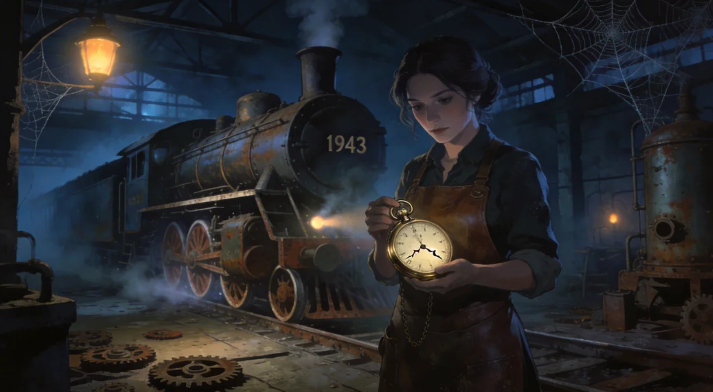
The last train left Greystone Station on 3 September 1943. The next morning the ticket hall was empty, the coal heaps untouched, and the big clock forever frozen at 23:47. Townsfolk said the war had rerouted the lines; others whispered the station had simply “forgotten how to be alive.” Whatever the truth, the iron gates were chained for seventy-nine years—until the night Elara Voss received the letter.
Elara, thirty-two, lived above her tiny repair shop two valleys away. She spoke more to torque wrenches than to people, and the steady heartbeat of a well-made machine comforted her more than any human pulse. The envelope that slid under her door was yellowed, the ink faded, yet her name was written in perfect copperplate: Miss E. Voss, Clockwork Mechanic. Urgent: Steam-heart requires restoration. Come alone. Payment in advance. Inside lay a brass pocket-watch that ticked—impossibly—backward.
Curiosity overrode caution. At twilight she followed the cracked map enclosed with the watch, motorbike headlight carving through pine fog until the abandoned station loomed like a rusted ribcage. The chains on the gate snapped open at her touch, as though the metal itself expected her. Elara stepped onto the platform, tool-bag slung across her back, and the big clock above the doors shuddered into motion, hands spinning counter-clockwise until they settled once more on 23:47.
Inside the echoing hall she found the “steam-heart” the note mentioned: Locomotive 13, an art-deco colossus of riveted steel and obsidian glass, crouched on Track 3. Its headlamp flickered on as she approached, bathing her in a cold halo. The cab door stood ajar; inside, the engineer’s seat was dustless, and the pressure gauge read zero—yet she heard the slow, deliberate breathing of pistons.
Elara’s fingers moved by instinct. She opened the firebox: cold, but lined with fresh coal that gleamed like onyx. She checked the boiler: no cracks, no rust, only a single rivet missing from the crown plate. That missing rivet was odd—perfectly circular, as though it had never been punched in. She placed her palm against the iron skin and felt a tremor, not of machinery but of something like grief.
Then the pocket-watch in her coat grew warm. Its reverse ticking grew louder, synchronizing with the station clock until both beat like twin hearts. A gust of wind slammed the cab door. The windows fogged, and in the condensation a single word appeared: HELP.
Elara’s rational mind fought her rising fear. Machines do not plead; they obey. Yet she remembered her grandfather’s stories: “Every engine remembers its last journey. If the journey ends wrong, the memory haunts the metal.” She pulled her schematics tablet from her bag, but the screen glitched, showing only the date 03-09-1943 and a passenger manifest of one name—Conductor Otto Klein.
Determined to finish the repair and leave, she climbed down to the running gear. The missing rivet hole aligned with a hairline crack seeping a thin, black oil that smelled of coal smoke and lilies—funeral lilies. She inserted a new rivet, hammered it home, and the locomotive exhaled a sigh that rattled her teeth. Headlamp blazing, it lurched forward half a meter, pistons awakening like waking beasts.
Elara jumped back onto the platform. Track 3 now stretched into darkness that had not been there moments before, rails polished to a mirror shine. The station loudspeaker crackled: “Final call for the 23:47 to Elsewhere. All aboard who mend what time has broken.” The voice was hers—recorded, warped, reversed.
She tried to run, but the platform elongated with each step, tiles becoming gear teeth that ground beneath her boots. The only exit was the cab she had just sealed. Heart hammering, she re-entered Locomotive 13. The throttle moved of its own accord, notch by notch, and the engine rolled onto the phantom track, whistle screaming a chord that tasted of rust and regret.
Through the windscreen Elara saw the world outside unwind: bombed-out factories rebuilt themselves, then crumbled anew; meadows bloomed and withered in seconds; people aged backward into children, into dust, into nothing. Time itself was being rewound, and she was the mechanic oiling its gears.
At the peak of speed the cab door behind her opened. A figure stepped through—Conductor Otto Klein, translucent as steam, his uniform immaculate save for a single missing brass button. His eyes were hollow clocks. He spoke without sound, yet Elara understood: on the night of 3 September 1943, Locomotive 13 had carried one final refugee—his daughter, hidden in the coal tender. Enemy aircraft strafed the line; the boiler burst; the child vanished between seconds. Otto’s guilt had held the train in a loop, waiting for someone who could “mend the rivet of time.”
Elara realized the black oil she had sealed was not oil but condensed sorrow. The new rivet she had hammered was strong, but it sealed the memory, not the wound. To free the locomotive she must undo her own repair. She grabbed her drill, reversed the motor, and bored the rivet out. Hot sorrow sprayed, filling the cab with the scent of lilies. The train shrieked, brakes locking in a shower of sparks.
Darkness collapsed into light. Elara found herself standing on the platform at 23:47, but the station was alive: lights warm, benches polished, passengers in 1940s dress boarding calmly. Among them a small girl in a blue coat clutched a brass button, waving to the solid, smiling conductor. Otto tipped his cap toward Elara, mouthed thank you, and boarded. Locomotive 13 whistled once—no longer mournful—and steamed away, fading into the night like an old song ending on the right chord.
The big clock above the doors ticked forward to 23:48, then 23:49, and kept going. The station exhaled seventy-nine years of dust and became an ordinary ruin again. In Elara’s pocket the brass watch had stopped, its hands fused at the moment of departure. She walked back to her motorbike, tool-bag lighter by one rivet but heavier with the knowledge that some machines remember, and some mechanics are remembered.
At sunrise she opened her shop and hung a new sign above the bench: Elara Voss—Mechanic of Lost Time. All repairs guaranteed, especially those that let the past depart on schedule. Outside, the morning trains on the distant ridge ran smooth and on time, their whistles sounding almost grateful.