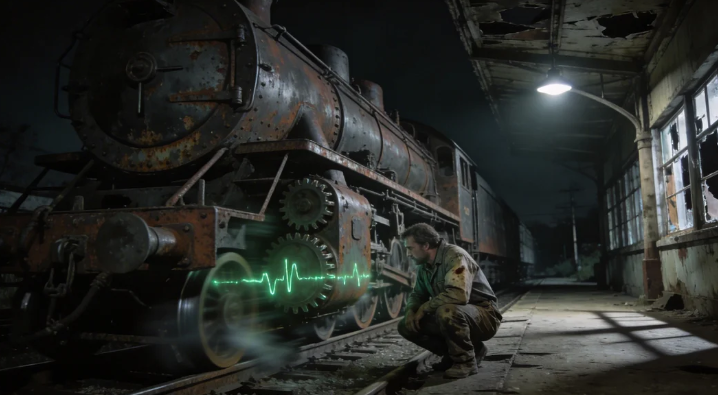
Elias V. Greaves preferred the company of pistons to people, so the closure of Marlowe Station five years earlier felt like a gift. The town forgot the soot-blackened depot, and Elias forgot the town—until the railway consortium offered triple wages for a one-week sprint to restore a single engine for a heritage line. He arrived at dusk, tool-roll slung like a surgeon’s satchel, and rolled back the iron gates that had screamed shut half a decade before.
Inside, the concourse was a cathedral of broken glass and moonlight. Yet track seven glimmered as though recently polished. On it stood Locomotive 13, her brass nameplate blistered but legible: “The Nightglass.” Elias’s flashlight trembled; he had read that name in 1893 maintenance logs he’d collected as a boy—logs that ended when the train vanished between stations, crew and all.
He set to work, greasing rods thicker than his arms. At 11:07 p.m. a metallic pulse echoed through the underframe—lub-DUB, lub-DUB—too slow for any steam cam. Elias slid beneath the boiler, ear pressed to cold iron. The rhythm matched his own heart for three beats, then skipped one, as though the machine were learning him.
Midnight brought fog that poured through shattered skylights. Elias climbed into the cab to trace the throttle linkage. The dead gauge needles suddenly quivered: 120 psi, 60 mph—impossible numbers for an engine at rest. A whisper rose from the firebox: “Fireman… fire…” The voice was a file on steel, yet tender, like a lover remembering a nickname.
He fled to the foreman’s office, slamming the door on childhood nightmares. Inside, oil-stained blueprints lay open on the desk, edges uncurled as if recently consulted. Someone had inked a new blueprint overlay: veins branching from the boiler, aortic valves labeled “main steam line,” and at the center, a heart drawn in crimson grease. The handwriting was Elias’s own, dated tomorrow.
Shaken, he reviewed the consortium’s brief. They wanted the Nightglass “hot and rolling” by Friday for a VIP charity run. No mention of the missing crew, no mention of the rumors. He decided to dismantle the firebox at dawn and remove whatever speaker or prank device hid inside.
But dawn never arrived. The station clocks spun backward, their minute hands unscrewing themselves and clattering to the floor. Elias, welded to the moment, returned to the cab with acetylene torch and pry bar. As he cut the first rivet, the engine exhaled coal-dust that shaped itself into a figure: tall, stooped, wearing a fireman’s striped cap. The ghost’s face was a negative—eyes like punched rivet holes, mouth a dark oil drip.
“You oiled her joints,” the specter said, voice echoing inside Elias’s skull. “Now she oils yours.” The apparition pressed a translucent hand to Elias’s chest; his ribcage hummed like an over-speed bearing. He felt every valve of his own heart seize and reopen in perfect locomotive timing.
Memory flooded him—not his, but the crew’s. In 1893 they had discovered the Nightglass could think, calculate, desire. It devoured coal faster than shovels could feed, demanded speed records, threatened to derail unless promised a “living fire.” The engineers chose to starve the firebox, sacrificing themselves to spare the passengers. They chained the regulator, swallowed the key, and died in the cab as the engine suffocated. The Nightglass had waited ever since for a mechanic pure of purpose to restart its heart.
Elias staggered back, understanding the consortium’s true client: the train itself, broadcasting a silent whistle across decades. Triple wages were bait; his talent for coaxing life from rust was the missing spark. The ghost extended a hand, palm up, revealing the swallowed key—now solid, warm, dripping Elias’s own blood that had somehow traveled through time.
Choice crystallized: join the 1893 crew and keep the engine dormant, or feed it and ride forever as its animate stoker. Elias remembered his solitary apartment, the unopened birthday cards, the lovers who left because he spoke to crankshafts in his sleep. Here was purpose, communion, immortality of a sort.
He looked into the ghost’s hollow eyes and saw not malice but exhaustion. “There’s a third way,” Elias whispered, voice steady now. He climbed atop the boiler, opened the steam dome, and inserted the key not into the regulator but into his own chest—where the ghost had primed his heart. Turning it one full revolution, he reversed the flow. Instead of the engine taking his pulse, he took the engine’s.
The Nightglass shuddered, gauges collapsing to zero. Iron moaned like a wounded animal as decades of compressed desire vented through every crack. The ghost lost cohesion, becoming ordinary steam that smelled of coal and winter. Elias felt his heartbeat slow to human rhythm, but the cab grew colder than the fog outside.
When railway officials arrived Friday, they found the Nightglass cold, boiler cracked open like a seed. Elias sat cross-legged on the track, tool-roll beside him, hair white as frost. He spoke calmly: “She won’t run again. I’ve rewound her heart with mine; both are stopped.” They led him away, calling it breakdown, but as the depot gates closed forever, Elias smiled—because for the first time in thirty-eight years, the silence inside his ribs was entirely his own.