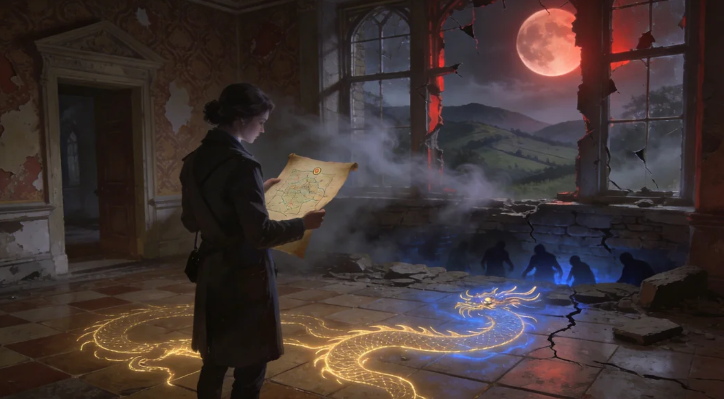
Rowan H. Everly had never believed in anything she could not measure with a steel ruler. So when the letter arrived announcing that Great-Uncle Silas—an eccentric she barely remembered—had left her Greyroot Manor, she laughed. The envelope smelled of camphor and contained a single brass key so cold it stung her palm. Still, the deed was legal, and the ruin might become the eco-retreat that would rescue her failing firm. She drove north on the last day of October, GPS faltering as lanes narrowed into tunnels of yew.
The house loomed at dusk, chimneys crooked like broken fingers. Ivy strangled the stone; every window seemed to squint. Inside, dust floated in perfect spirals, as though the air itself practiced calligraphy. Rowan set her laser measure on the flagstones, but the device blinked erratically, numbers skipping like a frightened heart. She blamed damp batteries and went to bed in the only furnished room, a tower chamber whose curved wall followed the hill’s contour.
At 3:07 a.m. she woke to the sound of someone pacing the corridor. Footsteps matched her own heartbeat, yet when she flung the door open, only moonlight spilled across the boards. The next morning she found footprints in the dust—bare, narrow, pointing inward but never outward. She followed them to the library where shelves sagged under scrolls instead of books. One scroll had unfurled itself on the oak table: a faded map of Greyroot overlaid with red arrows that curved like dragon veins. A caption in brush-stroke English read: “Qi swims beneath; disturb not the pearl.”
Rowan’s rational mind labeled it theatrical nonsense, yet her skin prickled. She took photographs, emailed them to a colleague who specialized in heritage conservation. The reply came fast: “Get out. That symbol is the Luoshu Square—used only in burial feng-shui to trap spirits. Someone buried something powerful under your house.” Rowan scoffed, but that night every door she closed reopened, hinges sighing like tired lungs.
Desperate for sleep, she drove to the village of Wren’s Hollow. The locals avoided her eyes until Mrs. Pei, the elderly herbalist, touched the key in Rowan’s pocket and whispered, “Silas was the last gatekeeper. The vein runs dragon-belly to dragon-eye; if the eye opens, the belly drinks.” She sold Rowan a cracked jade compass, warning her to follow the needle’s true song, not north.
Back at the manor Rowan switched off every gadget. The jade compass spun wildly, then stilled, pointing to the hearth in the great hall. She pried up the stones and found a iron ring. When she lifted it, a breath of wind rose from the shaft below, carrying the scent of chrysanthemums and rust. A ladder led into darkness.
Descending, she entered a circular chamber whose walls were carved with the sixty-four hexagrams. At the center stood a miniature pagoda made of black bamboo, sealed with red wax stamped by a single Chinese character: “sleep.” Around it, eight mirrors faced inward, their backs painted with mercury. One mirror was cracked, its mercury flaking like dead skin. Through the fracture she glimpsed movement—something coiling, waiting.
Rowan remembered the feng-shui rule: mirrors route qi; break the route, and qi escapes. She realized Silas had engineered this cage to keep the dragon vein dormant. The cracked mirror was failing; the footsteps she heard were qi echoing her own vitality, searching for an exit. If the vein fully awakened on the lunar eclipse, the house would become a feeding mouth, draining every living spark nearby.
She climbed out, fetched contractor’s epoxy, and sealed the fracture, but the moment the resin touched mercury, the temperature plummeted. Frost ferned across the mirrors; the pagoda rattled. A voice—not heard but remembered—whispered inside her skull: “Replace the pearl, or become the pearl.” Rowan understood: the jade compass was the missing heart, the “pearl” that anchored the dragon.
Yet placing the compass on the pagoda meant surrendering her rational identity, accepting a world where architecture breathed and earth had memory. She hesitated, hearing her mother’s scoff at superstition, her professors’ lectures on load-bearing facts. Then the lights of her phone flickered, showing battery at one percent though she had charged it in the car. The house was already sipping her.
Rowan descended again, this time carrying no technology, only respect. She knelt, set the jade compass onto the bamboo roof. It fit as if carved for that hollow. The mirrors brightened, reflecting not her face but landscapes she had never seen: terraced tea mountains, moonlit rivers, villages whose roofs curved like praying hands. Wind rose again, now warm, carrying the sound of distant bells. The footsteps in the corridor ceased; instead she heard a single heartbeat—huge, ancient, content.
When she climbed back into the hall, dawn bled through the windows, but the glass now showed the garden blooming out of season—peach blossoms heavy with snow-white petals. Rowan felt no fear, only stewardship. She drafted new plans: Greyroot would become a sanctuary where guests learned to listen to soil, to orient beds along meridians of calm. The dragon slept beneath, fed by stories rather than souls.
Years later, architects would praise her innovative “biophilic” designs, never guessing that every curve obeyed an older map. Rowan never corrected them; she simply smiled, remembering the moment she chose mystery over measurement, and the house, satisfied, whispered back: “Well done, gatekeeper.”