Mara Vale first saw the wolf on the widow’s walk of the cottage, its silhouette cut from the rising full moon like a black paper doll. She told herself it was only a coyote, larger than the ones she had known in Boston, but the eyes—liquid mercury—followed her every step as she unpacked the last of her grandmother’s journals. The pages smelled of lavender and something older, iron-rich, as though the ink itself had once been alive.
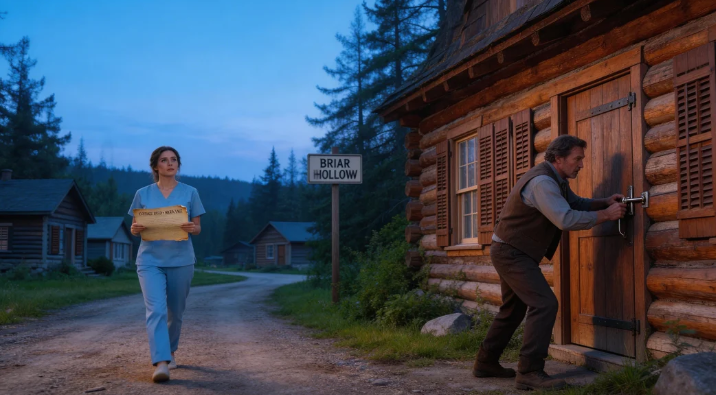
Briar Hollow greeted newcomers with cordial nods and closed curtains. At the diner, coffee arrived thick as river silt, and no one sat within two tables of Mara. When she asked about the howls that ribboned the night air, the waitress whispered, “Wind in the gorge, hon. Nothing more.” Yet every porch bore a wreath of wolfsbane, and every threshold was painted with a slash of scarlet ochre.
On the third night, curiosity outshone caution. Mara followed the sound of padded footfalls past the abandoned church and into Briar Hollow’s forgotten cemetery. Headstones leaned like tired soldiers; moss erased surnames. At the center stood a marble mausoleum sealed by a rusted gate. A single paw print, broad as a man’s palm, pressed into the wet earth leading inside. The moon hovered, bloated and red as a wound.
She pried the gate open with a fallen branch. Cold exhaled from the tomb, carrying the same metallic sweetness of the journals. Inside, candles flickered though no hand had lit them. On a stone bier lay a necklace of silver links and onyx—her grandmother’s, Mara realized, recognizing the broken clasp from childhood photos. As she reached for it, a growl vibrated through the walls, too deep to belong to anything mortal.
The wolf filled the doorway, fur shimmering like moonlit water. But the shoulders… the curve of the spine… were wrong. It stood upright, half-man, half-beast, claws clicking on marble. Mara’s breath clouded the air; her heartbeat sounded louder than the creature’s rumble. Instead of attacking, it tilted its head, eyes reflecting not hunger but recognition. A low whine escaped its throat, almost mournful.
“You knew her,” Mara whispered, clutching the necklace. The beast flinched at the silver, yet did not retreat. In that moment she understood the villagers’ fear, the painted doors, the wolfsbane—they weren’t keeping the creature out; they were keeping something else from coming in. She stepped aside, and the wolf padded past her to the bier. With surprising gentleness it nosed the stone lid aside, revealing a hollow space lined with faded blankets: a cradle, not a coffin.
Images flooded her—memories that were not hers. A woman with Mara’s dark curls cradling a swaddled infant beneath the crimson moon. The same woman years later, silver blade in hand, standing between the village and the forest, chanting in a language of growls and sorrow. The beast beside Mara lowered its head, and she saw the scar that ran from brow to muzzle, mirror to the faint line across her own shoulder she had never understood.
Grandmother’s final journal entry scratched itself across her mind: “The curse passes daughter to daughter, but love can choose the shape of the moon. When the red tide rises, blood or bond must seal the circle.” Mara felt the necklace pulse, warm as living skin. Outside, church bells tolled midnight though Briar Hollow had no working bell tower; the sound came from the sky itself, lunar vibrations calling the change.
Her bones answered. Pain blossomed—sweet, electric—rearranging marrow. She dropped to all fours, fingers lengthening, nails curving. Vision sharpened: every crack in the stone, every moth wing. Yet her mind remained fiercely human, tethered by the silver chain she clasped between teeth. The beast—her grandmother’s other self, or perhaps the first self—nuzzled her, sharing breath that tasted of pine and old songs.
Together they loped from the mausoleum, up the hill toward the village. Doors flew open; rifles lifted, then lowered when the villagers saw Mara’s eyes—human stars within lupine galaxies. She stood at the border between forest and fence, howled once, a sound that carried every lullaby her grandmother had hummed. The red moon slid west, paling to pearl. Fur receded like a tide; she stood barefoot in dew-drenched grass, necklace glowing against her collarbones.
At dawn, Briar Hollow found its wolfsbane wreaths braided with fresh wildflowers. The ochre marks on thresholds were painted over with sunrise hues. Mara hung a shingle: “Nurse Practitioner—Open at Moonset.” On nights when the moon blushed crimson, two shapes ran the ridge—one silver, one dark—guarding the hollow they had once been sworn to fear. And if travelers asked about the howls, the diner waitress now smiled over strong coffee and said, “Just the wind in the gorge… and the guardians who answer it.”