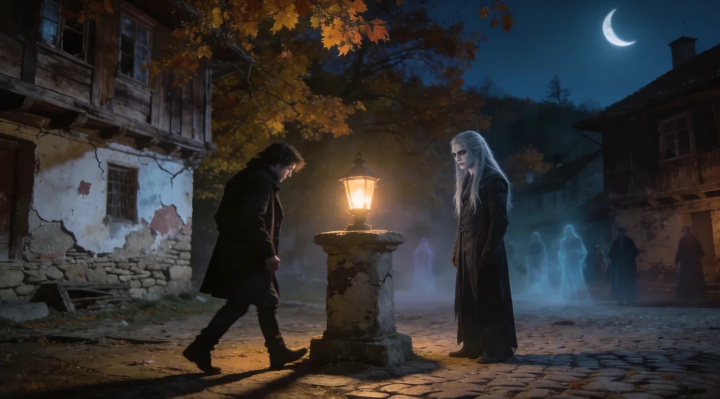
The train hissed to a halt at a station whose name had rusted away. Julian Cross, a young archivist from London, stepped onto the cracked platform clutching a leather satchel and a letter dated 1742. The letter—addressed to his ancestor—spoke of "a debt of blood unpaid" and bore the wax seal of Aurelia. Julian had traced the village to this valley, but found only fog, moonlight, and a footpath that appeared when the last passenger left.
The path led downhill between dead oaks whose branches clawed at the sky. Each tree was wrapped in iron wire, as if to keep something inside. Julian’s flashlight flickered, then died. Ahead, a lantern flickered to life on its own, suspended in mid-air above a stone well. The flame inside it was cold; it cast no warmth, yet his breath frosted. Drawn by an instinct older than curiosity, he reached out. The lantern did not burn—it drank, sipping the heat from his palm until his skin blanched. A voice, velvet and hollow, spoke without sound: "Welcome, debtor."
From the well emerged a woman in a gown the color of dried roses. Her eyes were black where white should be, and when she smiled the moon seemed to bleed. "I am Lysandra," she said, "steward of promises." She touched the lantern; the iron wires on the trees shivered like violin strings. Julian tried to step back, but the path had vanished; fog walled him in. Lysandra explained: in 1742 his ancestor, Captain Cross, had begged her to spare his plague-stricken regiment. She granted one night of her protection, but the price was a future heir delivered to her lantern on All Hallows’ Eve—an heir to renew her bond with the living world. Every hundred years the lantern chooses the descendant who most resembles the original face. Julian’s reflection now rippled across the glass, wearing a tricorne he had never owned.
He argued, claiming free will. Lysandra listened, head tilted like a raven studying a coin. Then she offered a game: if he could find a single soul in Aurelia who freely gave him refuge until dawn, the contract would break. If not, he would take the captain’s place and keep her lantern fed for another century. Julian accepted, believing no village could be completely empty.
Aurelia’s cobblestones were slick with mist. Houses stood roofless, their interiors filled with autumn leaves yet no wind stirred them. Churches lay open, bells frozen mid-chime. Julian called out until his throat cracked. No dogs barked; no babies cried. He began to understand: the village itself was undead, preserved by Lysandra as a stage for her bargain. The only heartbeat he detected was his own, loud as a drum in a crypt.
At the eastern edge he found a small cottage whose window glowed amber. Inside, an old man tended a hearth that gave real heat. His name was Emil, the last beekeeper of Aurelia. Emil’s shadow moved independently, busy as the bees embroidered on his scarf. He spoke quickly, as though time were leaking away: "She lets me stay because I remember the taste of honey. Memories are spices to her kind." Julian pleaded for shelter. Emil’s eyes brimmed with pity, but he refused: "If I help you, she will turn my memories to vinegar. Better a bittersweet eternity than none." He pressed a jar of honey into Julian’s hand and closed the door. The cottage light died like a snuffed candle.
Hours slipped away. The lantern followed Julian at a distance, floating always ten paces behind. Each time he glanced at it, scenes from the past flickered inside: Captain Cross kneeling, soldiers feasting on unseen meat, Lysandra drinking their gratitude. The visions left Julian dizzy, his pulse slower, as if the lantern were sampling him drop by drop.
Near the well again, he noticed carvings on the stones—names of every heir who had failed. Some had scratched last words: "She was kinder than hunger." Others merely drew bees. Julian realized the contract was not cruelty but loneliness; Lysandra collected shadows to keep the night from swallowing her too. He felt an unexpected sympathy, the way a candle sympathizes with the dark that defines it.
Dawn was still far, yet the eastern horizon remained sealed. Time in Aurelia answered only to the lantern. Julian unscrewed Emil’s honey and tasted it—sunlight on his tongue. An idea sparked: if memories fed her, perhaps one freely offered could satiate without bondage. He walked to the well and called Lysandra. She rose, sorrow etched in the tilt of her shoulders. Julian asked her to drink not his blood but his recollection of this night—every fear, every pity—leaving him empty yet unchained. In exchange he would carry the lantern beyond the valley, letting her see the world through his mortal eyes until natural death claimed him. A human lifespan of wonder, willingly shared.
Lysandra hesitated. The lantern flared, testing the sincerity of his offer. Julian felt years peeling away like pages, yet he stood firm. At last she touched the glass; it cracked, bleeding light. The fog recoiled, revealing a ridge where the real sky blushed with approaching dawn. "A new taste," she whispered, "hope with an aftertaste of mortality." She dissolved into the lantern, her gown becoming rose-colored flame. The iron wires fell from the oaks; buds swelled on branches. Aurelia began to breathe.
Julian lifted the lantern. It was warm now, its weight that of a sleeping child. Behind him, Emil’s cottage door creaked open; the old man stepped out, shadow finally still. They nodded once—gratitude too large for words. Julian walked west, the lantern swinging at his side. Where its light touched the ground, wildflowers sprouted, blooming and withering in seconds, as though time itself were catching up. He did not look back; he carried a village and a vampire toward the ordinary miracle of sunrise, uncertain which of them had been truly saved.
Some say if you follow the old railway past the erased station you can still see that lantern moving across the hills, never stopping, never fading. Travelers report dreams of a woman in a rose gown who whispers, "Tell me what morning feels like." And though Julian Cross never returned to London, his satchel was found on a park bench, containing a single jar of honey and a note: "Memory is sweeter when it ends." The archivists catalog it under "Unfinished Journeys," unaware that the story itself walks on, keeping the dark both company and distance—one mortal heartbeat at a time.