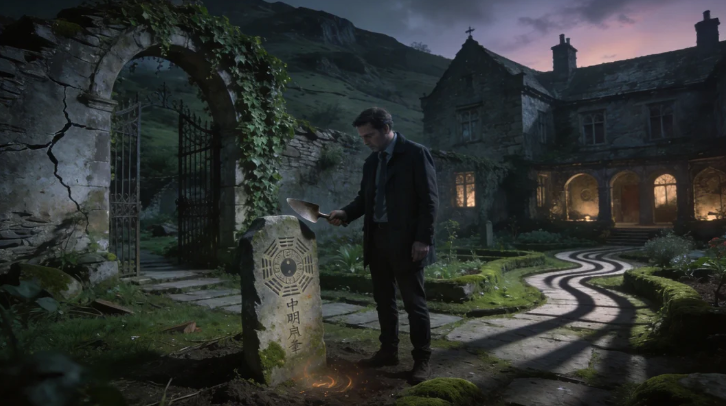
Elena V. Haworth had built glass towers that kissed the clouds, yet nothing prepared her for Bryn Myrddin, the stone-and-slate mansion her great-uncle bequeathed to her in his spidery will. The locals in the valley village of Llynog refused to speak of the place except in murmurs about “the sleeping dragon beneath the floorboards.” They crossed themselves when the wind rattled the slate roofs at dusk, and every child knew the rhyme: “When the compass spins, the jade begins to sing.”
On her first night, Elena set her digital theodolite on the cracked terrace and watched the needle jerk like a trapped moth. She laughed—electromagnetic anomaly, she told herself—until the needle froze, pointing not to magnetic north but to a gnarled yew that grew exactly where a cornerstone should have been. The yew’s trunk was split, revealing a smooth green stone the size of a heart. It was jade, cool even in the firelight, etched with the characters for “gate” and “pulse.”
That night she dreamed of a courtyard in Suzhou where an old man in indigo robes placed a lacquered compass on a silk map. He spoke in measured Cantonese: “Qi is a river; dam it and it remembers.” The dream ended with the compass cracking, jade dust spilling like luminous sand. She woke to the smell of rain on hot slate and found real jade grit on her pillow.
The house itself was a labyrinth of right angles that felt wrong. Corridors kinked abruptly; windows framed only sky or earth, never both. In the library she uncovered a scroll sealed in wax: a feng-shui audit dated 1911, signed by “Li Wen-Ming, Apprentice of the Green Satchel.” The scroll warned that the manor sat on a “knotted dragon vein” and that the jade talisman must never be moved lest the vein thrash awake. A later pencil note, scrawled by her great-uncle, read: “I tried to straighten the house. Forgive me.”
Each adjustment she made—nudging a mirror, shifting a bed—provoked counter-moves. A door she had barred stood open at dawn; wallpaper she stripped revealed older paper underneath painted with coiling azure dragons whose eyes followed her. The yew began to bleed sap the color of jade, and the compass needle spun faster, humming like a bee.
Desperate, Elena invited local dowser Mrs. Pritchard, who walked the halls with a forked hazel rod. At the yew the rod twisted so violently it splintered. “The dragon’s turning,” Mrs. Pritchard whispered. “It wants its spine straight.” She spoke of “sha qi,” killing breath, pooling in the unnatural corners of the house. The only remedy was to restore the original flow—replace every moved stone, every tilted beam.
Over the next weeks Elena became both architect and acolyte. She read Li Wen-Ming’s annotations until she could feel the pulse in the flagstones. She rehung mirrors to invite auspicious stars, unblocked vents to let the breeze carry wealth, and—hardest of all—pried up the Victorian parquet her uncle had laid, revealing the Ming mosaic of green jade tiles beneath. Each tile clicked home like a vertebra sliding into place.
On the night of the spring equinox, she stood barefoot on the jade floor as dusk bled into the valley. The compass needle slowed, trembled, and settled true. Wind rushed through the house, but instead of howling it sang—a low, clear note that rattled every pane until they rang like bells. The yew split entirely, yet the halves did not fall; they arched away like gates. Between them lay a stair of roots descending into darkness lit by a faint emerald glow.
Elena descended. The air smelled of pine and petrichor. At the bottom she found not a dragon of scale and claw but a river of jade light flowing through a cavern. In its surface she saw reflections: the Suzhou courtyard, her great-uncle’s frightened eyes, her own blueprints superimposed on mountains. She understood then that the dragon was the land’s memory, and feng-shui was merely the grammar with which humans apologized for building upon it.
She pressed her palm to the river. The light surged up the stair, through the yew, into the house. Every crooked corridor straightened like a stretched spine; windows suddenly framed both sky and earth. The jade tiles warmed beneath her feet, and the compass dissolved into motes that settled on her skin like freckles of light.
When she emerged, dawn was seeping over the hills. The manor stood serene, its angles now gentle, its doors aligned with the rising sun. The yew had become two living pillars, a doorway open to the wind. Elena felt the valley breathe through the house and the house breathe through her. She no longer called herself merely architect; she was the steward of a conversation between stone and sky.
Years later, travelers hiking the Welsh ridges speak of a house whose windows flash green at sunset, and of a woman who greets them with tea brewed from pine needles, who can point to any hill and tell you where the dragon sleeps. She carries no map, only a small jade compass that never spins—unless the land itself forgets its name. And when that happens, she walks the corridors she once straightened, whispering the old words: “Qi is a river; guide it and it will sing.”