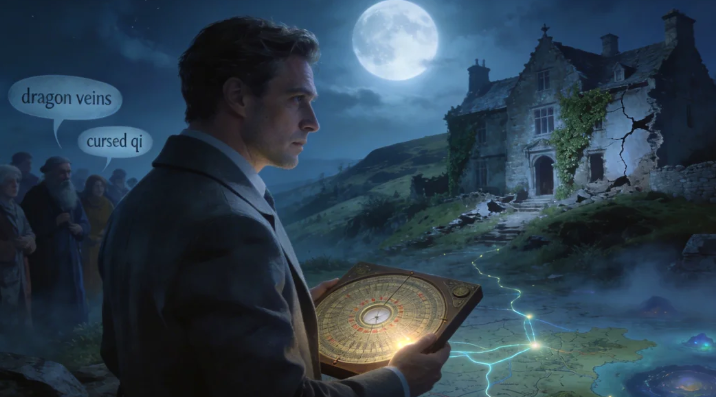
Elena V. Drax—E.V.D. to the drafting tables that feared her deadlines—had built glass towers that clawed the sky, yet she had never believed in anything she could not autoclave. So when the letter arrived announcing her unexpected bequest, Ty Llyn Manor, she drove west with a roll of blueprints and a yawn for superstition.
The house crouched above a mist-ringed lake like a black toad on jade. Local builder Gareth Huws met her with a gift: a Qing-dynasty luopan whose needle trembled even when the wind was still. “The compass chooses the reader,” he warned. Elena tucked it into her satchel the way one pockets a pebble—an afterthought.
That night she mapped the manor’s floor plan. Doors opened south to north in a straight shot: the dreaded “poison arrow” layout said to channel sha qi. She snorted—until every corridor exhaled a cold sigh that flattened the candle flames. Her phone’s GPS spun like a roulette wheel; the luopan needle mirrored it, ticking toward the cellar.
Curiosity is the first doorway. Elena lifted the iron ring. Stone steps spiraled into dark that smelled of iron and pine. At the bottom, five boulders formed a crude ring—an earth altar. The luopan needle froze, pointing to a gap where a sixth stone was missing. She felt the air thin, as though the room inhaled without exhaling.
Back in the library she found a brittle journal of the last owner, Madoc Llyn, amateur geomancer. “To dam the dragon is to be damned by it,” he wrote. “The sixth sentinel must be returned before the moon wanes, or the vein will invert.” Pages bore water stains shaped like claw prints.
Elena’s rational skin prickled, yet the architect in her sensed structure even in madness. She scanned Ordnance Survey maps, overlaying topographic lines until she spotted a quarry pond shaped like a broken taijitu. At dawn she hiked there, luopan in hand. The needle quivered over a slab of slate half-submerged, its grain swirling like a sleeping dragon’s eye.
Dragging the stone uphill, she felt weight lessen—as if the slope itself exhaled help. But night arrived faster than physics allowed. Fog folded the path; branches clicked like beads on an abacus. Somewhere ahead a child’s voice recited numbers in Cantonese: one, two, three… matching her heartbeat.
She stumbled into the manor courtyard at the stroke of lunar zenith. The five boulders now glowed faintly, lines of qi visible like luminous chalk. Elena wrestled the sixth stone into the gap. The luopan needle snapped, its tip embedding in the slate. Wind reversed; clouds unraveled into a perfect spiral over the roof.
From the well at the center rose a column of translucent air—no, a silhouette of swirling robes. The spirit of the vein bowed, neither male nor female, neither kind nor cruel. “You have mended the seam,” it whispered without sound. “Take this gift: see the bones beneath the skin of cities.”
The manor settled with a sigh of timbers realigning. Elena ran outside; constellations shone in mirror-perfect symmetry. In the morning she found the luopan repaired, its needle now steady gold. When she later drafted her first circular tower—an office block wrapped around a living atrium—elevators curved gently, guiding foot traffic in gentle spirals. Tenants reported calmer breath, fewer sick days. Investors called it innovation; Elena called it apology.
Years later, giving a TED talk on “invisible infrastructure,” she closed with a photograph of Ty Llyn at sunrise. “We build not on land but on living memory,” she said. “Ignore its flow and the building will exact its own rent.” Applause thundered, but her ears still heard distant counting in Cantonese, numbers folding into the steady pulse of a contented dragon asleep beneath the world.