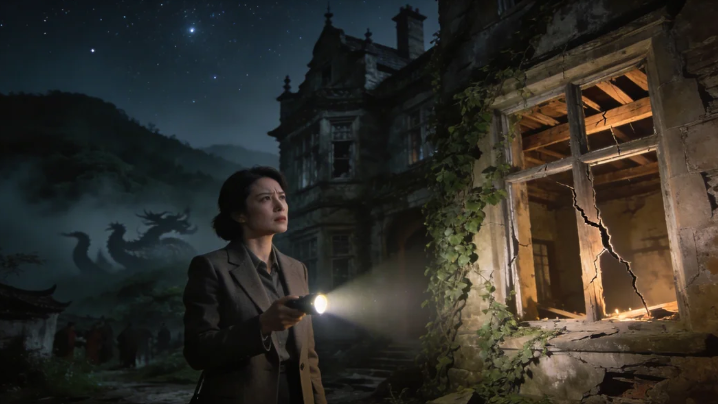
Isla Moreau always trusted straight edges and steel. Blueprints, not superstition, had built her reputation in London, so when the letter arrived announcing her unexpected inheritance—an abandoned manor called Yunwu—she booked the next flight to Guangxi Province simply to sell the relic and fly home. The local taxi driver refused to climb the final switchback, pointing at the fog-crowned ridge. “The dragon’s tail coils there,” he muttered. “Roads are only for the living when the moon is kind.” Isla laughed, paid him, and hiked the remaining kilometres with nothing but a headlamp and sarcasm.
Yunwu loomed like a wound in the bamboo: grey walls cracked by banyan roots, tiled roofs sagging toward earth. Yet the structure felt oddly deliberate, its wings angled to cradle an interior courtyard shaped like the yin-fish of the taijitu. Isla stepped across the threshold and her phone compass spun wildly, then died. She shrugged; electromagnetic anomaly, she told herself, nothing a chartered surveyor couldn’t explain tomorrow.
That night she unrolled her sleeping bag in the main hall. At 2:22 a.m. she woke to the sound of someone pacing the upper gallery—measured footsteps, no creaking boards. She grabbed her flashlight and swept the balustrade. Empty. The air, however, carried the scent of crushed jasmine and copper. Isla’s scientific mind catalogued possibilities: hallucination from jet-lag, mold spores, carbon-monoxide pooling in a sealed room. She opened every shutter to vent the house and noticed, carved above each lintel, a ring of tiny jade disks arranged like compass points. They glowed faintly, as though lit from within.
At dawn the village headman, Mr. Lok, arrived with offerings of pomelos and incense. He bowed politely, then stared at the jade rings. “You must not disturb the Luo-Pan,” he warned. “Your great-grandfather trapped a vein of angry qi here during the war. The disks keep the balance.” Isla thanked him for folklore, then ushered him out so she could photograph cracks for her structural report. When she uploaded the images in town, every file showed the same anomaly: a greenish blur obscuring the eastern wall, as if the camera had captured its own reflection in jade.
Days blurred into nights of pacing echoes. Tools vanished, only to reappear in impossible places—her laser level balanced atop a 300-year-old beam, her tablet propped against a statue of Kuan Yin with screensaver changed to a spinning luopan, the feng-shui compass. Each time, the jasmine-copper smell preceded the discovery. Isla’s skepticism eroded; she began researching feng-shui principles, learning that Yunwu sat precisely where two dragon veins supposedly crossed beneath the ridge. Interrupting such currents, texts claimed, could “awaken the dormant breath of the mountain.”
On the seventh night, a storm pinned clouds against the peaks. Electricity failed, and the jade disks pulsed brighter, projecting shifting shadows that mapped the floor into eight trigrams. Isla, flashlight trembling, followed the moving symbols toward the courtyard. Rainwater there spiralled counter-clockwise, defying gravity, forming a shallow whirlpool that never deepened or spilled. At its centre stood a single jade needle, the missing spindle of the luopan. She understood: the house was not haunted; it was unfinished, its energetic circuit broken, waiting for an heir to choose either completion or escape.
A voice—not heard but remembered—rose from the spiral: her great-grandfather’s apology in accented English, recorded perhaps in qi itself. He confessed that wartime desperation had made him divert the dragon’s path to protect the village from invading troops. The jade rings were anchors; remove them, and the pent breath would surge free, erasing Yunwu and perhaps the valley below. Replace the needle, and the dragon would sleep again, but the caretaker must stay forever to maintain the balance. Two choices, no third.
Isla’s architect brain saw a third option: redesign the flow. If energy behaved like water or wind, it could be channelled, not merely dammed or released. She waded into the spiral, lifted the jade needle, and—instead of inserting it into the missing luopan—drove it into the courtyard’s centre stone at a calculated angle, tilting the axis fifteen degrees. The trigram shadows convulsed, then stretched outward through every corridor like opening wings. Jasmine gave way to petrichor; the copper scent softened into rain on slate. The whirlpool dissolved, leaving only normal puddles.
Silence settled, deeper than before yet somehow breathable. The jade disks dimmed to ordinary stone. Isla felt the house exhale, a long tremor beneath her feet that tasted of gratitude. Outside, moonlight broke through clouds and traced a new ridge-line across the tiles—an altered silhouette that no map recorded. She realised she had sketched a fresh dragon path, one that curved around Yunwu instead of colliding with it. The manor remained, but its doors now opened toward life rather than imprisonment.
Mr. Lok returned at sunrise, eyes wide at the changed atmosphere. “The valley breathes easier,” he whispered. Isla, exhausted, handed him the old luopan frame. “Teach me to read this,” she said, half plea, half promise. She would stay one year, maybe two, documenting the renovation while learning the language of wind, water, and jade. When she finally wired London to dissolve her firm, her partners thought she had gone mad. She smiled, remembering that straight lines are only one kind of truth; sometimes the most durable structures follow curves unseen by blueprints.
Years later, travellers hiking the ridge report glimpses of a woman in work boots and a faded cheongsam, placing jade disks along new trails, tilting them a fraction each season. They say if you ask directions, she answers in crisp British tones, then points to the horizon where mountain meets cloud. “Follow the dragon,” she advises, “but never block its way.” And as visitors descend, the wind carries the faint scent of jasmine and copper—no longer ominous, merely a reminder that every place has a pulse, and respect is the finest architecture of all.