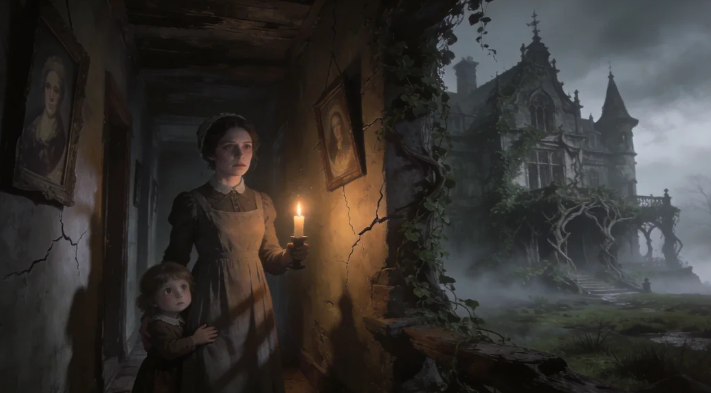
The carriage wheels ceased their clatter at dusk, depositing Elara before iron gates whose spikes resembled the ribs of some half-buried beast. Ravenshollow rose beyond them, its black stone walls sweating moisture the color of rusted tears. A single turret, split by lightning decades earlier, leaned like a broken candle, its summit forever crowned by ravens that never sang.
Inside, the silence was upholstered in velvet. Dust lay thick as fur on the banisters, and portraits followed her with eyes wet with varnish. The housekeeper, Mrs. Thorne, moved without sound, her keys clinking only when Elara’s gaze was turned away, as though the manor itself wished to keep secrets audible only to the blind.
Her pupil, little Cedric Ashcroft, was a pale boy of eight who spoke in questions. "Why does the clock strike thirteen?" "Who breathes behind the attic wall?" His nursery occupied the west wing, where wallpaper patterned with wilted roses peeled like sunburned skin. Each night Elara read him tales of knights until his eyelids fluttered shut; yet when she closed the book, she found fresh candle stubs arranged around his bed in a perfect circle of melted wax, their wicks blackened as if snuffed by unseen lips.
On her third night, Elara followed the scent of extinguished wicks through corridors that narrowed like throats. She discovered a chapel abandoned mid-service: prayer books open, communion goblets overturned, and at the altar a girl’s dress of 1830s lace, laid flat as though the wearer had evaporated. A diary beneath the fabric bore entries that ended mid-sentence: "I will hide inside the walls if—" The ink pooled into a stain shaped like a keyhole.
Days grew shorter; candles grew fewer. Mrs. Thorne rationed them, insisting the chandler had drowned crossing the moor. Yet every dawn Elara found fresh wax beneath Cedric’s bed, the dribbles forming runes she almost recognized from childhood nightmares. She began to suspect the house was cultivating its own night, feeding it tallow and time.
One storm-twisted afternoon, Cedric led her to the leaning turret. Inside, a spiral staircase ascended into darkness so complete it felt liquid. Halfway up, the boy stopped and pressed his ear to the stone. "She’s singing again," he whispered. Elara heard nothing, but her skin prickled as if brushed by the hem of a wedding gown soaked in river water. At the summit lay a circular room lined with mirrors, every glass cracked in identical spider webs. In their center stood a cradle of tarnished silver, rocking of its own accord. Within: not a child, but a candle as thick as a wrist, its flame blue and cold. Reflected in each mirror, the flame multiplied into a constellation of grieving stars.
That night Elara confronted Mrs. Thorne in the kitchen where copper pots hung like decapitated suns. The housekeeper, kneading dough that bled black currants, admitted the truth: the Ashcroft line was cursed to produce only one heir each generation, and when that heir turned nine the house claimed them as wicks to sustain its heart. The blue candle was the distilled soul of every lost child, fed by mirrors that remembered their final breaths. Cedric’s birthday loomed three nights hence.
Refusing fate, Elara plotted escape. She hoarded tallow scraps, molded them into counterfeit candles, and soaked their wicks in salt to purify. On the eve of Cedric’s ninth year, she replaced the blue candle with her forgery while the house slept its uneasy sleep. But Ravenshollow sensed deceit; walls contracted, floorboards yawned. Mirrors shattered outward, each shard a tooth hungry for the dark. Mrs. Thorne appeared, eyes reflecting the blue flame now guttering. "The house keeps what it lights," she intoned, voice layered with children’s choirs.
In the crucible of chaos, Elara seized the true blue candle and fled downward, following the diary’s unfinished map etched in her mind. She descended beneath the chapel, through soil moist as lungs, until she reached a cavern where roots intertwined like infant arteries. There she plunged the candle into a pool of groundwater, steam hissing like lullabies reversed. The flame died, and with it the manor’s pulse.
When she emerged, dawn was breaking, but Ravenshollow had aged a century overnight. Stones crumbled gently, ivy released its grip, and the leaning turret finally toppled without violence, scattering ravens into a sky already forgetting their names. Mrs. Thorne lay peaceful among the roses, her keys rusted shut. In the nursery Cedric rubbed his eyes, freed from circles of wax, and asked, "Why is the morning so loud?" Elara took his hand, leading him across the moor where fog lifted to reveal a road neither of them recognized, lined with candles that would never need snuffing.