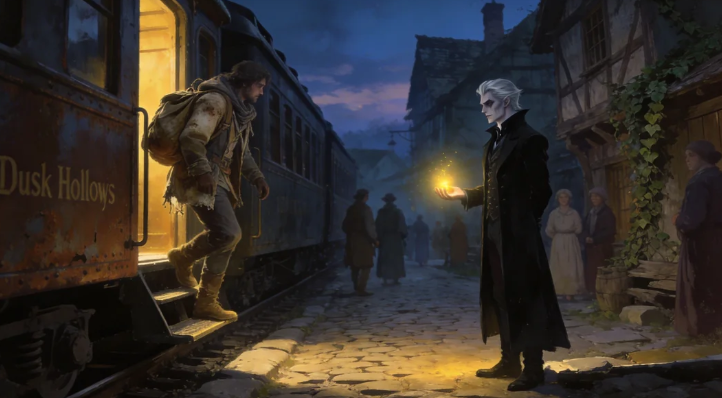
Rowan Vale had been riding the rails for so long that the clatter of wheels felt like a second heartbeat. When the train sighed to a halt at a weather-beaten platform labeled Dusk Hollow, he stepped off simply because the name sounded like a place that might forgive a man running from his past. Twilight folded over the valley like indigo silk, and the only light came from a single gas lantern flickering outside the station house.
The stationmaster, a stooped man with silver eyebrows, accepted Rowan’s ticket without a word. When Rowan asked about lodgings, the old man lifted his eyes, pupils oddly reflective. “The Hollow keeps its guests,” he murmured, pointing toward a cobbled lane that sloped downhill between leaning Tudor façades. A damp wind carried the scent of pine and something metallic, like old pennies.
Rowan shrugged off the chill and followed the lane to an inn whose signboard creaked above the door: The Lantern’s Rest. Inside, candles guttered in sconces shaped like cupped hands. The innkeeper, a woman in a high-collared dress the color of dried blood, offered him a room key forged from black iron. “Breakfast at moonset,” she said, voice soft as falling ash. Rowan almost laughed—who scheduled meals by moonset?—but fatigue pressed him upstairs.
That night he woke to the sound of hymn singing. The melody drifted through the window, minor and slow, as though the very air mourned. He peered outside and saw figures in charcoal robes walking toward the forest, each carrying a lantern that burned crimson rather than gold. Their procession moved without conversation, feet gliding inches above the cobblestones. Rowan’s pulse stuttered; he rubbed his eyes, but the vision held.
At dawn—real dawn, pale and watery—the village looked ordinary again. Bread deliveries clattered, old women swept stoops, children chased hoop wheels. Rowan descended to ask about the midnight parade, but conversations evaporated the moment he approached. Finally a boy with a slingshot tugged his sleeve. “They feed the Angel,” the child whispered, then scampered off as his mother yanked him away.
Curiosity outweighed caution. Rowan spent the day exploring. He discovered that Dusk Hollow had no church, no graveyard, and no electricity, yet every doorstep bore a scratched sigil: a circle bisected by a vertical line, like an eye closed to the sky. When he traced the mark with his finger, the wood felt warm, almost alive.
Come evening, Rowan hid in the shadow of a buttressed wall and waited. The robes appeared again, lanterns blooming like blood-red poppies. He followed at a distance, boots silent on mossy flagstones. The procession entered the forest along a path lined with white stones that glowed faintly. After a mile the trees parted, revealing a natural amphitheater. In its center stood a monolith of obsidian, chains wound around it like vines. The robed figures formed a circle and lifted their lanterns. From behind the stone, a shape emerged: tall, cloaked, skin luminous as moonlit marble. The Angel.
Rowan’s throat tightened. The creature’s eyes were pools of liquid night, but its mouth was the worst—too wide, too knowing. One by one, the villagers approached, rolled back their sleeves, and offered their wrists. The Angel drank delicately, almost tenderly, sealing each wound with a kiss that left the donor swaying, euphoric. When the final supplicant stepped away, the creature lifted its gaze directly to Rowan’s hiding place.
“Travelers taste of distance and regret,” the Angel said, voice echoing inside Rowan’s skull. “Come.” The compulsion tugged like a riptide. Rowan stumbled forward until cold fingers tilted his chin. “Why chase the sun when darkness keeps you kind?”
Images flooded him: the Angel centuries ago, stumbling wounded into the valley, hunted by torch-bearing knights; villagers choosing mercy over fear, offering blood to heal the stranger; the pact forged—protection from plague and famine in exchange for sips of life. The sigils on doors were not wards but invitations, reminders that they belonged to something immortal and grateful. Rowan saw himself through those ageless eyes: a man hollowed by guilt, running from a brother’s death he could have prevented. The Angel’s offer glimmered—an end to memory, to pain, to the weary march of years.
Yet in the crimson lantern glow Rowan noticed something else: the villagers’ eyes carried not just euphoria but fatigue, skin stretched thin as parchment. Eternal caretaking had become eternal draining. The Angel needed them, yes, but they also needed the Angel to need them—a closed loop of shadow.
Rowan’s hand brushed the iron key in his pocket. Black iron, the innkeeper said. Cold iron, bane of old magic. He wrapped his fingers around it, feeling its bite. “Your gift is heavy,” he whispered, meeting the vampire’s gaze. “Let them go.”
The Angel’s smile was sorrowful. “Would you carry their night, wanderer?” It opened its arms, chains clinking. Rowan understood: the monolith did not imprison the vampire; it anchored the village’s collective guilt. To break the cycle required a new bearer, someone already haunted.
Rowan thought of his brother’s face fading beneath river water, of train whistles that never quite outran the echo of blame. Perhaps some darknesses were meant to be faced, not fed. He pressed the iron key against the stone. A hairline crack raced upward, releasing a sigh like a thousand extinguished candles. The Angel staggered, eyes widening not in rage but relief. Lanterns flickered gold, then white, then blazed with ordinary flame. Dawn—true dawn—speared through the canopy for the first time in centuries.
The robed villagers gasped as if surfacing from deep water. Some wept; some laughed; all felt the weight of borrowed centuries slide from their shoulders. The Angel’s form thinned, becoming translucent as morning mist. “Guard them in daylight,” it murmured to Rowan, voice barely a breeze. Then it dispersed, a scatter of shadows that the sun drank away.
Rowan expected to feel hollow, but instead warmth spread through him, the gentle heat of forgiveness. The villagers gathered around, no longer spectral caretakers of night but simply people blinking beneath a sky they had almost forgotten. They walked back to Dusk Hollow together, leaves glittering with dew that tasted of nothing but water.
Years later travelers still find the village, though it no longer appears on maps. They speak of an inn whose candles burn steady and golden, of an innkeeper who greets them with eyes clear as river ice, of a quiet man tending a garden where white stones catch the morning light. If asked whether the Angel still haunts the forest, the villagers smile and point to the sun rising over the amphitheater ruins, its obsidian cracked open like a seed. And sometimes, when dusk folds again over the valley, a single lantern glows atop the hill—not crimson, but warm hearth-red, a promise that darkness can be carried without being kept.