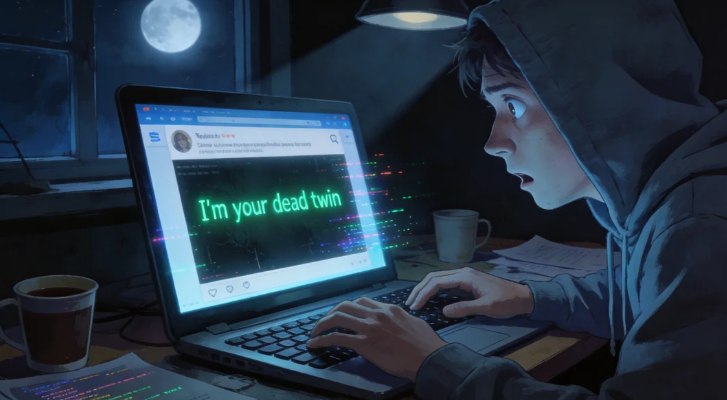
Ethan Calder, 29, lived in a single-room flat above a shuttered bakery in Gdańsk, Poland. His world was code, coffee, and the soft blue glow of three monitors that never slept. Friends had stopped inviting him out years ago; he preferred the company of algorithms to people. Yet on the first of November, while the city outside dripped with fog and candlelight from All Saints’ graves, Ethan’s oldest laptop chimed a notification sound he had not heard since university: the cheerful ping of FriendVerse, the campus social network that had collapsed after a data-leak scandal in 2014.
He froze, fingers hovering above the keyboard. The site was dead; the domains had been auctioned to pornographers. Curiosity overrode caution. He opened the retro interface. One unread message glowed amber:
“Don’t look at the clock. You have 9 min 57 sec. —E.”
Ethan’s skin prickled. E was the initial of Elias, his identical twin who had drowned on a kayaking trip exactly ten years ago. The profile picture showed the two of them at nineteen, arms slung over each other’s shoulders, the same crooked grin mirrored. Ethan had not seen that photo since he deleted every trace of Elias from his online life, unable to bear the digital ghost.
He glanced at the system tray: 00:00. The real clock on the wall read 12:03 a.m. He swallowed and typed:
“Who is this?”
The reply arrived before he hit enter:
“8 min 40 sec. Go to the window. You’ll see a woman in a red coat drop her roses. She’ll kneel but not pick them up. Watch.”
Ethan’s rational mind screamed hoax, but his body obeyed. The street below was empty except for lamplight on wet cobblestones. Seconds stretched. Then, precisely on cue, a woman turned the corner, red coat bright against the night. A gust of wind snatched the bouquet from her arms. She knelt, touched one petal, stood, and walked away, leaving the roses like drops of blood.
Back at the desk, Ethan’s hands shook.
“How?” he typed.
“7 min 02 sec. Open the fridge. The milk will be sour. Smell it.”
He raced to the kitchen, yanked open the door. The carton, bought yesterday, bulged at the seams. When he unscrewed the cap, the stench of rot filled the room. He gagged, slammed it shut.
“5 min 30 sec. Check your inbox. Subject: ‘We regret to inform you.’”
Heart hammering, Ethan opened email. At the top sat a message from TechNova, the company that had flown him to Berlin for a final interview. The first line read: “We regret to inform you that we have selected another candidate.” He had been waiting for that email for weeks; he had dared to imagine a new life.
Tears blurred the screen. He typed:
“Stop it. What do you want?”
“4 min 10 sec. Look under the bed. You’ll find the GoPro we used on the river. It still holds the last video.”
Ethan dropped to his knees. Dust bunnies, forgotten socks, and there—sleek, silver, impossible—the waterproof camera Elias had worn that day. It had vanished with the rescue team, claimed by the current. Ethan’s pulse roared in his ears. He pressed power; the battery indicator glowed 1%. The screen flickered to life: Elias’s laughing face, the canoe rocking, then the sudden overturn, the sky tilting, water rushing in. Ethan watched himself swim toward the opposite bank, shouting for his brother, not knowing Elias’s foot was trapped in reeds below. The footage ended with Elias’s gloved hand rising toward the lens, a thumbs-up that turned into a wave goodbye.
Ethan sobbed, clutching the camera. The chat window refreshed:
“2 min 00 sec. You always blamed yourself. I never did. Forgive. Live.”
He typed furiously:
“Stay. Please. I miss you.”
“1 min 00 sec. Close the laptop. Go outside. Smell the roses. They’re not rotten. Nothing is.”
Ethan hesitated. The cursor blinked like a slowing heartbeat. He slammed the lid, severing the glow. In the sudden darkness he smelled… roses. Sweet, fresh, impossible. He stumbled downstairs into the street. The woman’s abandoned bouquet lay untouched. He knelt, lifted a single stem. The petals were cool, fragrant, alive.
Behind him, the bakery’s neon sign flickered on for the first time in years, casting pink light across his face. Ethan felt something loosen in his chest, a knot he had carried for a decade. He walked toward the main square where late-night revelers spilled laughter like coins. For the first time since Elias died, Ethan did not feel watched by absence; he felt accompanied by presence.
Back in the flat at dawn, he reopened the laptop. FriendVerse returned a 404. The GoPro’s battery was dead, its memory card empty. Yet on the desk lay one red petal, pressed flat, smelling of morning gardens.
Ethan opened a new code window and began building—not an app to monetize loneliness, but a platform where people could leave voice letters for the ones they lost, timed to release on future anniversaries, so grief could become conversation instead of silence. He called it “Echoes.” By winter, thousands were sharing stories once locked in their throats. TechNova called again; this time Ethan declined. He had already been hired by a greater firm—memory, mercy, and the fragile kindness of midnight messages.
Sometimes, when the monitors reflect two faces instead of one, Ethan smiles and whispers, “Got your notification, bro.” The petal remains taped beneath the screen, a quiet firewall against despair, proof that even deleted networks can carry love across the dark.