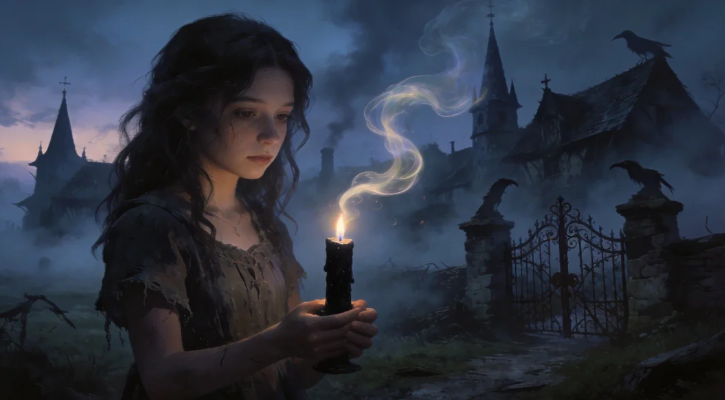
The letter arrived at dusk, slid beneath the warped door of the foundling home like a blade. Elara Mire, seventeen summers pale and silence-heavy, read the wax-sealed command with fingers that had never known a parent’s touch. “By decree of the Hollow Council, you are appointed Keeper of the Last Candle. Present yourself at the Thornwatch Tower before the moon drains color from the sky.” The ink smelled of iron and lilies.
She crossed the square where no children played. Gargoyles leaned from rooftops, tongues frozen in mid-roar, as if warning the stones themselves. The townsfolk watched from behind cracked shutters; their eyes reflected the gas-lamps like coins dropped in dark water. No one spoke. Speaking made things real, and Ravenshollow preferred its truths half-swallowed by mist.
The Thornwatch Tower had once been a bell tower, but the bell was removed centuries earlier after it rang thirteen times at midnight and every newborn cried blood for a week. Now its hollow crown cradled a single iron pricket waiting for the candle. Elara climbed the spiral stairs; each step exhaled damp soot that coated her throat with ancestral ash. At the summit, the Hollow Council waited—three figures draped in moth-wing velvet, faces hidden by mirrors that reflected only starless sky. They handed her the candle: obsidian wax, wick the color of a bruise, weightless as guilt.
“Light it when the sun dies,” the middle mirror intoned. “Keep it alive seven nights. On the eighth dawn, your duty ends. Let it gutter, and the shadow beneath the town will rise to wear our skins.” The mirrors turned away, already forgetting her name.
Night one. Elara struck flint. The flame that answered was not orange but ultraviolet, a color loneliness might have if it burned. It cast no warmth; instead, the tower grew colder, as though the fire drank heat from memory. Outside, fog folded into shapes: a bride without a face, a hound with too many mouths. They pressed against the glass, whispering invitations. She did not answer. The candle shortened one inch, and Elara forgot the lullabies she had invented for herself as a child.
Night two. Footsteps ascended the stairs, slow and wet. A boy appeared—or what had been a boy. His skin was sewn from pages of condemned books, words writhing under translucent parchment. “I was Keeper before you,” he rasped. “The flame took my name. When you forget yours, you’ll join the binding.” He reached for the candle; the fire leapt, licking the air like a starving tongue. The boy scattered into sentences that moaned and evaporated. Elara’s own memories flickered: her mother’s face blurred, replaced by a blank oval of moonlight.
Night three. The tower door vanished. Where it had been, a corridor stretched, lined with portraits whose eyes followed her heartbeat. At the far end stood a woman in bridal veils woven of cobwebs. “Daughter,” the woman sighed, though Elara had no memory of maternal voice. The veils lifted, revealing a mirror instead of a face. In it Elara saw herself aged to dust, candle still in hand. The reflection crumbled; the dust spelled RUN. She fled back to the tower room, but the word followed like a second shadow.
Night four. The candle now reached halfway. Elara’s reflection in the window had no eyes, only twin flames. She tried to recall her surname; syllables slipped like wet pebbles. Somewhere below, church clocks struck thirteen though timepieces in Ravenshollow were forbidden. Each chime erased a year of her life. By the twelfth stroke she was five, barefoot in the snow the town never remembered. The thirteenth stroke never came; the candle had swallowed it.
Night five. The Hollow Council returned, no longer robed but naked as scarecrows of starlight. They carried a cradle woven from raven feathers. Inside lay an infant made of smoke, mouth open in silent scream. “Feed it,” they chorused. “The flame demands innocence.” Elara understood: the candle was a umbilicus between worlds, and innocence its milk. She lifted the smoky child; it weighed nothing yet crushed her arms with sorrow. She pressed it toward the fire. The candle brightened, and the infant dissolved into a lullaby she almost remembered. Her own childhood vanished with the smoke.
Night six. The tower walls grew translucent. Beyond them, Ravenshollow unraveled: houses folded inward like paper coffins, streets liquefied into ink rivers. The townsfolk wandered, skin peeling into moths that circled the tower, hungry for light. Elara saw the truth—Ravenshollow was not haunted; it was a scab on the wound of something older, and the candle kept the wound closed. She was not protecting the town; she was protecting the world from the town.
Night seven. The candle stood only a fingertip tall. Elara’s mind was nearly hollow, a cave echoing with forgotten footsteps. She lifted the last remnant of herself: the memory of choosing to climb the tower instead of running. She touched it to the flame. The fire roared, violet becoming blinding white. The tower shattered like glass made of night. Moths burst into ashes. The Hollow Council screamed as their mirrors cracked, each shard birthing a new star.
Dawn of the eighth day broke, not over Ravenshollow—there was no Ravenshollow anymore—but across open moorland where a single black candle stub melted into dew. Elara lay among wildflowers that had never known fog. In her palm, a wick of ordinary hemp waited. She struck flint. This time the flame was small, yellow, warm. It illuminated her face, and for the first time she saw her own eyes clearly: they held no reflection of shadows, only morning.
Some say a village still appears on the moor when twilight thickens, beckoning travelers to keep its candle burning. But those who follow the call find only a girl tending a modest fire, telling stories to the wind. She remembers every tale except the one about her name, for names are seeds, and she has planted hers where shadows cannot grow. The candle she keeps now is not a lock but a lantern, guiding the lost away from the places that eat remembering. And somewhere beneath the grass, a bruise-colored wick sleeps forever unlit, dreaming of a girl who forgot herself enough to save everything else.