Paragraph 1
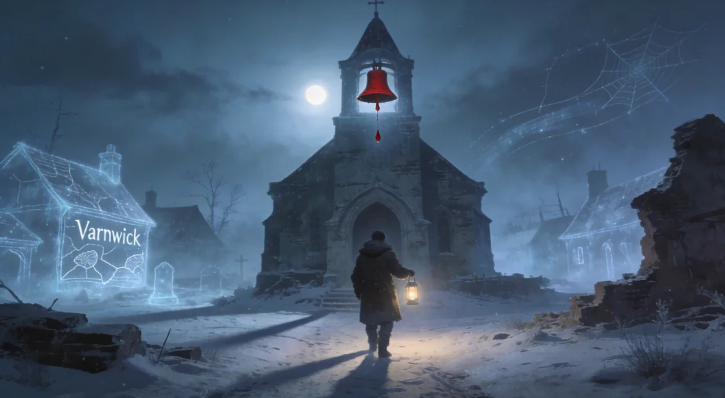
The train that carried archivist Liora Vale lurched to a halt in the middle of a forest that did not appear on any modern atlas. Snow hissed against the windows while the conductor muttered that the tracks ahead had "forgotten their purpose." Liora stepped off alone, lantern in hand, following a single set of iron rails that vanished into darkness. She had come for a sound: the bell of St. Erasmus, said to ring every dusk in the abandoned village of Varnwick. No living soul had reported hearing it since 1893, yet the acoustic logs in her institute captured the peal nightly on expired wax cylinders. The institute, embarrassed by impossibilities, sent her to bury the story. Liora, orphaned by curiosity, hoped instead to unearth it.
Paragraph 2
The forest thinned without transition into a street of slate-roofed houses, their windows glowing faintly as if lit by remembered fireplaces. No footprints disturbed the snow except her own, yet smoke curled from chimneys. Liora noted the phenomenon the way other people note beauty: politely, but without trust. At the far end rose the church, steeple cracked like a broken tooth, bell intact. The bell rope hung motionless, yet the bronze tongue swung and clanged as she approached. With each toll, frost on the nearby graves rearranged itself into new patterns—letters, then words: WELCOME HOME. She had never been here before, but her veins answered with a cold surge, as if the blood inside them recognized the address.
Paragraph 3
Inside the church, pews were draped in white sheets that looked suspiciously like shrouds. The altar candle was freshly lit, wax still warm. Liora set her recorder beside it; the spinning reels captured not only the bell but also a heartbeat doubled beneath. She spoke the date aloud, a habit of scientific certainty, and the echo replied a year off by a century. Turning, she found the doorway blocked by a man in a frock coat the color of dried blood. His collar was high, his eyes higher, pitched into shadow by the brim of a top hat. "You rang?" he asked, voice polite as a dinner invitation. Liora, trained in folklore, recognized the greeting of the house-bound dead. She answered with the prescribed humility. "I came for knowledge, not conquest." The man smiled, revealing teeth like neatly filed affidavits. "Knowledge," he said, "is merely conquest wearing spectacles."
Paragraph 4
He introduced himself only as the Warden and led her through a side door that should have opened into a vestry but instead descended into catacombs that predated Christianity in that region. The walls were lined with niches, each cradling a glass sphere the size of a heart. Inside every sphere drifted a crimson thread that curled and uncurled like a question mark. "These are the chronicles," the Warden explained. "Every soul that ever pledged itself to the night leaves a filament. When the filament stills, the debt is paid." He lifted one sphere; the thread inside hung limp. "Your ancestor’s, I believe." The name he spoke—Vale—was a key turning in Liora’s marrow. Family legend claimed her great-grandfather vanished while surveying Varnwick. She had assumed railway politics, not vampiric mortgage, sealed his fate.
Paragraph 5
They walked until the passage widened into a library where books breathed. Leather spines rose and fell as if lungs, and when Liora opened one, the pages were mirrors reflecting her at increasingly younger ages. At volume seven she saw herself at nine, chasing fireflies that transformed into sparks of arterial spray. She slammed the book; the Warden chuckled. "Memory is edible here. The more you recall, the less you require of others." He offered her a chair carved from tombstone marble. Across the desk he spread a contract inked in iron gall that had browned to the hue of old bruises. The clauses were simple: remain as archivist, catalogue the spheres, and the village would spare the outer world its appetites. Refuse, and the bell would follow her heartbeat wherever she fled, drawing the hungry like moths to a mobile flame.
Paragraph 6
Liora asked for time, a human reflex. The Warden granted her until the candle on the altar burned down—an hour, perhaps less. She retreated not to think but to count. There were 314 spheres; 42 still pulsed. If she could sever the active threads, perhaps the contract would lack signatories to enforce. She pocketed a shard of stained glass, holy relics being scarce. Back in the nave she climbed the spiral staircase to the belfry, each step echoing like a distant gunshot. The bell was larger up close, its rim inscribed with a line from a forgotten poet: "I toll for the blood that remembers the river." She wedged the glass between clapper and bronze, hoping the next strike would fracture the instrument. Instead, the bell rang once, and the shard liquefied, dripping silver that hissed through the planks toward the graves below.
Paragraph 7
The Warden awaited her at the base, coat flapping like wings that had mislaid their bat. "Violence is a dialect," he said sadly. "Speak it, and every echo answers in kind." He led her to the cemetery where soil parted without spade. Coffins surfaced, lids yawning to reveal occupants perfectly preserved, cheeks rouged by circulation not their own. Among them lay a woman with Liora’s same sharp chin, same widow’s peak—her great-grandmother, left behind when the menfolk vanished. The woman’s eyes snapped open, pupils dilated with century-old thirst. "Family reunites at the hinge of need," the Warden whispered. "Your blood can still the bell forever, but the price is residence. One Vale must remain to keep the records honest."
Paragraph 8
Liora understood the arithmetic: sacrifice autonomy, save strangers. Yet her profession rested on the belief that every story deserved continuance, including her own. She removed not the glass now but the recorder, switching it from receive to transmit. Holding the device high, she spoke her own name, birth date, and the precise coordinates of the institute’s vault. Sound, she reasoned, was only pressure over time; if the bell’s toll could travel forward, so could her refusal. She pressed PLAY. The reels spun backward, releasing every heartbeat the village had fed upon. The graves erupted in reverse burial; the spheres cracked, threads unraveling into red auroras that fled through the steeple’s fissures like startled swallows.
Paragraph 9
The Warden lunged, but the released chronicles buffeted him with centuries of stolen sunsets. His form flickered between man and mist, finally condensing into the shape of the top hat, now empty, collapsing like a tent without occupant. The bell gave one last toll—soft, almost apologetic—then fell mute. Snow began to fall upward, flakes returning to clouds as if the night itself rewound. Liora ran along the iron rails that now glimmered with sunrise at their edges. Behind her, Varnwick folded like a paper village dropped in water, houses smudging into blankness. She reached the stationary train as the conductor called, "All aboard for places that admit us." Only when the wheels lurched forward did she notice her recorder still running, its reels inscribed with a single new thread—scarlet, restless, but hers alone.
Paragraph 10
Weeks later, scholars at the institute dismissed her cylinders as hoax, the backward heartbeat a trick of resonance. Liora was reassigned to folklore, where stories go to hibernate. She keeps the recorder on her desk, reels unmoving, waiting for the day her own filament stills. Sometimes at dusk she hears a distant bell, but the sound is faint, like memory conceding defeat. She no longer sleeps with the lights off; darkness, she learned, is a place that keeps receipts. Yet on clear evenings she opens the window, letting the wind riffle through her notes. If the pages flutter in a rhythm of seven, she smiles—an archivist’s lullaby—and whispers to the horizon, "Catalogue this: some debts are rewritten, not repaid." The bell, denied its Vale, tolls elsewhere now, searching for readers who mistake silence for conclusion. And Liora, candle rekindled, writes every night, ensuring the story remains unclosed, the ink still warm, the river of blood remembering her name instead of the other way around.