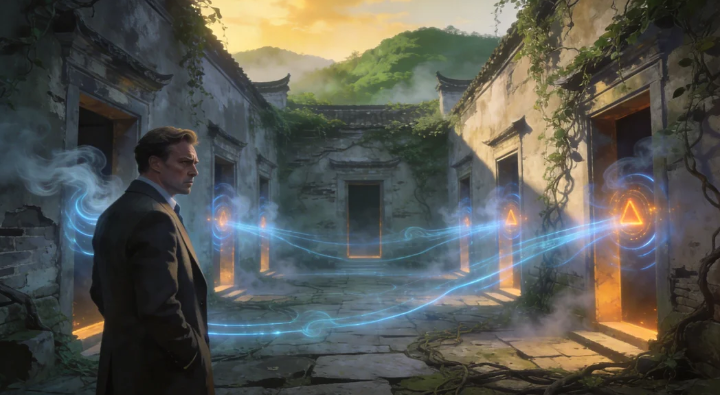
Elara V. Whitcombe had measured every angle of every building she ever designed, so the letter from a Chinese solicitor felt like a misplaced decimal point in her tidy life. The ancestral estate of her late mother—whom she had believed to be a Cockney orphan—lay outside Guilin, where karst peaks rose like stone lotuses. The will demanded she “restore the breath of the house before the seventh moon, or forfeit her shadow to the earth.” Lawyers, Elara thought, were poets when paid by the hour.
She flew in during the Dragon Boat humidity, clutching a rolled blueprint like a shield. The manor, Jade-Gaze Hall, squatted on a ridge shaped, locals whispered, like a sleeping qilin. Its green tiles were dulled to the color of old bruises; the courtyard pool was a black mirror. A bent woman named Mrs. Lǐ waited by the gate, fingering a loop of red thread. “The house exhales only grief,” she warned. “The fēngshuǐ master who built it loved symmetry more than life.” Elara laughed—symmetry was her religion too.
That night she slept in the western wing, where the corridor angled five degrees off true. At 3:07 a.m. she woke to the sound of a brass compass spinning, though she owned none. Moonlight showed dust devils racing across the floorboards, sketching spirals that aligned with no cardinal point. She chalked the pattern, photographed it, told herself it was convection, barometric pressure, the digestive rumble of an old mountain.
Morning brought rain that fell upward first, pattering on the underside of the eaves before reversing to earth. Mrs. Lǐ brought tea and a sandalwood box. Inside lay a cracked luopan, its concentric rings frozen on a needle of jade. “Master Qīan’s compass,” she said. “He vowed the house would stand only while the needle pointed to benevolence. When the Japanese came, he buried himself beneath the central courtyard, sitting upright, to guard the meridian. The needle cracked the night you were conceived.” The old woman’s pupils reflected the broken circle like a second moon.
Elara’s rational mind drafted a schedule: demolish unstable walls, install steel beams, redirect drainage. Yet every measurement she took disagreed with her laser ruler. The east wing was three hand-breadths longer at dusk than at dawn; doorframes narrowed when watched. She began to dream in classical Chinese characters that rearranged themselves into floor plans. One repeated symbol—井, the water well—appeared wherever she intended to place a window.
On the fourth day she uncovered a stone tablet beneath the lotus pond. The inscription read: “Move one stone, invite the wind to dine.” She hired workers; none stayed past lunch. They spoke of hammers that swung themselves, of plumb bobs pointing to the sky. Elara worked alone, jackhammer singing, until the courtyard cracked open like a seed. A column of air shot upward, carrying the smell of gunpowder and jasmine. In the hollow beneath the foundation she saw the mummified figure of Master Qīan, cross-legged, his right hand raised in abhaya mudra, the other clutching the jade needle. Around him swirled miniature tornadoes, tiny dragons of dust.
The moment her shadow crossed his, the tornadoes froze. The broken luopan in her pocket vibrated, then healed with a sound like ice cracking on a warm lake. The needle spun, seeking, and stopped pointing not north, but at her heart. A voice—genderless, ageless—spoke in the language of angles: “You are the final line.” Elara felt every blueprint she ever drew peel away from her memory, pages fluttering into the vortex. In their place rose the image of the house as it wanted to be: roof tiles breathing, corridors bending like bamboo, windows that blinked.
She understood then the bargain. Master Qīan had built the manor as a compass itself, its walls aligning with veins of copper below the mountain. Each generation inherited the task of recalibration; fail, and the qi would shear, slicing the ridge—and the family’s future—clean off the map. Her mother had fled to London to escape the burden, erasing her name, but blood is a stubborn ink.
Elara climbed out, shaking, and walked the perimeter with the restored luopan. Where the needle quivered, she planted wind-dampening willows; where it stilled, she set granite to anchor the pulse. She redirected the entrance three degrees south, so the gate would greet the morning sun and exhale the night’s sorrows. She left the central courtyard open, a pupil gazing at heaven, and built no structure above Master Qīan’s resting place, only a lattice where wisteria could climb like green fire.
On the seventh moon the house breathed once—a sigh that rattled every teacup in Guilin—and settled. The upward rain ceased; the compass needle glowed. Elara signed the final document, but added a clause: the estate would become a school for architects who study the breath of buildings, learning to listen before they draw. Mrs. Lǐ cut the red thread and tied it around Elara’s wrist. “You have returned the wind to its cave,” she said. “Yet remember—every line you sketch elsewhere will echo here.”
Years later, students tell of nights when the central courtyard glows jade-green, and a woman in Western clothes walks beside a figure in Ming-dynasty robes, measuring infinity with a compass that needs no map. They leave no footprints, only the faint scent of gunpowder and jasmine, reminding the living that some spaces are not owned but borrowed, and that the truest fēngshuǐ is the kindness woven into angles.