I’m Lila, twenty-three, grease under my nails and a head full of bolts. When Pop got sick, I took the graveyard shift at Rudy’s Garage so we wouldn’t lose the lease. First night, the air tasted like burnt oil and something sweet, like flowers left too long in a jar. I figured the scent came from the trash, cranked the radio, and slid under a beat-up Chevy.
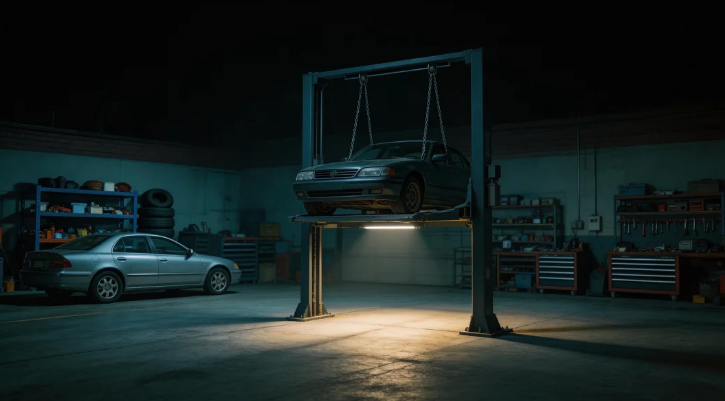
Half past two, the lift groaned. I wasn’t touching the controls, yet the car rose slow, chains shivering. My flashlight flicked out. In the dark I heard boots—heavy, steel-toed—crossing concrete. No one else was scheduled. I rolled out, heart knocking, and the bay was empty except for a single handprint in thick grease on the hood, fingers long and thin, like a skeleton wearing a glove.
Next evening I brought Rex, my mutt who barks at anything that breathes. Rex took one look at Bay 3 and backed under the bench, whining like a busted fan belt. I laughed, nervous, told myself it was mice. Then the Snap-on drawer slid open by itself, wrenches lifting in a line, hovering like they were waiting for instructions. I felt cold breath on my neck, smelled that flower-rot again, and a voice whispered, “Torque to thirty.” My arm moved on its own, snatching the ⅜ ratchet, turning an invisible bolt. When I dropped the tool, the drawer slammed shut so hard the glass cracked.
I asked Rudy at sunrise. He stared into his coffee, eyes red. “Shop’s always had a ghost, kid. Name’s Elias Monk. 1948, he was the best mechanic in the county, fixed tractors to tanks. One night a lift lock failed, car fell, crushed him flat. Folks said he died mid-repair, never got to finish.” Rudy sipped, voice shaking. “He don’t like sloppy work.”
Third shift, I brought holy water from Mom’s church, splashed it like brake cleaner. Big mistake. The fluorescent lights burst, raining sparks. Air compressor turned on, hose whipping like a snake, chasing me around the lift. I yelled, “I’m trying, okay!” and every tool froze, quiet as held breath. On the wall, oil dripped, forming letters: HELP ME.
I realized Elias wasn’t haunting—he was stuck, same way a rusted nut won’t come loose. I popped the hood of that Chevy, the one that lifted itself. Inside, I found a cracked distributor cap, exactly the kind Elias died fixing. My hands moved without me, swapping parts, wires clicking perfect. When I tightened the last screw, the shop bell rang though the door never opened. Cold air swept past, carrying the flower smell, now fresh like spring. Tools settled, dog wagged, radio played only static, then cleared into Elvis.
At dawn, the Chevy started on first crank, purred like a kitten full of cream. Painted on the firewall, where no one could’ve reached, was a perfect handprint—five fingers, this time giving a thumbs-up. Rudy came in, saw the print, grinned through tears. “He’s gone,” he said. “Shop feels…lighter.”
I kept working nights, but the lift never moved alone again. Sometimes, when I’m stumped, I’ll find a wrench placed just where I need it, oil shaped into tiny arrows. I nod, say thanks, and keep turning bolts, knowing every good mechanic leaves a mark, even if you can’t see it in daylight.