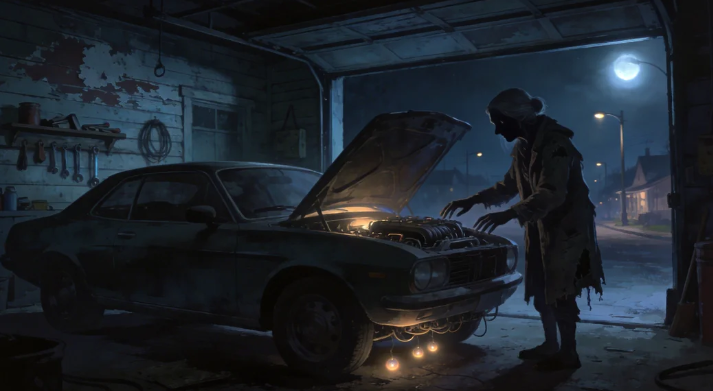
I’m just a broke courier with a van that coughs like grandpa on a cold morning, so when the fan belt snapped at 2 a.m. I rolled straight to Maud’s. Shop was dark except for one bulb swinging over the pit, and there she was, coveralls black with years of oil, hair tucked under a rag that might once been red.
“Can ya pay?” she rasped, not even looking up from the guts of a ’72 Plymouth. I showed her the twenty-three bucks in my pocket. She wiped her hands, nodded toward the bay, and said, “Leave the keys. Come back sunrise. And don’t poke around.” Then she smiled, teeth too white for a woman who never saw toothpaste ads.
I should’ve listened. But curiosity’s cheaper than a motel, so I bunked in the waiting room, cracked vinyl couch smelling of gas and wintergreen. Around three the clangs stopped. Dead quiet. I peeked through the window between the office and the shop floor. Maud stood alone, arms raised like she was conducting an orchestra, except the tools were floating—wrenches, ratchets, a whole damn torque wrench spinning itself onto a spark plug. No strings, no magnets, just air and metal dancing.
My phone died right then, screen fizzing out the way electronics do when they’re scared. I ducked back, heart banging harder than my busted pistons. Footsteps dragged across concrete, slow, like someone wearing steel-toe boots two sizes too big. The door handle rattled. I held my breath so long I saw stars. Then Maud’s voice, soft as grease smoke: “Sleep, boy. Engines need silence to remember who they are.”
Morning came greasy yellow. Van sat outside washed clean, hood shut polite. Maud handed me the keys with a bill: zero dollars. “On one condition,” she said. “When she talks, you listen.” I laughed, thought it was a joke about lifter tick. She didn’t laugh back.
Week later the van purred like a kitten on warm milk, but every night at 3:02 a.m. the radio crackled on by itself. Not music—voices, static, then my dead dad calling my name like he used to when I missed curfew. I’d reach to shut it off and the knob burned cold, frost spreading over the dash. One time I punched the stereo and the punch echoed back from under the hood, metal hitting metal, though nothing was there.
I drove back to Maud, moon full and mean. She waited in the doorway, coffee mug steaming though the night was July thick. “Told you she’d talk,” she said. “Cars keep memories in their bolts. Your daddy’s last ride was this same model, remember? Crashed, burned, but the block survived. I bought it at auction, built your van around it. He’s just saying hi.”
I wanted to run, but my boots stuck to the oil-stained gravel like the earth itself had turned to tar. Maud led me to the pit, flipped a switch. The lift rose carrying nothing but air, yet tire prints appeared in the dust, walking themselves toward me. “You can swap the engine,” she said, “but blood remembers mileage. Only way out is to drive him home.”
“Where’s home?” My voice cracked like an old belt.
She pointed to the horizon where the road disappears. “Where the crash happened. Let the metal rest. Or keep hearing him every night till you join him.”
So I drove. Van handled like a dream, headlights cutting tunnels through cornfields. At mile marker 187 the temperature gauge dropped to zero though the night was hot enough to fry eggs on the fender. Dad’s voice came clearer: “Almost there, son.” The steering wheel tugged left, tires skidding on dry asphalt. I let go. Van rolled gentle into the ditch exactly where the newspaper photo showed the wreck years ago. Airbags didn’t deploy; instead the horn played lullabies mom used to hum.
I climbed out, knees shaking. The engine coughed once, then silence so complete it rang in my ears. Rust spread over the hood like waking up from a dream, paint peeling in seconds. By sunrise the van was a skeleton swallowed by weeds. I walked back to town, thumb out, no ride, no haunting, just the smell of burnt oil following like a loyal dog.
Maud’s shop was boarded up when I passed. Locals swear she died the night I first arrived, heart stopped under a car she’d been fixing since 1983. But sometimes, when the moon’s thin and the highway’s empty, you’ll see a tow truck with no driver hauling a ghost-white van toward the junkyard that ain’t on any map. And if you listen past the whine of tires, you’ll hear two men talking—one young, one older—laughing about fan belts and second chances, voices carried on the grease under her nails.