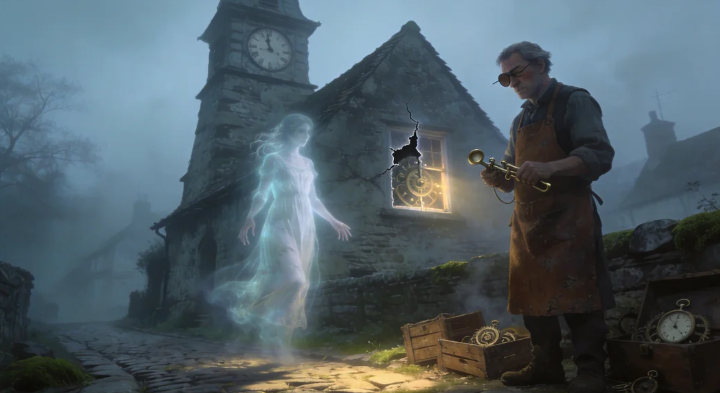
They say the mist in Gallows Corner ain’t weather—it’s the town sighing, letting out the breath it’s held since 1893. I didn’t believe that till the night I lugged my toolbox up Thornback Lane and the fog bit my cheeks like tiny teeth. The job sounded simple: repair the grandfather clock in the old Blackthorn house so it could be flogged at auction. Dead people’s junk, easy money. Except the lady who hired me, Mrs. Eveline Blackthorn, had been buried two weeks prior. I’d seen the obituary myself, complete with a photo of her in a lace collar so high it looked like it was trying to strangle her polite.
The front door swung open before I knocked. No creak, just a sigh, like it had been waiting. Inside smelled of damp velvet and metal shavings, the sort of scent that sticks to your tongue. I called out—“Only me, the clock fella!”—and the echo came back wearing someone else’s voice. The hallway was lit by one gas lamp that flickered Morse code at the ceiling. Shadows stretched long enough to trip over, and every step I took the floorboards counted under their breath.
The clock stood at the end of the corridor, seven foot of walnut and bad attitude. Its face showed thirteen hours, each number painted with a tiny bleeding heart. The pendulum hung mid-swing, frozen like it had seen something indecent. I opened the case and nearly dropped my screwdriver—inside, the gears were moving backwards, teeth chewing their own tails. I muttered, “Well, that’s not regulation,” and the clock answered with a wet click, like a tongue leaving the roof of a mouth.
I felt her before I saw her: a cold spot shaped like a woman standing too close. My grandma used to say the dead crave warmth the way the living crave meaning, so I tucked my hands under my armpits like that’d hide my heat. Eveline Blackthorn stepped out of the wallpaper—literally, just peeled off the damask and became solid. Her eyes were pocket-watch dials, hands spinning frantic. She whispered, “You’re late,” and I swear the clocks in the house all agreed, striking eight though my phone said midnight.
She led me upstairs, gliding over the runner so her dress didn’t disturb the dust. Each bedroom door had a keyhole shaped like a coffin. She paused at the last one, said, “Time broke here first.” Inside was a workshop: tiny brass cogs on every surface, jars of minute hands swimming in oil like silver fish. On the bench lay a pocket watch cracked open, its heart a black gem that swallowed light. Eveline picked it up with fingers that bent the wrong way. “My husband tried to stop my death,” she said. “Built this to steal seconds from the future. But futures don’t like being robbed; they send collectors.”
I wanted to bolt, but my feet had grown friendly with the floorboards. She placed the watch in my palm; it weighed more than a newborn. “Fix it,” she begged, “and I’ll give you the years he took from me.” I laughed, high and stupid, because who trades lifespan for a repair bill? Then I looked in the mirror above the bench and saw myself gray and stooped, thirty years older, eyes ticking side to side. The reflection winked. I swallowed my scream like a mint.
I worked through the night, oiling, calibrating, whispering apologies to machinery that purred like a cat full of bones. Every time I glanced up, Eveline was closer, her skin translucent enough to read the moon through. She hummed a lullaby in 3/4 time, and the walls swayed along. At some point I realized the house had no mirrors anymore—they’d all been covered with black crepe. Except the one in the workshop, which now showed only Eveline and empty space where I should be.
Dawn coughed through the curtains just as the watch snapped shut, its hands spinning forward like greyhounds. The frozen pendulum downstairs lurched, began slicing seconds neat and proper. Eveline smiled, teeth tiny gears. “Debt paid,” she said, and kissed my forehead with lips cold as a locksmith’s key. I felt years flood into me, too many, like someone pouring tea till the cup overflows. My knees buckled; the room tilted.
I woke at the gate, toolbox gone, fog already burning off. The house looked normal, windows blank, For Sale sign hammered into the lawn. My reflection in a puddle showed me twenty-five again, though I’d been thirty-eight when I walked up that hill. I checked my phone: same date as the obituary, but the year had rolled back. I ran to the parish records—Eveline Blackthorn died today, 1893, and beside her name, freshly inked, was mine: apprentice, timekeeper, widower.
Now I wind the town clocks every Sunday, though no one hired me. I age a day for each I fix, hairs silvering like frost on a spiderweb. At night I hear thirteen chimes from the hill, and I know she’s waiting for the future to run out. Sometimes I see her at my window, holding the cracked watch like a valentine. She taps the glass: tick, tock, tick. I smile back, because love in Gallows Corner is just another measurement, and I’ve got plenty of seconds left to spare—though fewer every time the moon forgets to set.