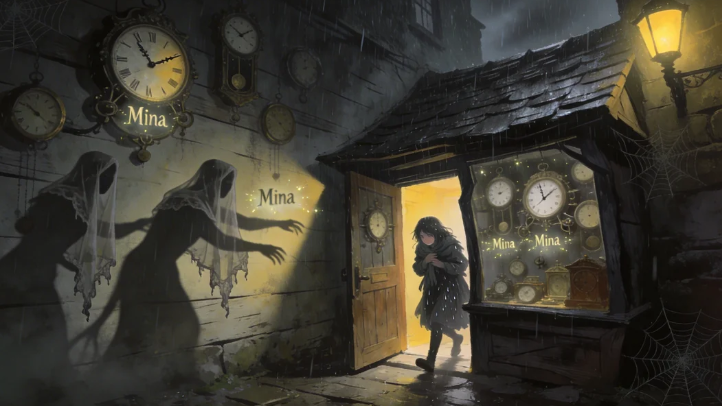
They say the alley behind Fishburn Yard don’t exist on maps, but I found it sure enough when the rain started coming sideways and my boots had more holes than soles. I was aiming for the warm glow of the Raven Tavern, yet the wind shoved me left, left again, till the cobbles tilted like a ship deck and the gaslamps coughed themselves out. That’s when I saw the shop: narrow as a coffin, windows blacker than the inside of a cat, and a sign that squealed “H. Blackwood, Horologist—Open at Any Hour.” The door drifted inward before I even knocked, polite as a butler at a funeral.
Inside smelled of rusted pennies and lilacs gone to rot. Hundreds—no, thousands—of clocks crowded every shelf, their pendulums swinging in perfect sync, tick-tick-tick like heartbeats lined up for inspection. A woman stood behind the counter, veil so thick I couldn’t tell if she had a face or just more shadow. Her dress was the color of candle smoke, skirts brushing the floorboards like brooms chasing away the living. “Looking for time?” she asked, voice soft as moth wings. I laughed, because what else do you do when you’re sixteen and soaked to the bone? “Got any going spare?” I said. She tilted her head, veil shifting, and every clock hiccuped—one single tock out of rhythm. My own heart copied it.
She told me her name was Mrs. Blackwood, though folks in town called her the Clockmaker’s Widow. Her husband vanished the night the big storm of ’89 swallowed the pier, leaving behind only a brass gear clenched in a seagull’s beak. She kept the shop running, she said, “so time wouldn’t wander off like he did.” I figured she was cracked, but she offered me tea that steamed silver and a place by the coal stove. I should’ve run right then, but the room felt stitched around me, threads invisible yet tight. Besides, the rain outside had turned to nails against the glass.
While my socks dried on the hearth, she showed me her favorites: a grandfather clock whose face showed phases of the moon instead of numbers; a pocket watch that ticked backward; a cuckoo that popped out wearing a tiny mourning wreath. “Clocks remember,” she whispered. “They keep the bits of us we forget to carry.” I nodded like I understood, but my skin kept prickling. Every time I glanced at the mirrors between the shelves, I saw her twice—once beside me, once inside the glass, standing closer.
Midnight bonged from somewhere deep in the walls, and the gaslight flicked to blue. That’s when the rear door groaned open by itself, revealing a staircase spiraling down into dark that smelled of wet stone and salt. “He’s still working,” Mrs. Blackwood said, eyes shining behind the veil like wet marbles. “Come, child. Let time introduce itself.” My legs moved without permission, boots clanging on iron steps that felt warm as skin. Down we went, past gears bigger than wagon wheels, pendulums long as gallows ropes, all dripping the same thick black oil that might’ve been blood if blood could shine.
At the bottom lay a workshop lit by a single green bulb. On the bench rested a half-built clock shaped like a cradle. Tiny silver chimes dangled where a baby’s mobile should spin. Mrs. Blackwood glided to it, fingers stroking the wood the way maids pet cats. “I’m crafting a replacement,” she murmured. “Something to fill the hour he left empty.” She turned to me, veil lifting just enough to show a slice of cheek—white as porcelain, cracked like old paint. “Every clock needs a heart, and hearts are so hard to find these days.”
I backed up, but the staircase was gone. Solid wall behind me, bricks breathing in and out. My own pulse hammered loud enough to rattle the tools on the pegboard. She reached into a jar and pulled out a gear no bigger than a sixpence, etched with letters I finally recognized: my initials, the ones Ma carved on my locket before she died. “Found it in the gutter,” the widow said. “Time returns to me what’s lost.” She placed the gear into the cradle clock; it clicked, and the whole contraption shuddered alive, rocking gentle as a mother’s arms. A lullaby tinkled out—my ma’s song, the one she hummed the night the fever took her. My knees buckled.
I wasn’t crying, not exactly, but salt water dripped off my chin anyway. The widow knelt, veil brushing my hair like a baptism. “Stay,” she cooed. “Keep the shop with me. I’ll teach you how to wind the world so it never stops missing you.” Her hand closed over mine, skin cold as the iron steps. I felt the tick-tick-tick travel up my arm, settling behind my ribs, syncing me to the walls of clocks. For a heartbeat I almost said yes—because who doesn’t want to be wanted, even by darkness?
Then the cradle clock hiccuped. The tiny gear with my initials slipped, jammed, and the lullaby warped into a scream. All around us, every pendulum froze mid-swing. Time snapped like a violin string, and the widow staggered, veil shredding in wind that came from nowhere. I smelled lilacs again, sharp as funeral flowers hurled into a grave. My mother’s voice—real this time, not metal—whispered, “Run, Mina. Run before the hour claims you.”
I shoved the workbench; tools clattered, oil splashed like blood. The cradle clock toppled, gears scattering like startled mice. The widow shrieked, a sound of breaking glass and rusted hinges, but I was already moving, fingers scrabbling at the wall till they found a hidden latch. A service tunnel yawned—damp, fish-smelling, but slanting upward toward a circle of night sky. I clawed my way through cobwebs thick as wedding lace, lungs burning.
I burst out between two lobster crates on the harbor just as the church bell tolled one. The storm had wandered off, leaving moonlight slick as oil on the water. Behind me, the alley was gone—only brick wall and a poster flapping in the breeze: “Lost: One Girl, Answers to Mina, Reward if Found Before Tomorrow.” I touched my chest; the ticking was fading, replaced by good old sloppy human thumps. My palm, though, still bore a half-moon scar from the gear’s bite, silver against the grime.
Whitby folks swear no shop ever stood on Fishburn Yard, and maybe they’re right. But sometimes, when the fog rolls thick and the pier lights blink like dying stars, I hear it: tick-tick-tick drifting from nowhere, chasing me down the quay. I walk faster, humming Ma’s lullaby off-key, because I know the Widow’s still winding, still waiting for the hour she can swap my heart for a gear that fits. I keep moving—because time’s got a cradle shaped like me, and I aim to stay too loud, too messy, too alive for any clock to hold.