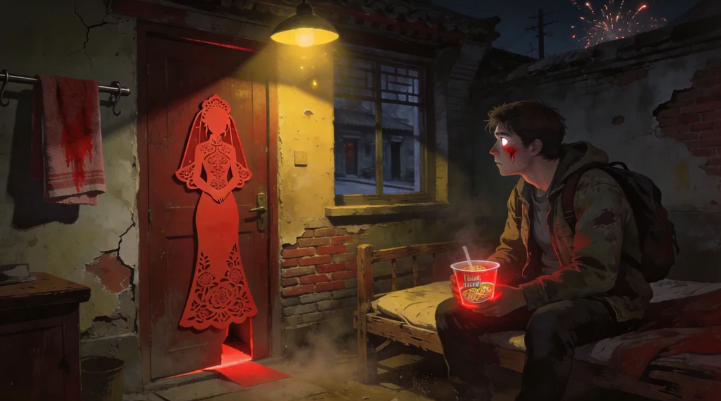
I’m Max, 23, Aussie, zero cash, big hunger for "real China." The landlord Auntie Luo, chain-smoking Double Happiness, shows me the cupboard-sized room at the end of a mossy alley in Hangzhou. "No Wi-Fi, no AC, no ghost," she cackles, which in my dictionary means bargain. I pay fifty kuai, drop my pack, and crash on the plank bed.
First night, 12:07 a.m., BOOM—firecrackers under my pillow. I jerk awake, heart drumming. Silence again. I peek outside: moonlit alley, zero people, zero red confetti. Must be leftover kids’ prank, I mutter, go back to sleep.
Second night, same bang, same time. Plus, a square of red paper slides under the door. I flick on my phone torch: it’s a chuangxi cutout, the double-happiness wedding character, but someone scratched the groom away, leaving only the bride. Creepy origami, nothing more. I chuck it in the trash, snore till dawn.
Third night, the cutout’s back, taped to my forehead like a souvenir sticker. My towel, formerly white, now drips pink water. I march to Auntie Luo. She puffs smoke rings, refuses refund, whispers, "House remembers, not me." Whatever that fortune-cookie riddle means.
I ask the fruit-stall grandpa across the lane. He lowers his voice: "Room used to be bridal chamber, 1923. Bride name Su Mei, sixteen, forced marriage to opium trader. Day before wedding, she hanged herself with red silk. Since then, every guy who sleeps there gets courted." He hands me a bunch of bananas like consolation prize.
Great, I’m flirting with a teenage ghost. I buy cheap yellow charms from the temple fair, stick them on door, window, even the cracked mirror. Night falls. 12:07—firecrackers pop, charms flutter like drunk moths, one bursts into flame. The red-paper bride slips under the door again, this time life-sized, flat as credit card but somehow smiling. My wall calendar bleeds; dates drip onto floor, forming a puddle shaped like a wedding sedan.
I Skype my Chinese classmate Ling for translation help. She gasps at the red puddle, yells, "She wants a groom! Give her one or she’ll take you." Ling’s grandma butts in: "Find her unfinished business, silly waiguoren."
Research time. I bribe the archives auntie with Aussie chocolate. Old register shows Su Mei’s dowry never delivered—her dad gambled it away. Opium trader still married the corpse for luck, buried her under the room to "lock" prosperity. That’s why the alley smells sweet and rotten.
I need a dowry, fast. I pawn my camera, buy red silk shoes, hairpin, and a paper iPhone (yes, they sell those for ancestors). Midnight, I lay gifts in circle, light joss sticks nicked from temple, read vows I Google-translate: "Su Mei, here’s your bling, now scram."
Wind whooshes, firecrackers explode inside my ears. The red-paper bride stands up, 2-D but taller than me. She tilts her head, kinda sad, not scary. She points at my chest—no, at my heart. I get it: dowry’s nice, but respect’s better. I speak, voice shaking: "You deserved choice, not chains. I’m sorry."
She steps closer, paper hand touches my cheek—feels like warm rice paper, not cold death. The red drains from the room, colours return normal. She folds herself smaller, smaller, becomes tiny paper crane, lands on my palm. Then she burns, smoke smells like jasmine, no heat. Gone.
Next morning, the alley smells of rain, not opium. Auntie Luo stares at my now-spotless room, mumbles, "Rent double if you stay." I laugh, pack, leave the paper crane ash in an envelope on the windowsill—my wedding gift to her.
I walk out, phone pings: Ling sent meme saying "Ghosted and proud." I feel light, like someone cut invisible red silk wrapped around my own neck. Behind me, the hutong bricks shift, almost like a sigh of relief. I don’t look back. Some stories you survive by simply listening, not running.