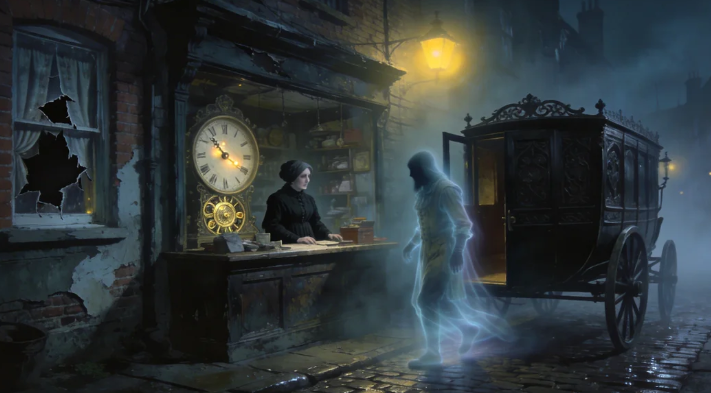
They say the sea mist in Whitby eats sound, but I swear it’s the clocks that do it. I’ve lived above my husband’s shop for seven years since the fever took him, and every night at twelve the tick-tock swallows the world. Folks think I’m cracked, a gray-haired widow in bombazine, oiling gears at three in the morning like the dead care about punctuality. Maybe they do.
The shop’s called Horology & Sons, though there’s only me left. The sign creaks worse than my knees, paint peeling like sunburnt skin. Inside, hundreds of faces stare—grandfather, cuckoo, skeleton, carriage—each set five minutes fast because Albert believed the living should hurry and the dead can wait. I keep them running out of habit, or guilt, or maybe because the noise plugs the hole he left. Wind off the harbor sneaks through the gaps, smelling of salt and rust, and the pendulums sway like hanged men.
First strange thing was the carriage. Jet-black, no driver, horses the color of chimney soot. It rolls up at midnight on the dot, wheels silent as wet wool. I watched from the window, thinking I’d finally joined Albert in the cracked-brain club. Door opens, out steps a woman in a veil so thick it could be smoke. She glides—no footsteps—into the shop even though I’d locked up and thrown the key in the teapot. I crept downstairs, candle shaking wax onto my slippers.
She stood by the French regulator, finger tapping glass. Her skin was parchment, nails blue as mussel shells. “I need a minute,” she whispered, voice like wind through a keyhole. I almost laughed—lady, we sell hours here—but the air turned January cold. She pointed at the grandfather clock Albert built the year we married, the one with the moon face that winks on the full. “That one.” I wanted to tell her it wasn’t for sale, but my tongue felt nailed to my teeth.
I fetched the brass key, hands shaking so bad it slipped between us. She opened the case, reached inside, and pinched the pendulum still. Tick-tock snapped off like a neck. Then she drew out something shimmering, thin as a hair, coiled it round her finger, and tucked it into a silver locket. A whole minute, stolen. She left the same way, veil dissolving into fog. The clock started again, but the moon face wasn’t winking anymore; it looked surprised, like it had seen its own funeral.
Next morning I checked—sure enough, the hands were missing sixty seconds. I wound it forward, but the gap stayed, a black tooth in a smile. Customers noticed, though they couldn’t say what felt off. They’d glance at their pocket watches, frown, leave without buying. Whitby folk are superstitious; sell them time and they worry about the bill.
Second night, same carriage, different passenger. This time a sailor boy, maybe sixteen, barnacles in his hair. His uniform dripped seawater that stank of low tide. “Give me an hour,” he begged, eyes reflecting the gaslight like wet stones. My heart twisted—reminded me of Albert when the fever cooked his brain, begging for one more hour to finish the chronometer he swore would beat death. I tried to speak, to ask the boy who sent him, but he placed a gold coin on the counter, coral growing on the edges. I unlocked the Vienna wall clock, the one with the porcelain dial painted with forget-me-nots. He reached in, pulled out a fat golden hourglass, sand frozen mid-fall. He tucked it under his coat, nodded thanks, and left footprints of brine that ate the floorboards black.
By the seventh night I’d lost a day and a half. The regulators lagged, the cuckoos stuck their heads out at random, scaring the cat into fits. I boarded the windows, stuffed the keyhole with wax, nailed horseshoes over the door—old wives’ tricks, but the carriage still came. Passengers varied: a bride with blood on her lace, a chimney sweep charred to bone, a little girl clutching a tin soldier. Each wanted time—five minutes, a week, a heartbeat—and each paid with coins minted from grief. I stopped resisting; it was easier than watching them cry.
I started marking the lost time on the wall, chalk scratches like prison days. Albert used to say time is a river; mine was bleeding dry. My reflection in the shop mirror aged overnight, hair snowing, cheeks sinking. I wondered if the clocks felt it too, if their gears ached for the minutes I’d sliced away.
On the last night of October, the veil woman returned. This time she lifted her veil. No face—just clockwork, tiny brass cogs whirring where eyes should be. “You’ve kept the shop well, Mrs. Blackwood,” she said, voice echoing inside my skull. “But balance is due.” She laid a ledger on the counter, pages fluttering like moth wings. Inked names covered every line—those who’d bought time, and beside them, the seller: Albert Blackwood, Horologist. My husband’s signature, over and over, dated the week he died.
My knees buckled. “He traded his own hours?”
“And more. He bargained for you, my dear. Wanted you to live long enough to forget him. Sweet, really. But debt compounds.” She tapped the final blank space, quill materializing in my hand. “Your turn. Sign, and the shop is yours forever. Refuse, and we take back every second he gave you.”
I stared at the quill, feather black as a raven’s lie. Outside, the clocks struck twelve in fractured chorus. I thought of Albert’s hands, oil-stained and gentle, winding our wedding clock. Thought of the widow I’d become, hiding among gears. I dipped the quill, but instead of signing I wrote: “Time returned, no interest.” Then I did what Albert never could—I smashed the regulator. Glass exploded, springs popped, and the stolen minutes burst out like startled bats, swirling round the room.
The woman screamed, veil shredding into crows that pecked at the cogs in her skull. The shop shook; floorboards spat nails. I grabbed the main spring, felt it slice my palms, and hurled it into the hearth. Fire whooshed blue, eating hours like kindling. One by one the clocks collapsed, hands spinning backward, faces cracking. I laughed, blood dripping on the ledger, pages curling to ash.
When the sun crawled over the harbor, the shop was silent for the first time in seven years. No tick, no tock, just the sea gulls swearing at the dawn. The carriage was gone, replaced by a single black feather on the step. I picked it up, tucked it behind the ear of Albert’s portrait. “We’re square,” I told his painted smile.
I left Whitby that morning, hands bandaged, heart lighter than a pocket watch without gears. Sometimes, in quiet towns where the fog forgets to visit, I hear a distant tick—but maybe it’s only my pulse keeping its own time. I’ve learned you can’t sell what you never owned; you just lend it, and someday the universe collects. Until then, I walk forward, every second mine to spend, no refunds, no regrets.