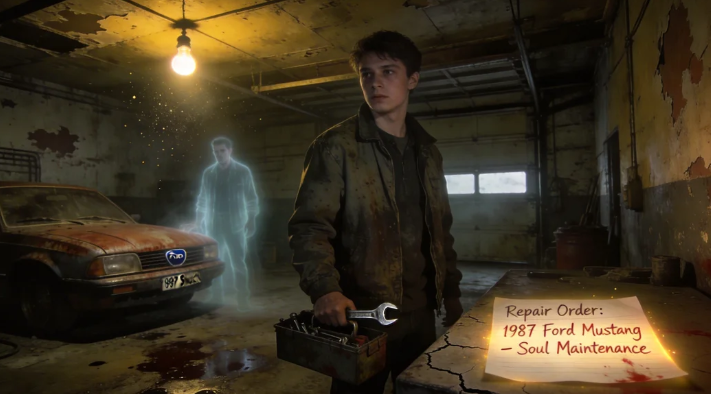
They say the harbor fog in Rotterdam tastes like diesel if you lick it straight outta the air. I wouldn’t know; I’m the guy who fixes the engines that suck that fog in and spit it back black. Name’s Milo, Milo Griggs, and the day Uncle Dirk’s lawyer rang me I was under a Peugeot with half a sump bolt in my mouth. “You’ve inherited the workshop,” he says, like he’s telling me I won a toaster. I figured free bricks, free hoist, maybe flip a couple vintage bikes and coast. I drove over that same night, rolled up the squealing shutter, and the smell hit me—grease so old it’s basically a ghost itself.
First thing I notice is the big Snap-on chest still locked. Uncle Dirk was paranoid; he kept the key round his neck even when he showered, Mom used to joke. Key wasn’t on any necklace now, so I did what any sane mechanic does: I grabbed the biggest flathead and popped the lid. Inside, every tool sat in its shadow, perfect like museum crap, except for one open slot shaped like a wrench nobody makes anymore. The silhouette looked weird—skinny neck, fat jaw, almost like a mouth screaming. I shrugged, slammed the drawer, and went to brew coffee on the hot plate that still worked.
That’s when the radio turned itself on. Old Bakelite thing, knobs gone, but it crackled alive and spat out numbers: “07 14 22.” Over and over, same monotone voice you hear at ferry countdowns. I yanked the plug; the voice kept going, softer, like it was leaking straight outta the wires. I laughed, nervous, told myself copper can hold a charge, blah blah. Then the lights dipped, and I saw footprints across the floor, boot prints dripping something darker than oil. They started at the Snap-on chest and stopped at the pit. I swear on my ten-mill the concrete was dry two seconds earlier.
I’m no hero; I grabbed my backpack and noped out, but the shutter jammed halfway down, like the building wanted me on overtime. That’s when she rolled in—this ancient Norton Commando, black tank, no plates, engine colder than the fog outside. Bike stood upright, no kickstand, just balanced. Headlamp flicked on, spotlighting me like I was on stage. I heard the word, not with ears, more like it dripped inside my skull: “Fix.” My hands moved on their own, popping the tank, pulling the plugs. Plug tips were rusted nails. Who does that?
I tried to say shop’s closed, but my throat only made tool noises—ratchet clicks, air-gun hiss. The Snap-on drawer slid open by itself, and that missing wrench floated out, hovering like a drunk bumblebee. It touched each nail-plug, twisted them soft as butter, then dropped into my palm. Cold. Colder. Skin-burning cold. The Norton fired up, one cylinder, then two, then a third note that definitely wasn’t combustion—more like a heartbeat. Bike rolled forward, pushed me toward the pit. I looked down and saw chains, thick ship chains, coiling up like snakes. They wrapped my ankles, gentle, almost polite, and tugged. I dropped the wrench.
Instantly everything stopped. Radio died, lights steady, chains gone. Only proof anything happened was the wrench on the floor, jaw dripping wet. I picked it up; etched on the steel, fresh as graffiti, were those same numbers: 07 14 22. I stuffed it in my pocket, shut the shop, slept in my van like a scared kid.
Next morning I did research, because Google’s cheaper than therapy. Uncle Dirk’s obit was short: “Industrial accident, July 14, 2022.” 07 14 22. The dude died the exact day he closed up early, complaining about a “final service customer.” Cops found him in the pit, lungs full of seawater though the shop’s five kilometers from tide. Case open, file dusty.
I should’ve walked away, but the wrench felt heavier every mile I tried to drive. Steering shook, engine coughed, until I turned back. Soon as I rolled the shutter up, weight lifted. Shop sighed, I swear, like it was glad I came home. On the bench sat a new work order, paper yellow yet ink fresh: “Replace impeller, customer: D. Griggs.” My uncle’s initials. I laughed until I cried; you can’t replace an impeller on a motorcycle. But the Norton stood there again, this time with the rear wheel fizzing foam like a boat prop. I smelled harbor brine inside the shop.
So I did the only thing a mechanic can do: I obeyed. I hoisted the bike, cracked the crankcase, and instead of gears I found a tiny ship’s propeller, bronze, spinning in place, throwing water in slow motion, each droplet hanging like a star. I reached in; blades sliced my thumb, blood mixing with brine. The prop stopped, waiting. I unscrewed it, swapped in a normal sprocket from a junked Yamaha, closed her up. Norton sputtered, lights dimming, then died quiet. For the first time the shop felt empty, like the silence after a customer finally pays cash.
I thought that was it, job done, ghost satisfied. I even locked the wrench back in the drawer, taped the work order on the wall like a trophy. But closing time, the radio returned: “One more.” Doors blew wide; fog rolled in thick as foam padding. A shape stepped through—Uncle Dirk, skin gray, coveralls dripping harbor water. He didn’t talk; he just pointed at the pit. Chains lay coiled again, this time with a seat carved from an old ship’s wheel bolted on top. Invitation or warning, who knows, but my legs walked me over. I sat. Chains wrapped gentle, almost father-like, and lowered me into darkness.
Down there it wasn’t dirt or concrete; it was the bottom of the Rotterdam channel, bikes and cars half buried, mechanics in coveralls drifting like kelp, each holding tools, each eyes glowing the same numbers. They reached out, not angry, just tired. I understood: every unfinished repair ties a soul to the shop that birthed it. Uncle Dirk had fixed machines his whole life, died mid-job, and created a backlog stretching into forever. He’d been waiting for another Griggs dumb enough to pick up the wrench. Now it was my shift.
I wanted to scream, but water filled my mouth, tasted of diesel and regret. Then I felt the wrench in my pocket again, numbers glowing hot. I grabbed it, swam to Uncle Dirk, and did what mechanics do: I tightened. I tightened the loose bolt on his chest plate, the one letting water pour through his ribs. When it snugged, light burst, chains rusted away, and the pit spat me back onto the shop floor, gasping air that never tasted sweeter.
Sun was rising outside; fog lifted like a bad debt. The Norton was gone, only a wet tire mark remaining. The Snap-on chest sat open, that one slot now empty. I walked over, slammed it shut, and snapped the lock. I keep the key on a necklace ever since. Some nights the radio still mutters numbers, but softer, like a reminder. I close up early, no matter how busy, because the last thing I want is another final customer rolling in balanced on nothing.
So if you ever break down near Rotterdam and see a shutter half closed, tools inside gleaming, don’t knock. Shop’s got a shift, and trust me, you don’t want overtime that pays in forever. Me, I just change oil, swap brakes, and whistle loud enough to drown the harbor. Because somewhere under the concrete a propeller still spins, and every bolt I tighten keeps one more soul from drowning. And the wrench? It’s wherever I lay it, jaw open like a mouth that remembers the taste of salt. Just numbers now, 07 14 22, etched behind my eyelids when I sleep, reminding me the job’s never really done—it just waits for the next mechanic dumb enough to inherit the keys.