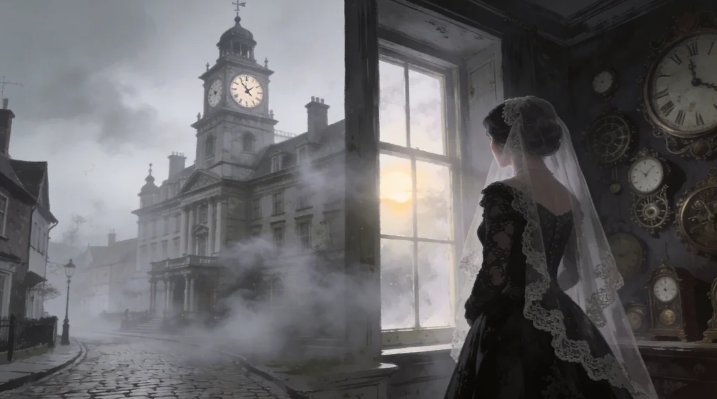
They say the hour before dawn belongs to the dead, so I always set my alarm for 3:59. That’s when the buses stop groaning and even the drunk crows tuck their heads under their wings. I moved into Larkspur Row the week the leaves turned the color of dried blood, renting the top floor of a house that used to be a clock shop. The sign still swings outside: “T. Hawthorn & Son, Timepieces Mended.” The son never came back from the Somme, and Mr. Hawthorn hung himself with a pocket-watch chain, but the place kept ticking anyway—like it forgot how to stop.
My landlord, Mrs. Plover, warned me the first night. “Don’t open the attic door, love. The widow’s still up there, winding.” I laughed, because widows knit scarves, not clocks, but she didn’t laugh back. She just pressed the key into my palm like it was hot. “She’s waiting for the hour that never comes.” Whatever that means. I was too broke to care; the rent was half anywhere else, and the walls smelled of rust and lavender, a combo that somehow felt like home.
The second week, the ticking started. Not polite, grandfather-clock ticking—more like a heartbeat with hiccups. It came through the pipes, through the floorboards, through the pillow I smashed against my ear. I marched downstairs in my polka-dot socks, ready to bang on Mrs. Plover’s door, but she’d left a note: “Gone to my sister’s. Back when the clocks strike thirteen.” Cute. Except clocks don’t do thirteen, do they?
That night I met her. I’d finally fallen asleep and dreamed of gears raining like hail. When I woke, the room was foggy inside, like someone had breathed ghost soup under my door. She stood at the foot of my bed, all in charcoal silk, veil trailing to the floor. Her face was a negative photograph—white skin, black lips, eyes like two broken watch glasses. No feet. Just hem, floating.
“You’re early,” she whispered, voice rusted shut. “He promised midnight forever, and the hands keep cheating.” I tried to scream, but it came out a hiccup. She glided closer, bringing the smell of wet iron. “Fix it,” she said, pressing a cold key into my hand—the same key Mrs. Plover gave me, only now it dripped. “Bring me the hour that got away.”
I bolted, barefoot, down the stairs, through the shop. Moonlight painted the dusty workbench silver. Hundreds of clocks covered every shelf, all stuck at 3:59, all shivering like they were cold. In the middle sat a grand tower clock, its door yawning open. Inside, no pendulum—just a heart, shriveled and blue, tied with a gold wedding ribbon. The ticking boomed right out of it.
My brain said run, but my fingers were already reaching. I caught the heart. It pulsed once, spraying rust across my pajamas. The widow appeared behind me, reflected in the glass face of a cuckoo clock. “Set it back,” she begged. “He swore time would stop when I died. He lied.” Tears of oil ran down her cheeks.
I don’t know squat about clocks, but grief I understand. My own mom waited at kitchen windows long after Dad’s taxi should’ve brought him home; the cancer took him at 3:59 pm. Maybe every ghost is just someone stuck on the wrong minute. So I did the dumbest, bravest thing: I climbed inside the tower case, squeezed the heart between the gears, and turned the hands backward. Metal screamed. The room spun like a carnival ride. I felt my own heartbeat sync with the machine—lub-DUB, lub-DUB—until I couldn’t tell which was me and which was iron.
When the dust settled, the clocks read 3:58. The widow smiled, a crack running across her face like porcelain. “One more minute,” she sighed, and dissolved into a swirl of soot that smelled of wedding cake. The ticking stopped. Silence poured in, thick as treacle. I crawled out, hands black, lungs full of rust.
Morning came, but the sun forgot to rise. The town stayed stuck in charcoal twilight, streetlamps flickering like tired fireflies. Mrs. Plover never returned. I keep the shop now, mending watches for people who don’t notice the sky’s broken. Every day at 3:59 I climb the tower, wind the heart one click, and give the widow her borrowed minute. It’s not much, but love—even dead love—needs maintenance, same as clocks.
Sometimes tourists ask why all my timepieces show the same time. I just shrug and say, “Some moments are worth repeating.” They laugh, buy a rusty brooch, leave before dark. If they stayed, they’d hear the faint beat under the floorboards: a woman and a machine, keeping each other alive, second by second, forever almost midnight.
Me? I’ve stopped aging. My reflection grows paler, hair blacker, eyes more like cracked glass. Soon I’ll be the one floating at the foot of someone’s bed, whispering, “Fix it.” But I’m not scared. Grief is just another kind of gear, and I’ve learned how to turn it. Tick, tock, love. Tick, tock.