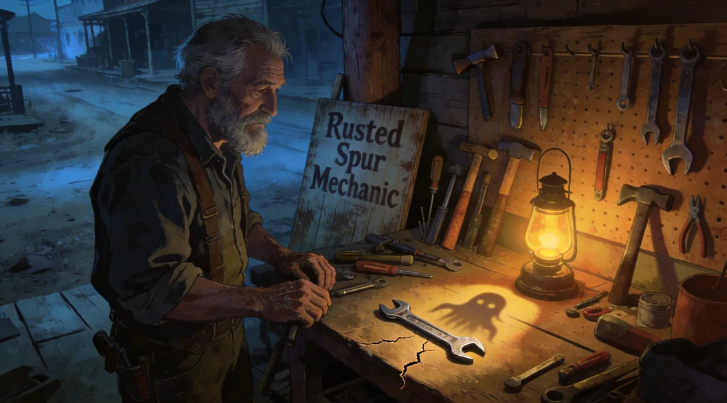
Most folks figured Manny Klimek was half nuts anyway, so when he said his favorite wrench hummed lullabies at night, they just nodded and backed away. The shop, a tin-roofed shack that used to be a horse barn, sat at the edge of the prairie where the wind sounded like a busted fan belt. Manny kept the place open twenty-four hours because, as he put it, “Ghosts don’t punch a clock.”
I rolled in around two a.m. with a coughing pickup, headlights flickering like they were shy. Manny shuffled out, overalls blacker than motor oil, eyes reflecting the neon "OPEN" sign that buzzed louder than any bug. He didn’t ask what was wrong; he just pressed his ear to the hood the way a mom checks a baby’s forehead. “She’s scared,” he muttered. I laughed, but it came out squeaky. Trucks don’t get scared—right?
Inside, the shop smelled of burnt rubber and something sweeter, like roses left too long in the sun. Tools hung on every wall, outlines drawn around them like chalk at a crime scene. One space was empty: the shape of a big adjustable wrench, fourteen inches long. Manny caught me staring. “She’s working tonight,” he said, voice low. “Been working ever since the accident.”
He told the story while he poked at my engine, voice mixing with the clink of metal. Ten years back, a traveling kid named Davey helped out for food and couch change. Davey loved that wrench more than anything, called her “Sweet Louise.” One stormy evening the kid crawled under a jacked-up Buick, asked Manny to hand him Louise. Manny turned to grab her—slipped on a grease patch. Car dropped. Davey lasted long enough to whisper, “Keep her singing, okay?”
Police called it tragedy; Manny called it unfinished business. He welded the Buick’s frame into a shop bench so it could never hurt again, but every night at 2:17 a.m. the wrench returned to the empty outline, dripping tiny drops of coolant like tears. Manny started leaving the radio on oldies, because Davey loved doo-wop. Said it kept the kid calm.
I wanted to bolt, but the pickup’s starter was toast and the town was thirty miles of nothing in every direction. Manny handed me a coffee mug that read “World’s Okayest Mechanic” and told me to stay inside the office while he finished up. The office was a closet with a cracked window and a calendar stuck on July 2009. On the wall hung a Polaroid: young Davey, freckles and crooked grin, holding Louise like a trophy fish. The photo fluttered though the air was still.
Outside, tools started moving by themselves. Screwdrivers spun in their slots, ratchets clicked out a rhythm—shave-and-a-haircut, two bits. I peeked through the grime. Manny stood in the bay, arms open, talking soft. “I know, kid, I miss you too. But you can’t keep bending folks’ tie-rods just to get my attention.” The wrench floated off the bench, hovering chest-high, turning slow as if showing off. Metal glinted green, not silver—like it soaked up years of dirty coolant.
Wind rammed the tin walls; the neon sign stuttered O-O-OPEN. Manny’s voice cracked. “Let the stranger go. He didn’t know the rules.” My heart pounded louder than any impact gun. Rules? I scanned the office: a dusty sign read “Customers: No After-Midnight Entries—Seriously.” I’d missed it; the doorbell had been ripped out. Great.
Louise drifted toward me, passing clean through the glass window like it wasn’t there. Cold hit my bones, same temp as the morgue I visited once after Dad passed. The wrench hovered inches away, then tapped my boot—gentle, almost shy. I felt words form inside my skull, rusty syllables: “Take me… finish… song.” My hand rose on its own, fingers wrapping around solid steel. No chill, just warmth, like holding a puppy that’s been lying in the sun.
Images slammed into me: Davey under the Buick, singing “Blue Moon” off-key, knuckles bleeding from stubborn bolts. He wasn’t angry about dying; he was terrified of being forgotten. The tune cut off mid-note that night, and he’d been stuck on repeat ever since. My throat opened and I sang the next line, voice shaky but close enough. Louise vibrated, humming harmony. From the bay, Manny wept openly, tears shining like chrome polish.
When the last note faded, the wrench grew lighter, transparent, until only the memory of weight remained. A breeze swept through the office, carrying the sweet-rot rose smell out into the prairie. Tools settled; the neon steadied. Manny stepped in, wiping his face with a rag that left more streaks than it took. “You did what I couldn’t,” he croaked. “Gave him an ending.”
He refused my money, slapped a new starter in the truck, and sent me off with a fresh thermos of coffee. As I pulled away, I saw him in the rearview, standing beside the Buick bench, talking to empty air that somehow felt less empty. The radio inside the shop switched off, and for the first time the prairie wind sounded like a finished song instead of a broken belt.
Two weeks later I drove past again—sun high, no reason to stop—but the shop was gone. Not burned, not boarded up; just gone, like someone erased it with a giant rag. Only thing left was that dusty Polaroid wedged under my wiper: Davey, freckles and grin, holding Louise. On the back, fresh grease-pen scribble: “Keep her singing, okay?” I keep the picture in my glove box now. Sometimes, late at night when the highway’s empty, I swear I hear doo-wop under the hum of tires. I roll the window down and sing the next verse, just in case a wandering kid needs to catch the tune and finally go home.