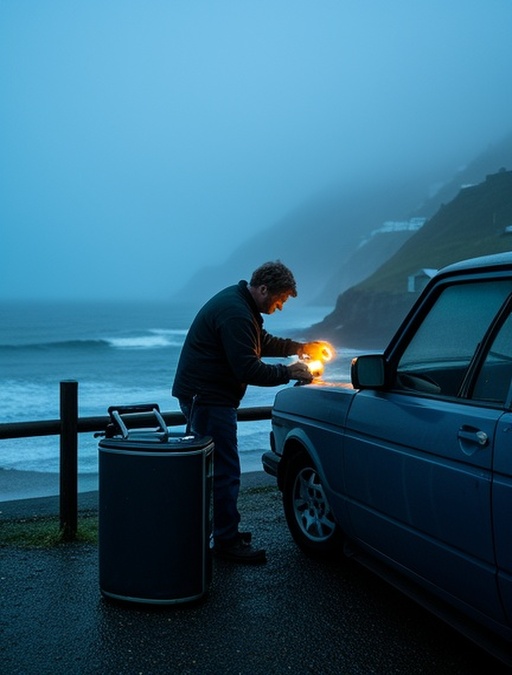
My name’s Len, and I run the only garage in Greyhaven, population three-hundred-if-you-count-the-cats. Folks here say the mist carries voices; I used to laugh until the night a ’73 Plymouth rolled in with the engine already dead and the headlights still blinking like it was trying to cry.
Customer was a woman in a coat too thin for October. She never gave her name, just handed me a wrench that felt colder than the night air. “Use this,” she whispered. “It knows what’s loose.” Then she walked off into the fog, barefoot, no footprints.
I should’ve tossed that wrench into the bay, but a tool’s a tool, right? I slapped it on the Plymouth’s crank bolt. Soon as the metal touched, the whole car shuddered, belts tightening themselves, hoses squirming back onto nipples like snakes finding their own tails. Engine fired up with a purr that sounded…grateful. I told myself I was tired, seeing things.
Next morning the bay floor was soaked with seawater though we’re two miles inland. Salt crusted the lift arms like someone dipped them in the ocean and pulled them out again. My phone buzzed: a text from an unknown number—just a single emoji, blue wave. No one in town admits sending it.
That week every car I touched fixed itself faster than I could diagnose. Spark plugs regapped, gaskets sealed, even a cracked block welded smooth while I blinked. Word spread; fishermen started leaving keys with notes: “Give her whatever she needs.” Money piled up, but the nights got heavier. I’d lock up, yet the compressor kicked on at 3 a.m., hissing like someone breathing behind me.
I tried leaving the cursed wrench at home, but it kept reappearing in my top drawer, wrapped in seaweed that smelled of diesel and rotting roses. One dusk I stayed late to confront whatever was happening. I killed the lights, sat on an oil drum, waited.
Midnight hit and the fluorescent bulbs flickered alive by themselves. Every vehicle rose on its suspension an inch, like they took a collective breath. Doors opened slow, hinges singing. From the Plymouth’s speakers came static, then the woman’s voice: “You tightened the world, Len. Now things slip through.”
I felt fingers—greasy, ice-cold—brush my shoulder though no one stood there. The air compressor chuckled, pressure gauge spinning past red. Tires rolled off racks, stacking themselves into a pyramid. I grabbed the haunted wrench, meaning to chuck it, but it twisted in my grip, pointing toward the open bay door where the fog pooled thicker than oil.
Out in the dark, engines idled that I’d never seen before: old Packards, Studebakers, rusted rigs that should’ve been crushed decades ago. Headlights formed a corridor of yellow eyes. They wanted in. The woman appeared again, this time behind the windshield of the Plymouth, palms pressed to glass. Her mouth moved: “Close the gap.”
I understood, kinda. Every bolt I’d over-tightened with that wrench pinched the world thin. Cars are just metal vessels, but they carry stories, regrets, ghosts who died on highways. I’d stitched the veil too tight and now the stitches popped.
So I did what any decent mechanic would: I grabbed the biggest breaker bar I owned, slammed the bay door shut, and started loosening every fastener I’d touched that week. Each turn spilled cold air that smelled of low tide. Bolts clattered to the floor like teeth. The lights dimmed, bulbs popping one by one, showering me with hot glass but I kept going.
When I reached the Plymouth, the woman nodded, almost smiling. I loosened the crank bolt the final quarter-turn. A sigh rippled through the garage so strong it rattled the corrugated roof. Then silence. The seawater soaked into the concrete, leaving only white stains shaped like tiny bones.
Cars outside coughed, sputtered, died. Their headlights blinked out in reverse order, like runway lights shutting down after a plane takes off. The fog rolled back toward the cliffs, taking the woman with it. She mouthed “thank you” before dissolving.
At dawn I found the cursed wrench split in half, rusted through like it had spent a century underwater. I buried it beneath the old kerosene tank out back, poured concrete over top, and planted rosemary—herb for remembrance, or maybe for forgetting.
Business is slower now, and I keep it that way. I tell customers some jobs just ain’t worth the money. Every so often a seabird smacks into the shop window, leaves a print of wings that looks eerily like open hands. I nod, say “I know,” and loosen a bolt a hair more than specs allow, letting the world breathe.
Engines still hum, but these days they sound content, not grateful. And when the mist rolls in thick, I stay inside, sipping coffee, listening for whispers. If I hear one, I grab my ordinary steel wrench—no magic, no chill—and give the nearest fender a gentle tap, reminding whatever’s out there that some gaps are meant to stay open, and some mechanics are done tightening things that should stay loose.