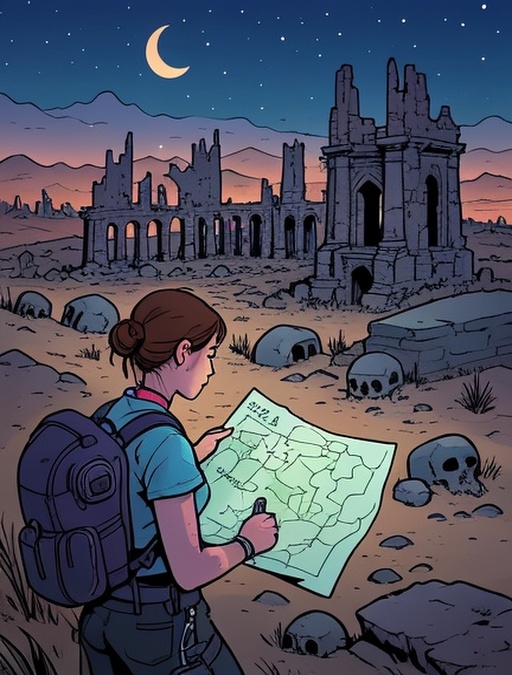
I was down to my last granola bar when the jeep died. The driver cursed in three languages, pointed at the dunes and said, “Walk that way, maybe you find your ghost city, maybe you die. Same price.” He took my last twenty, left me the map my granddad sketched in 1962, and drove off singing.
The sand swallowed the sun real quick. I walked till my boots filled with powder, and just when I was ready to cry, the ground hardened under me like bread crust. I stepped onto a cobblestone street that shouldn’t exist. Varn. The stones were warm, like they’d been waiting for feet to come home.
First thing I noticed: no wind, but the lanterns—rusty iron cages—were swinging slow, oil still sloshing inside. Second thing: every wall had tiny handprints baked into the clay, kid-sized, fingers spread like starfish. I touched one and felt a heartbeat, quick, rabbit-fast. My own heart answered like it had been called.
I set up my tent in what used to be a square. Midnight, the air tasted of copper pennies. Footsteps circled me—soft, barefoot—never close enough to see. I whispered “Who’s there?” and the city answered with a thousand sighs, the sound you make when you finally take off a heavy backpack. The tents walls puffed in, sucked out, like the place was breathing through the zipper.
At dawn I explored deeper. Found a well with no bottom, just black that hummed lullabies. Dropped a rock, counted to twenty, never heard it land. Instead, the hum got louder, words forming: “Lila… we kept your room.” My name, dusty but polite.
I ran, but every alley folded back to that well. Cartoons do that gag; real life does it meaner. On the fifth loop I met the boy. Seven, maybe eight, shirt the color of sunset, eyes silver like old TV screens. He held a wooden top that spun without stopping. “You’re early,” he said, “but late too.” Kid logic.
He led me through a doorway that appeared after he knocked on air. Inside, a feast waited—goat, apricots, flatbread steaming—yet the table was carved from a single block of salt. “Eat,” he insisted, “so you remember the taste when you forget everything else.” I bit bread, it crunched like snow, dissolved into nothing. My hunger stayed, now sharper.
The room filled with people dressed in yesterday’s fashions—flapper beads, bell-bottoms, smartphone holsters on belts made of camel hair. They chatted without sound, mouths moving like fish behind glass. Whenever I blinked, their faces swapped: my mom, my ex, the jeep driver, me at age four with front teeth missing. The boy tugged my sleeve. “They’re rehearsing. You’re the audience, but also the play.”
Night again. No stars, just ceiling of low-hanging dust. The lanterns burned brighter, showed murals I’d missed: people climbing into the well, waving up at those who stayed. Under each painting, tally marks—years, maybe. I counted one wall: 3,333 strokes. Felt like a receipt for souls.
I tried to sleep. The tent fabric turned heavy, soaked with whispers. “Stay,” they said, “the city shrinks when no one’s watching.” I unzipped, saw the buildings had crept closer, windows now staring at my campsite like nosy neighbors. The well was in the square with me, though I’d left it three streets away. Geography’s just a suggestion here.
The boy stood on the rim, top still spinning. “Last chance to leave,” he warned, “but the price is a story no one will believe.” I offered my granddad’s map. He tore it in half, gave back the blank side. “Now you can draw whatever exit you want.” The paper smelled of diesel and old promises.
I walked toward the dunes, drawing doors in the air with the torn map. On the third pretend knob, a real breeze hit my face—hot, salty, alive. I stepped through and the city screamed behind me, not scary, just lonely. Sand filled my shoes, normal coarse stuff again. I turned, saw only desert, no stones, no well, no kid.
My camera held 200 shots of empty dunes. Yet my pocket held the spinning top, still turning, warm as skin. Back in Ulaanbaatar I told travelers the tale over cheap beer. They laughed, called it desert madness. I laughed too, until the top wobbled, slowed, and I felt 3,333 heartbeats skip inside my chest.
Sometimes, late at night in my city apartment, I hear cobblestones under the floorboards. I open the fridge and smell salt bread. I know Varn is still rehearsing, waiting for the day I finally believe the story enough to return. And I will—because everyone needs a place that remembers their name, even if the price is being the ghost in someone else’s map.