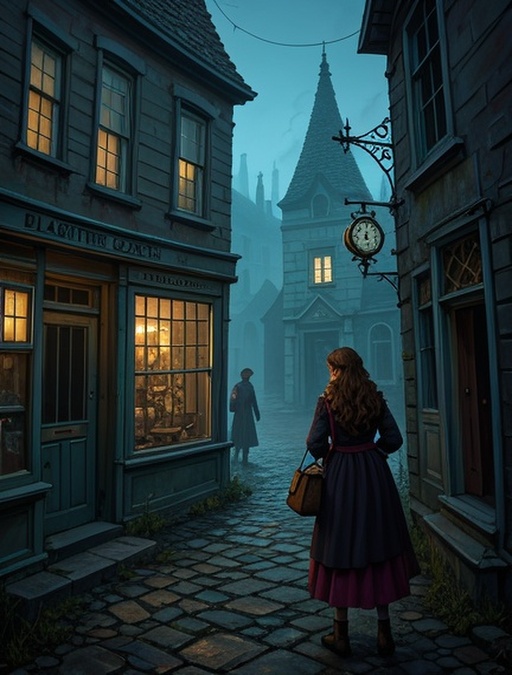
They say the fog in Blackthorn Row has teeth, but I never believed it till the night I nicked that silver locket from the junk table outside the clock shop. I was just a scruffy kid with a torn hoodie and no supper, so when the cold metal hit my palm I legged it, didn’t even look back. Big mistake, yeah? The locket snapped open the second I crossed the old stone bridge, and out poured a chime like a grandfather clock gargling glass. Creepy, but kinda pretty too.
Mum always told me, “Lila, curiosity feeds the cat, then kills it,” but Mum was half a country away in rehab, so her warnings felt like echoes from a busted radio. I hid under the railway arch, clicked the locket shut, and that’s when I heard the ticking. Not your normal tick-tock, more like a heartbeat wearing iron shoes. It came from the locket, from the air, from the marrow of the city itself. I should’ve dropped the thing, but the frost had made my fingers stupid, and the rhythm snuggled into my chest like it owned the lease.
By midnight the fog got thick as porridge. Gas lamps along the Row flickered green, the way bruises do before they turn purple. I felt someone watching, the prickly feeling you get when you forget to lock the loo door. I peeked out and saw her: tall veil, black lace dress, face nothing but shadow. The Clockmaker’s Widow, they call her, though nobody remembers her real name. She drifted toward me, boots silent, like the cobbles were too polite to squeak.
“Child,” she said, voice soft as coffin lining, “you’ve taken my husband’s pulse.” She pointed at the locket with a gloved finger so pale it glowed. I tried to speak, but my tongue felt stapled. She extended her hand, palm up, waiting. I thought about legging it again, but my knees were jelly and the ticking in my chest synced with the shop’s broken signboard overhead—creak, tick, creak, tick—like the whole street was breathing with me.
I dropped the locket into her glove. The moment it left my skin, the fog swallowed every sound. No trains, no rats, not even my own heartbeat. She smiled, or I think she did; the veil shifted. “Time is a debtor,” she whispered, “and tonight it collects.” Then she turned and glided back to the shop, door yawning open by itself. I should’ve stayed put, yeah, but the silence felt worse than any scream, so I followed, boots squelching like guilty sponges.
Inside, clocks covered every wall, but none showed the same hour. Some ran backward, others spun so fast the numbers blurred into white eyeballs. Candles guttered blue, dripping wax that smelled of rain on tombstones. The Widow stood by a workbench littered with gears the size of teeth. She pried the locket open, and instead of a photo, there was a tiny watch face, hands whirling like drunk spiders. “My husband tried to cage death,” she murmured. “Instead he married it.”
She placed the locket inside an enormous grandfather clock at the center of the room. The clock had no glass, just iron ribs, and when the locket touched the pendulum, every other clock stopped. The quiet hit me like a slap. She removed her veil. I wish she hadn’t. Her face was smooth porcelain, cracked in a lightning pattern, with clock hands ticking behind the fissures. Midnight lived inside her skin. “Look,” she said, tilting her head. Through the cracks I saw memories: the clockmaker winding his final spring, coughing blood into brass polish, promising her forever if she let him store his dying heartbeat in the locket. She agreed, not knowing forever meant she’d babysit his seconds for eternity while he slipped into peaceful nothing.
“I’m tired,” she confessed, voice suddenly small, almost human. “Thirty years of ticking for two. I want silence, but the shop won’t let me leave till another heart volunteers.” She gazed at me, eyes pools of frozen oil. My legs tried to bolt, but the floorboards twisted into clock hands, gripping my ankles. Panic tasted like copper pennies. I begged, promised to return the locket, to forget the whole night, but she shook her head. “Time keeps its own accounts.”
Then I remembered Mum’s lullaby, the silly one about the robin who tricked winter by offering a stolen second. Desperate, I sang it, voice shaky but loud. The Widow froze. A single tear, black as ink, rolled down her porcelain cheek and landed on the workbench, sizzling. The tear formed a tiny gear that spun backward. All around us, clocks lurched in reverse. The iron hands released my ankles. I lunged, grabbed the locket, and hurled it into the candle flame. It melted fast, gold dripping like sun-blood. The shop screamed—a metallic, wounded howl—and the walls cracked, spilling moonlight.
The Widow staggered, fissures widening till her face looked like a dropped plate. But instead of shattering, she sighed, sound pure and quiet, like snow falling on a forgotten grave. The ticking inside her slowed, then stopped. She smiled, real and gentle. “Thank you,” she mouthed, voice nothing but breath. The fog poured in through the splintered roof, swirling around her like a curtain call. When it cleared, she was gone, leaving only a pile of white dust and a single intact clock hand pointing at freedom.
I ran out as the shop collapsed behind me, bricks sighing into rubble. The Row looked normal again, lampposts yellow, fog harmless and dumb. I still hear ticking sometimes, but it’s just my own heart, loud and alive. I keep the melted locket in my pocket, a lumpy reminder that time can be bargained with, if you’ve got a song and a pinch of nerve. And whenever I pass the ruins, I leave a flower on the stones, because even debts deserve a little beauty, yeah? The Clockmaker’s Widow got her silence, and I got my tomorrow. Fair trade, I reckon, though I never linger past midnight. Some bargains stick like rust, and I’ve no wish to be late for my own funeral.