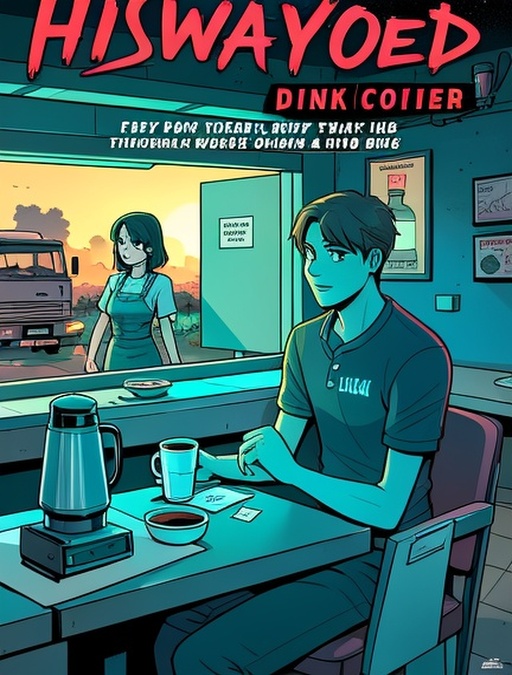
I’m Luka, I flip burgers for six bucks an hour at Moonrise Diner, the kind of place that smells like burnt coffee and lost dreams. Last Tuesday my boss begged me to work the night shift ‘cause Rosie called in “sick” again—code for hung-over. I said yeah, sure, I need the cash for my mom’s pills. How bad can it be, right? Midnight to six, just me, the sizzling grill, and the hum of the neon sign that flickers EAT EAT EAT like it’s trying to hypnotize you into obesity.
First three hours crawl by slower than ketchup. I’m wiping down counters when the door jingles and in walks this girl, couldn’t be older than twenty, skin like printer paper, hair so black it eats the light. She’s wearing a velvet coat in July, no sweat, no problem. Sits at the counter, taps a fingernail that’s more claw than nail, and says, “Coffee, still warm from the vein.” I laugh, think it’s a joke, pour her the oldest brew we got. She sniffs it like a sommelier, frowns, but drinks anyway, lips never parting enough to show teeth.
She keeps staring at my neck, not in a flirty way, more like she’s reading the expiration date on a milk carton. I try small talk: “Long night?” She shrugs, says, “Nights are long, life’s longer, unless it’s not.” Real cheerful stuff. I busy myself refilling napkin holders. When I turn back she’s gone, coffee cup empty, but there’s a crumpled napkin on the counter soaked red. I poke it: fresh blood, warm as pancake syrup. My knees go soft. I chuck the napkin in the trash, wash my hands till they’re raw, tell myself it’s fake, movie prop, whatever.
Two a.m., truckers thin out, radio plays static pretending to be music. I feel her before I see her—like someone opened a freezer behind me. She’s back, now in the booth corner, coat collar up, eyes glowing faint under the busted bulb. “You dropped this,” she says, holding the same bloody napkin, now pristine white. My trash can is empty. My stomach drops like a burnt fry. “Look, lady, I don’t want trouble.” She smiles, finally shows teeth: two neat little fangs, cute almost, like plastic vampire caps from Halloween. “Trouble wants you, Luka,” she whispers, and I swear the jukebox skips though nobody punched a song.
She knows my name—never told her. My scalp tingles. I back into the kitchen, grab the biggest knife we got, the one I use to halve frozen patties. Blade’s duller than my future but it feels good in my hand. When I peek back out, she’s standing right in front of the pass-through window, eyes level with mine though the floor’s a foot lower on my side. “You’re sweating,” she says, voice soft like a lullaby. “Sweat smells like copper and fear. Delicious combo.” I wave the knife. “Stay back, I’ll call the cops.” She laughs, sound of ice cracking on a winter lake. “Phone’s dead, Luka. Check it.” I lift the receiver: no dial tone. Of course—Rosie forgot to pay the bill again.
She slides into the kitchen without moving the door, like reality glitched. Knife feels stupid now, like bringing a spatula to a gunfight. “I’m Mira,” she says, tilting her head. “And you’re dying.” I wanna laugh, but something in her voice rings true, the way a doctor said “tumor” to my dad and we all pretended we misheard. “Everybody’s dying,” I mutter, trying to sound tough. “True,” she nods, “but you’re speeding. Heart murmur, left valve leaking like a busted soda machine. You’ve got weeks, maybe days. I can smell the flutter.”
My chest suddenly hurts, like her words poked the exact wrong spot. Mom’s pills, hospital bills, my crappy future flash before me: a closed diner, a closed casket. Mira steps closer, boots silent on greasy tiles. “I can fix it,” she offers. “Eternity’s just a bite away. No more rent, no more pain, no more ketchup stains on your shoes.” I swallow. “What’s the catch?” She grins wider. “You work for me. Night shift, forever. Different diner, same lonely road. We always need someone to keep the coffee hot and the secrets quiet.”
I picture decades of frying eggs while the world spins on daylight without me. Sounds like hell wearing an apron. But then I see Mom’s face, her hands shaking when she tries to open pill bottles. I grip the knife tighter. “Pass,” I say, voice cracking like old vinyl. Mira sighs, actually looks sad. “Most say yes. They beg. You’re boringly brave.” She reaches out, touches my wrist with fingers cold as a corpse in the walk-in freezer. Pain shoots up my arm, but also warmth, like morphine mixed with summer sun. My knees buckle.
Next thing I know I’m sitting on the floor, back against the fridge. Mira crouches, licks a drop of my blood off her thumb—must’ve nicked me when she grabbed. “Tastes like stubborn,” she mutters. “Fine. I’ll come back tomorrow. And the day after. Offer stands till your heart quits. After that, you’re just menu.” She stands, coat swirling though there’s no breeze. At the doorway she pauses, tosses something small. I catch it: a brass key, old-timey, teeth shaped like tiny fangs. “Lock up when you leave,” she says, vanishing into the dark beyond the neon.
Sunrise paints the windows pink. My chest still hurts but different now, like the pain’s been organized, given a schedule. I finish the shift, serve the early-bird truckers, wipe counters, count tips: thirteen bucks and a key that burns cold in my pocket. I clock out, walk home, streets already hot. Mom’s asleep on the couch, pill bottle empty on the table. I kiss her forehead, feel her fever. My own heart thumps steady, valve still leaking, but now I know the deadline.
That night I return the key to the diner, hang it on the hook labeled “Restroom.” I tape a note above: “Rosie, quit stealing from the register or the night girl will eat you. –L.” I quit the next day, start applying to day jobs, places with windows, places that serve salads and hope. Some afternoons I feel her watching—shadow in the rearview, chill in a crowded mall. My heart still skips beats, but now each flutter feels like a reminder: time’s short, make it sweet, add extra fries to every order.
Winter comes. Mom’s stronger, new meds, new smile. I work at a flower shop, sunlight and pollen everywhere. One evening I’m locking up when I find a single black rose wedged in the gate, petals cold as January. Attached: a napkin stained red, this time with lipstick print shaped like a tiny heart. I smile, tuck it in my apron. Some girls bring you flowers; others offer forever. I got petals and a pulse—beats messing up, but still mine. Tomorrow I’ll buy Mom tulips, yellow as sunrise, and maybe, just maybe, I’ll live long enough to see them wilt. If Mira comes back, I’ll offer her coffee, still warm, and tell her I’m busy living. Let the night shift stay hungry. I’ve got daylight to spare.