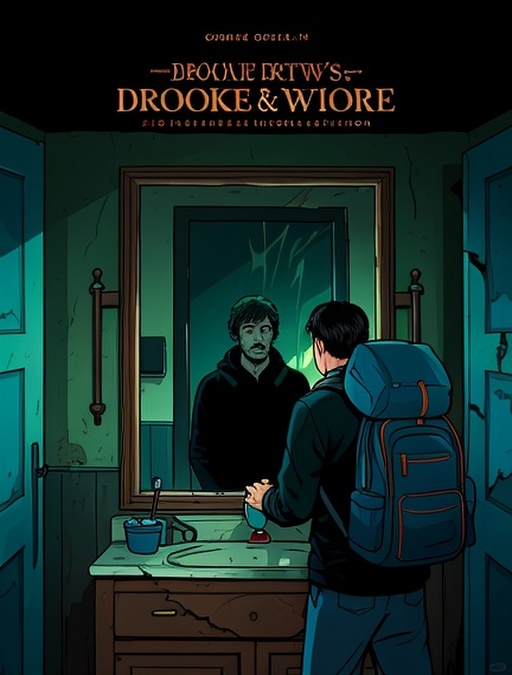
So I’m skint in Shropshire, right? Like, two-quid-and-a-bus-ticket skint. I’d been sleeping in this abandoned bus shelter that smelled of wet dog and regret when this little old lady, Mrs. Fenn, pops her head out of a hedge and goes, “You look like you could move furniture for a sandwich.”
Her house, Rose Thatch, was the last one on Willow Lane, half swallowed by ivy and gossip. Locals crossed the street rather than walk past it, but hunger’s louder than village whispers, so I said sure. She led me through a door that squeaked like it was telling on us already.
Inside smelled of mothballs and something older, like dirt that’s given up. She points at a mirror the size of a fridge, leaning against the far wall. Thing’s frame is carved with dragons biting their own tails, paint peeling like sunburn. “That stays,” she says, voice wobbly. “But everything else—shift it till the house feels… lighter.” Then she hands me half a cheese-and-pickle sarnie, and I swear it’s the best thing I’ve ever eaten.
I start shoving sofas, humming whatever tune was stuck in the hostel last week. Every time I pass that mirror, the room behind me in the glass looks different—like, the wallpaper’s greener, the ceiling taller. I blame cheap cider hallucinations and keep going.
Afternoon slides into evening. I’m dragging this heavy oak table when I notice the bagua compass I’d seen on YouTube. It’s etched right into the floorboards under decades of grime, but nobody mentioned it when I googled the cottage. Eight trigrams, faded but proud. I’m no expert, but even I know you don’t just plonk a telly on top of your health corner and call it Netflix.
I fetch a rag, wipe the symbols. The cloth comes up black, like the house is bleeding ink. Suddenly the air feels thick, like breathing through a wet towel. The dragons on the mirror twitch—honest to God twitch—wood creaking like joints standing up too fast.
I back away, heart doing drum’n’bass. Mrs. Fenn appears with two mugs of cocoa that smell of cinnamon and “please don’t leave.” She tells me her Harold bought the mirror in Kowloon back in ’72. Vendor said it’d balance any space, but only if the space wanted balancing. “Harold laughed,” she whispers, “then he stopped sleeping.”
She shows me a photo: Harold, skinny, eyes like burnt toast, standing in front of the mirror. Behind him, in the reflection, there’s no Harold—just a smudge shaped like a man with too many elbows. I nearly drop my mug.
“I moved everything except that,” she says. “Thought if I left the mirror be, the house’d settle. But it’s feeding, love. Feeding on whatever’s out of place.” She pats my arm, nails blue as dusk. “You’ve got young energy. Maybe you can tip it the right way.”
Now, I’m the kind of guy who loses at rock-paper-scissors against himself, but guilt’s cheaper than rent. I google “DIY feng shui exorcism” and get a mish-mash: salt lines, singing bowls, and something about mirrors being portals if they face north. This one faces whatever direction scares you most.
I raid the kitchen: coarse salt, a rusty spoon, and Harold’s old radio that only picks up shipping forecasts. I draw a salt circle so wide it looks like someone sneezed icing sugar across the lounge. Then I drag the mirror till it faces the front door—logic being, if it’s a door, let the nasty march straight out.
Big mistake. The moment the frame crosses the bagua circle, the glass ripples like pond water. My reflection steps back but I haven’t. It lifts a hand; I don’t. Then it smiles, wide, wider, cheeks splitting till dragons crawl outta the cracks. Real dragons, tiny but furious, made of splinters and spite.
I scream the kind of scream that makes dogs three farms over howl. Mrs. Fenn just stands there, cocoa gone cold, whispering, “It’s choosing.” The house groans, floorboards buckling like a ship in a storm. I feel something tug inside my chest—like homesickness mixed with gravity—and realise the mirror’s trying to swap us: me for the thing that’s been living in the reflection since Harold stopped sleeping.
No way, José. I grab the radio, whack the glass with its aerial. Sparks fly, shipping forecast turns into gargling static. The mirror cracks, one perfect line down the middle, and the dragons freeze mid-snarl. For a heartbeat everything’s quiet, even the dust motes hold their breath.
Then the crack seals, smooth as lying. My reflection winks. I’m toast, I think. Proper charcoal.
But Mrs. Fenn shuffles forward, places her sandwich plate against the glass. “You’re full,” she tells the mirror, voice steady as Sunday. “You’ve had Harold, near had me. You’re done.” She turns the plate sideways—cheese smeared like a yellow eye—and the reflection blinks first. The dragons hiss, curl into the frame, wood swallowing them back.
Glass fogs over, shows nothing but the plate and the salt. I feel the tug release, like someone let go of my T-shirt. The house exhales, warm and biscuit-scented. Floorboards settle, ivy outside stops tapping the windows.
We shove the mirror out the front door, frame scraping like it’s arguing. Dawn’s bleeding over the hedges as we tip it into the lane. Mrs. Fenn produces a hammer from her apron—of course she does—and we smash the thing to glitter. Each shard shows a different Rose Thatch: some burnt, some blooming, some never built. When the last piece cracks, the air smells of rain on hot bricks.
She makes me proper toast after, butter melting like apology. Says the house feels lighter than it has in forty years. Gives me twenty quid and a wool blanket that smells of lavender and safe. I kip in the spare room, no mirrors, and dream of dragons biting their tails till they turn into tiny houses with open doors.
Next morning I leave before the village wakes. At the lane’s end I glance back: Rose Thatch sits neat, ivy trimmed, windows shining like it’s laughing. Mrs. Fenn waves from the garden, shadow exactly where it should be.
I still avoid mirrors when I’m tired. Just in case one of them’s hungry, and I’m still out of place.