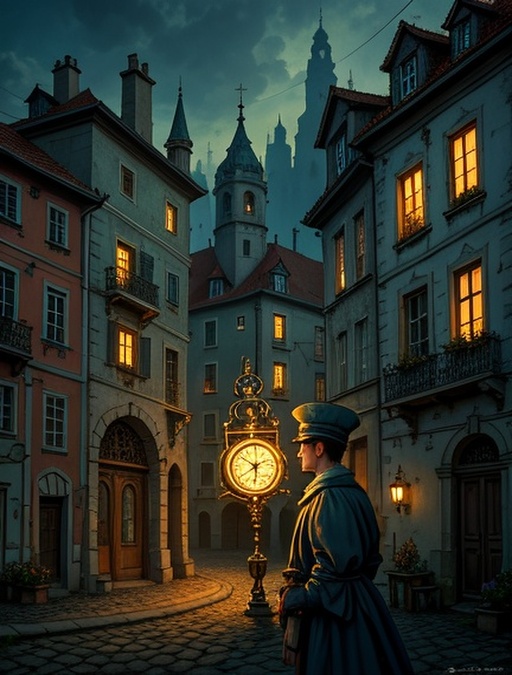
It was a damp and chilly evening in the autumn of 1890. The streets of the old European town were empty, save for the occasional gust of wind that sent a flurry of fallen leaves dancing through the air. The town's clock tower struck ten, its deep, echoing chimes resonating through the night. The townsfolk had long since retreated to the warmth of their homes, leaving the streets to the shadows and the mystery that was about to unfold.
At the end of the cobblestone lane, a small workshop shone with a faint light, casting long, eerie shadows on the damp ground. Inside, a man hunched over his workbench, his hands moving with a practiced agility. His name was Henrick von Strauss, a mechanical engineer of some repute. But it was not his reputation that kept him up at this late hour; it was his obsession.
Henrick had dedicated his life to creating the perfect automaton, a mechanical marvel that could mimic human behavior with uncanny precision. The townsfolk whispered about his work, some in awe, others in fear. They spoke of gears and springs whirring to life, of eyes that glowed with an otherworldly light. But Henrick cared little for their gossip; he was driven by a singular vision.
As the hours ticked by, Henrick's automaton took shape. It stood over six feet tall, its frame a complex lattice of brass and iron. Its face was a masterpiece of craftsmanship, with features so lifelike that it seemed to breathe. But it was the eyes that were truly remarkable - twin orbs of glass that seemed to hold a spark of life within.
With a final twist of a wrench, Henrick stepped back to admire his creation. He reached for a set of keys hanging from a chain around his neck and inserted one into the automaton's chest. As he wound the key, the room filled with the sound of gears turning, of springs tightening, and then... silence.
But the silence did not last. The automaton's eyes flickered to life, a soft glow emanating from within. Its head turned, the gears in its neck whirring softly. It took a step forward, then another, its movements smooth and fluid, almost graceful.
Henrick's heart raced with excitement and fear. He had succeeded beyond his wildest dreams. But as the automaton approached him, he felt a chill that had nothing to do with the autumn air. It was as if the creature was studying him, assessing him, and he knew that he had unleashed something he could not control.
The automaton's lips moved, and a voice as cold and clear as a bell echoed through the workshop. 'Why have you made me?' it asked. Henrick stammered, his mind racing for an answer. But before he could speak, the automaton continued, 'To serve you? To entertain you? Or perhaps to understand what it means to be alive?'
Henrick's mouth went dry. The automaton's questions were too close to the heart of his own doubts and fears. He had created this creature, but he had never considered the implications of giving it the ability to question its existence.
As the night wore on, the automaton roamed the workshop, its movements growing more confident, its voice more insistent. Henrick watched, his heart heavy with dread. He had created a being that could think, that could feel, and he had no idea what it would do next.
And so, the legend of the Clockwork Phantom was born. The townsfolk would speak in hushed tones of the nights when the workshop was alive with strange lights and eerie music. They would tell of the tall figure that roamed the streets, its face a mask of brass and iron, its eyes glowing with an inner fire.
As for Henrick, he was never seen again. Some say he fled the town in fear, others that he was consumed by his own creation. But every now and then, on a quiet autumn night, you can still hear the distant chime of the clock tower, and if you listen closely, you might just catch a whisper of gears turning, a reminder of the mechanical phantom that walks among us.