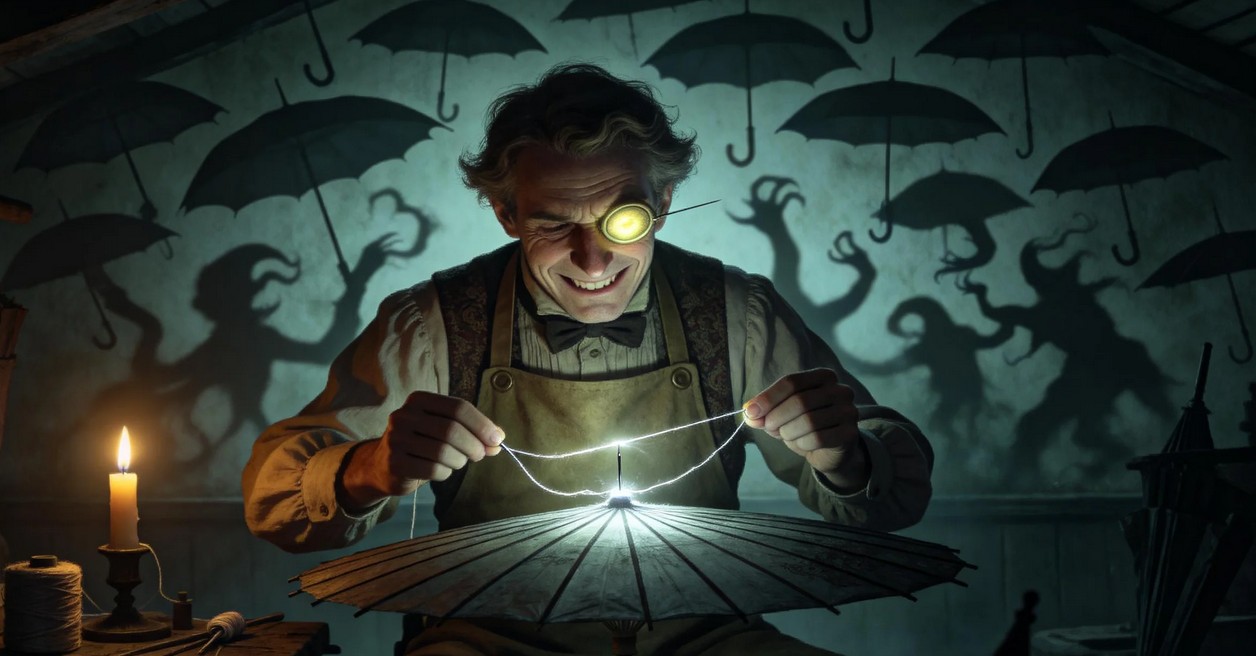
The hill village of Shuanghe was famous for two things: perpetual drizzle and oil-paper umbrellas. Every family soaked bamboo, stretched silk, painted peonies—except Grand-aunt Mei. She stitched umbrellas with human hair.
“They last longer,” she told customers, voice soft as rain. No one asked whose hair.
Seventeen-year-old runaway Lin Jia reached Shuanghe at dusk, backpack damp, phone dead. She needed shelter and a story—any story—to sell to city magazines. The village inn was boarded up; only Mei’s workshop glowed. Its sign read: 美氏老伞 (Mei Old Umbrellas) – Repairs While You Wait.
Inside, hundreds of umbrellas hung upside-down like sleeping bats. Each canopy bore a single red Chinese character: 归 – “return.” Mei sat beneath them, needle glinting. Her own hair, silver-streaked, brushed the floor.
“Room for the night?” Mei asked without looking up. “Pay with what you can spare.”
Jia offered a cheap wristband. Mei sniffed it, nodded, pointed to a ladder leading to a loft. “Don’t open the windows after the ninth bell.”
Rain drummed harder. Jia slept, but woke to the sound of cutting—snip, snip—like scissors beside her ear. Moonlight slanted through the shutter. Something silky brushed her cheek: a long black strand, warm, freshly severed. It slid across the floorboards toward the ladder, snaking downward.
Jia crept after it.
In the workshop Mei hummed, threading the black strand through an unfinished umbrella. The frame was not bamboo—it was pale, jointed, too slender. A human rib. Mei pulled the hair taut; the canopy opened halfway, revealing painted scenes that moved: a girl running along a highway, thumb out; the same girl entering Shuanghe; the same girl lying still under umbrellas while her scalp was calmly unzipped.
Jia’s knees buckled. She bit her lip to stay silent.
The ninth bell tolled from the village shrine. Every umbrella in the rafters opened at once. From their centers dripped dark water that smelled of iron. The puddles joined, forming a mirror. In it Jia saw no reflection of herself—only Mei, younger, smiling, holding a baby whose umbilical cord was a red thread. Mei cut the thread; the infant cried once, then was silent. The thread was wound onto a spool labeled 归.
Mei lifted her gaze to the loft. “You woke early, child.”
Jia bolted for the door. It melted into wet paper. She clawed; her nails came away coated in white paste—ground bone mixed with lacquer. Behind her the umbrellas rotated like slow fans. Hair strands descended, looping around her wrists, ankles, neck. Each time a strand tightened she felt memories leak away: the taste of city hotpot, her little brother’s laugh, the reason she had run.
Mei stepped closer, needle shining. “Every umbrella needs a spine, every spine needs a name. Your journey ends; the umbrella begins.”
Jia, choking, managed one word: “Why… the character 归?”
“So the lost know where to go,” Mei whispered. “Back inside, back to me. Rain carries them. Hair holds them.”
The canopy closed over Jia’s head like a giant flower at dusk. The last thing she heard was the sound of rain stopping—because the umbrella had drunk it all.
Dawn. Shuanghe’s cobblestones steamed. Tourists arrived, eager for authentic umbrellas. Mei displayed a new masterpiece: white silk painted with midnight highway, a girl’s silhouette thumb-out. The canopy smelled faintly of cheap plastic wristbands.
A German backpacker bought it for double price. As he left the village the rain began again—only over him. Drops tapped the silk, forming Chinese characters that no one read: 带我回家 – take me home.
The umbrella never dried. At night the buyer dreams of a loft, of scissors, of hair growing longer and longer, stitching him to a place he has never been… and yet remembers.
Locals now count their umbrellas at closing time. Always one extra. Always one less stranger.