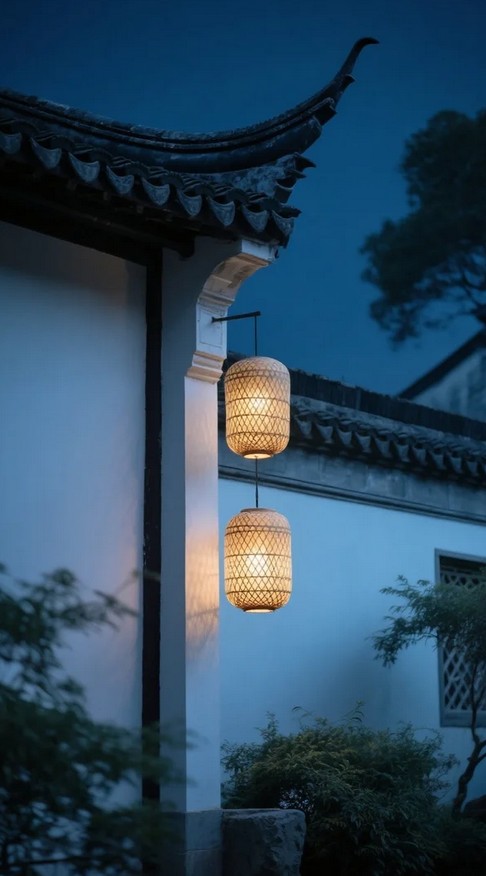
When American backpacker Zoe arrived in Beijing’s hutongs, she expected cheap beer and noisy bars. Instead, she found a narrow alley no map showed, its bricks veiled in red paper scraps left from last Spring Festival. At the end stood a deserted siheyuan, its wooden gate half open, a single crimson lantern swinging inside the courtyard though no wind blew.
Drawn by curiosity, Zoe stepped in. The lantern’s paper skin was painted with golden 福 (fú) characters, but every stroke was upside-down, the Chinese symbol for “luck inverted,” hinting at misfortune invited inside. As she raised her camera, the lantern dimmed, and the gate slammed shut behind her.
The air smelled of burned incense and something older—wet earth from an unearthed grave. A woman’s voice drifted from the main hall, humming the Mo Li Hua folk tune. Zoe followed it, pushing open carved doors whose red paint peeled like dried blood. Inside, an antique sewing machine worked by itself, its pedal thumping, though no cloth fed through the needle. On the wall hung a bridal qipao stitched from white silk, the color of Chinese mourning.
The humming stopped. The lantern outside brightened, casting long shadows shaped like bound feet. Zoe felt something brush her ankle—soft, too soft—and looked down to see the qipao now pooled at her feet, sleeves reaching for her arms. When she tried to step back, the sewing machine needle snapped, ricocheting into her shadow. Where it pierced, pain flared as though the needle had sewn her soul to the floor.
Doors banged shut in every room, echoing the traditional gong of a Ghost Wedding. On the central table appeared two cups of baijiu and a plate of mooncakes cracked open to reveal not lotus paste, but finger bones. Zoe remembered her Chinese classmate once saying: if you taste food meant for the dead, you join their banquet.
She hurled the cup away. The liquor spilled into the shape of the character 死 (death), seeping across the dusty floorboards. The lantern’s light turned jade-green, the color of grave goods. Wind rushed in, carrying paper talismans someone had burned long ago; their ashes reassembled mid-air into the outline of a bride with no face, arms outstretched.
Zoe fled toward the gate, but it was sealed by an invisible screen, cold as jade. The bridal qipao lifted behind her like a second skin. She remembered another piece of folklore: spirits cannot cross a line of uncooked rice. Frantically, she emptied her snack bag, pouring rice in a sloppy arc. The qipao recoiled, sleeves hissing like scalded snakes.
The gate creaked open just wide enough. Zoe dove through, rolling into the alley as the crimson lantern exploded in a shower of sparks that spelled one last upside-down 福. When she looked back, the siheyuan was gone—replaced by a new Starbucks whose neon sign flickered, then steadied, as if it had always been there.
She left Beijing the next morning, but on every following Chinese New Year, no matter where she traveled, she found the same upside-down 福 pasted on her hotel door. And somewhere outside, a crimson lantern always swung without wind.