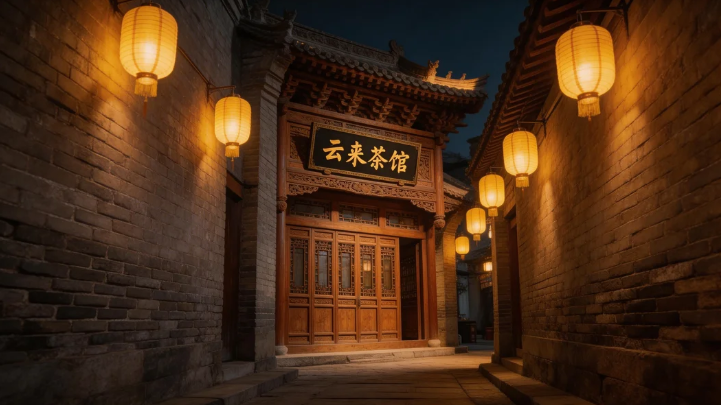
Backpacker Jonah had one night left in Xi’an before his flight home. Locals whispered about a century-old teahouse hidden in the Muslim Quarter where, after 11:11 p.m., the owner staged shadow-puppet shows for no audience. Curious, Jonah followed a lantern-lined alley until he found the place: a wooden two-story siheyuan whose signboard read “Yunlai Teahouse” in faded lacquer. A single red paper-cut of the character 影 (shadow) was glued to the door—backward, as though meant to be read from the other side.
Inside, sandalwood incense warred with the sour tang of aged pu-erh. Oil lamps flickered along the walls, casting silhouettes that moved an instant too late. An elderly man in a mandarin-collar jacket greeted Jonah without looking up and gestured toward a worn kang table. On it sat a delicate Yixing clay teapot shaped like a coiled dragon; steam rose, though no fire burned beneath.
“One cup, one story,” the owner murmured, pouring tar-black tea into a paper-thin porcelain cup painted with tiny 寿 (longevity) symbols—every one cracked. Jonah drank. The liquid tasted of iron and winter plum, leaving a film on his tongue that refused to dissolve.
At exactly 11:11 p.m., the lamps dimmed. A white silk screen unfurled against the far wall. Behind it, a single candle ignited, revealing a leather puppet: a scholar with a movable jaw. But the puppet’s shadow on the screen was not the scholar—it was Jonah’s silhouette, briefcase and all, as though the light had reached across the room and peeled his image away.
The owner began to narrate in Shaanxi dialect, voice creaking like un-oiled hinges. Each time he flicked a rod, the puppet moved, and Jonah felt an invisible string tug the corresponding limb. When the scholar-puppet bowed, Jonah’s spine snapped forward; when it raised a paper sword, Jonah’s arm lifted against his will, scattering teacups. Shards flew, yet the cups reassembled mid-air, refilled with tea the color of coagulated blood.
Jonah tried to stand, but his shadow was nailed to the screen by the puppet’s paper sword. He remembered a scrap of folklore: if your shadow is trapped, you must break the line of light. Seizing the dragon teapot, he hauled it onto the candle’s path. The clay shattered; boiling tea doused the flame. For an instant the room went pitch black.
When the oil lamps fluttered back, the screen was empty. So was the kang table—no teapot, no cup, not even a stain. The owner was gone, leaving only a paper-cut of the character 影 lying face-up, now sliced cleanly in half. Jonah’s shadow had returned, but it lagged two steps behind him no matter how quickly he moved.
He stumbled outside. The Muslim Quarter was silent; every storefront had its iron curtain drawn, and the lanterns that once lined the alley lay extinguished, wicks cold. Yet from each darkened doorway drifted the scent of pu-erh and sandalwood, as though the teahouse had stretched itself thin, slipping into every crack of the old quarter.
Jonah caught the airport bus at dawn. As the plane lifted off, flight attendants served complimentary tea—pu-erh, strong and metallic. When he raised the cup, he saw the inside rim: painted with tiny cracked 寿 symbols. His shadow, projected onto the cabin wall, lifted its own cup in salute… and drank first.