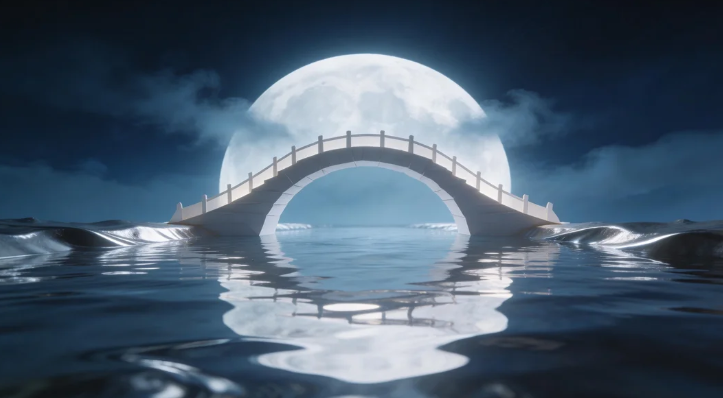
Travel blogger Mara reached Suzhou after midnight, chasing rumors of a “paper-moon bridge” that appears only during the Ghost Month’s final hour. Locals warned her never to cross it: “The bridge borrows your reflection to patch the sky.” Armed with her phone and a pocketful of joss sticks, she ventured into the quiet garden quarter where ancient canals glimmered like spilled mercury.
At 1:00 a.m. sharp, fog rose from the water and folded into origami clouds. Where a stone bridge had stood that afternoon, a new span now arched—constructed entirely from rice-paper ingots folded like gold nuggets used in ancestral offerings. Every step released the scent of burnt hell-money. Underneath, the canal reflected not the city, but a full moon printed on crinkled paper, its cratered face hand-painted with the character 冥 (underworld) instead of the usual 月 (moon).
Mara’s phone battery died the instant she set foot on the bridge. Paper planks flexed like damp cloth yet held her weight. Halfway across, she heard scissors snipping behind her. Turning, she saw an old woman in Qing-era robes cutting silhouettes from the fog—each cutout was Mara in a different posture: laughing, coughing, crying blood. The woman stacked the paper Maras and folded them into a paper boat, which she set afloat on the air. The boat sailed upward, patching a hole in the paper moon that leaked silver dust like ash.
With every patch, Mara felt thinner, as if her substance were being rationed. She remembered a childhood rhyme her Shanghai neighbor taught her: “If the moon leaks silver, feed it copper.” She had no coins, only a USB cable—copper wires inside. She yanked it out, bit it open, and sprinkled the exposed filaments onto the bridge. The paper planks hissed, turning wet jade green; the leaking moon sealed itself shut.
The bridge began to dissolve. Mara sprinted, each footstep tearing through soggy paper that clung like soaked bandages. She leapt the final meter, landing on solid stone just as the last sheet sank into the canal. The paper moon unfolded into a thousand paper cranes that flapped once, then ignited, raining fireflies that winked out before touching water.
Dawn found her on the original stone bridge, shoes soggy with rice-paper pulp. Her reflection in the canal was missing its eyes—blank ovals that reflected nothing, not even the rising sun. She hurried back to her hotel, but every mirror she passed showed the same eyeless reflection, holding a paper boat labeled 冥.
At the airport security line, the X-ray machine beeped. Guards opened her backpack to find it stuffed with hundreds of wet paper ingots, each pressed flat and still warm, smelling of hell-money and lake fog. On top lay a single paper crane, its wings inked with the missing eyes. When the guard reached for it, the crane unfolded into a tiny bridge—just long enough for one last step.